KwickAcademy Artificial Intelligence · 8 min · free
AI Ethics: Principles, Frameworks and Policies
AI ethics is about right and wrong in building and using AI. It rests on fairness, transparency, accountability, privacy and safety.
Follows the syllabus of: CBSE Class 9 Artificial Intelligence (417), CBSE Class 10 Artificial Intelligence (417), CBSE Class 11 Artificial Intelligence (843)
On screen in this lesson
What is ethics?
| Ethics: rules of right and wrong behaviour |
| AI ethics: right and wrong in building and using AI |
| It asks: is this fair, safe and honest for people? |
Why ethics matters in AI
| AI makes decisions about real people |
| One mistake can repeat for millions of users |
| AI learns from data that may be unfair |
| People trust AI only if it is responsible |
Five pillars of AI ethics
| Pillar | Question it asks | Example |
|---|---|---|
| Fairness | Equal for all? | Same loan rules |
| Transparency | Can we explain it? | Why rejected? |
| Accountability | Who answers? | Bank owns error |
| Privacy | Is data protected? | No selling data |
| Safety | Can it harm? | Tested car AI |
Pillars in a school example
| Fairness: marks predictor works for every school |
| Transparency: teachers see why it predicts a grade |
| Accountability: the school checks and corrects it |
| Privacy: student data stays with the school |
| Safety: it never replaces a teacher's final call |
Ethical frameworks
| Type | Focus | Example |
|---|---|---|
| Sector-based | one field's rules | Bioethics |
| Rights-based | people's rights | Consent first |
| Utility-based | most benefit | Help most people |
| Virtue-based | good character | Be honest |
Bioethics: a sector framework
| Respect for autonomy: people choose for themselves |
| Do not harm: avoid hurting patients |
| Ensure maximum benefit: help as much as possible |
| Justice: share benefits and burdens fairly |
Quick answers
Why is an AI mistake bigger than one human mistake?
It can repeat for millions of users.
Name the four principles of bioethics.
Respect autonomy, do not harm, maximum benefit, justice.
KwickClips from this lesson
Short clips, one idea each. Good for revision the night before.
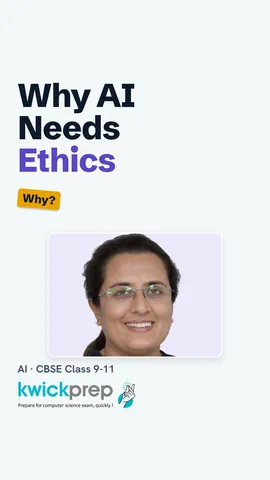 What does ethics mean?38 sec
 What does transparency mean?41 sec
 Which framework asks for the most benefit?43 sec
 Who made Moral Machine?37 sec
 What does a good policy name?37 sec
The full lesson, in text
Hello students, welcome to Kwickprep. An AI app decides who gets a bank loan and who does not. Who makes sure it decides fairly? Today we will learn AI ethics. We will cover why it matters, five key pillars, ethical frameworks, the Moral Machine activity, and how to write a simple AI policy.
Let us start with a new word. Ethics means the moral rules that tell us what is right and what is wrong. AI ethics applies these rules to how we build and use AI systems. It asks simple questions. Is this AI fair, is it safe, and is it honest with the people it affects?
Why does ethics matter so much for AI? AI now helps decide loans, job interviews and even medical checks, so its choices affect real lives. A human makes one mistake at a time, but an AI can repeat the same mistake for millions of users. AI learns from old data, and old data can carry unfair patterns. Finally, people will use AI only if they can trust it to act responsibly.
Responsible AI stands on five pillars. Fairness means the AI treats all groups of people equally, for example the same loan rules for everyone. Transparency means we can explain how the AI reached its decision, so a person can ask why they were rejected. Accountability means a human or a company must answer for the AI's mistakes. Privacy means personal data is collected with permission and kept safe. Safety means the AI is tested so it does not cause harm, like a self-driving car that must stop for people.
Imagine your school uses an AI to predict board exam grades. Fairness means it works equally well for students from every school and background. Transparency means teachers can see which marks led to a prediction. Accountability means the school, not the software, is responsible for fixing wrong predictions. Privacy means student marks are not shared outside the school. Safety means the AI only advises, and a teacher makes the final decision.
An ethical framework is a set of guiding ideas that helps us make a hard decision step by step. Sector-based frameworks are made for one field, like bioethics for health care. Rights-based thinking protects each person's rights, such as asking for consent before using data. Utility-based thinking picks the choice that gives the most benefit to the most people. Virtue-based thinking asks what an honest and caring person would do.
Bioethics is a sector-based framework used in medicine, and it is useful for health AI. Respect for autonomy means patients decide for themselves, with full information. Do not harm means the AI must not put patients at risk. Ensure maximum benefit means it should help as many patients as it can. Justice means benefits and risks are shared fairly, not just by rich hospitals.
Here is how you can use frameworks together. First, write down the decision the AI is making. Next, list everyone who is affected by it. Then ask, does this decision harm anyone's rights? If yes, go to the side and change the design before going further. If no, choose the option that gives the most benefit to the most people.
Now an activity. The Moral Machine is an online platform made by researchers at MIT in the United States. In each scene, a self-driving car's brakes have failed. You must choose which group the car should save, for example passengers or people crossing the road. After many scenes, it shows your choices and compares them with others around the world.
After you play, discuss these questions in class. Did you try to save the most lives, or did you protect people who followed traffic rules? Did the age or number of people change your answer? Did your friends make different choices for the same scene? Pause and think. If people disagree, who should decide what the car does: engineers, the law, or the public? There is no single right answer, and that is exactly the lesson.
Now let us turn ethics into action. An AI policy is a short written set of rules for how a group uses AI. It says clearly what is allowed and what is not allowed. It names the person or team responsible when something goes wrong. And a good policy is built on the five pillars we just learned.
You can write a simple AI policy in five steps. First, write the purpose, meaning why and where AI will be used. Second, list the uses that are allowed and the uses that are not. Third, describe what data is collected, and make sure people give consent. Fourth, name who checks the AI and fixes its mistakes. Fifth, promise to review and update the policy regularly, for example every year.
Here is a sample policy for a class. Students may use AI chatbots to understand a topic, but not to copy homework answers. Students must say when a project used AI help, which is transparency. Students never type names, phone numbers or addresses into AI tools, which protects privacy. Students check AI answers with a textbook or a teacher, because AI can be wrong. The class teacher reviews the policy every term, which is accountability.
Let us revise what we learned today. AI ethics is about right and wrong in building and using AI. The five pillars are fairness, transparency, accountability, privacy and safety. Ethical frameworks can be sector based, rights based, utility based or virtue based. The Moral Machine shows that people make different moral choices. And an AI policy covers purpose, rules, data, responsibility and review. Try writing a policy for your own class this week.
Courses that teach this
| Course | Unit |
|---|---|
| CBSE Class 9 Artificial Intelligence (417) | Part B - Unit 1: AI Reflection, Project Cycle and Ethics |
| CBSE Class 10 Artificial Intelligence (417) | Part B Unit 1: Revisiting AI Project Cycle & Ethical Frameworks for AI |
| CBSE Class 11 Artificial Intelligence (843) | AI Ethics and Values |
Voice-over in this lesson is AI-generated. The script is written and checked by Kajal Ma'am. Boards can revise a syllabus mid-year, so confirm anything you plan around against the official board circular. Keep your passwords, OTPs and ID numbers to yourself — we never ask for them. To reach Kajal Ma'am, use the WhatsApp button; sharing your number there is how we call you back.
Free to watch, no sign-up. Live classes with Kajal Ma'am are the paid course; these lessons stay free either way.