

CBSE Class 12 Computer Science (CS) Classes
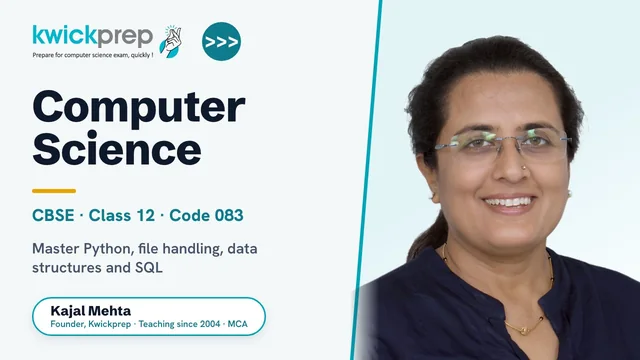
Master Python, file handling, data structures and SQL for the CBSE Class 12 CS (083) board exam.
A complete preparation course for CBSE Class 12 Computer Science (Subject Code 083) aligned to the 2026-27 syllabus from cbseacademic.nic.in. Covers Python programming with functions, exception and file handling, stacks, database management with SQL, Python-SQL connectivity and computer networks, with full coverage of both the 70-mark theory paper and the 30-mark practical, project and viva.
What you'll learn
- ✓Write modular Python programs using user-defined functions, scope rules and exception handling
- ✓Read, write, search and update text, binary (pickle) and CSV files
- ✓Implement and operate a stack data structure using Python lists (push and pop)
- ✓Design relational database tables and apply primary, foreign and candidate keys
- ✓Write SQL queries using DDL/DML commands, WHERE, GROUP BY, HAVING, ORDER BY and joins
- ✓Use SQL aggregate, math, text and date functions to analyse data
- ✓Connect Python applications to a SQL database and run queries via cursors
- ✓Understand computer networking fundamentals, devices, topologies and protocols
Full syllabus
Mapped to the official CBSE curriculum.
01Unit I: Computational Thinking and Programming - 2 (40 marks)+
- Revision of Python basics from Class XI
- Functions: scope, parameter passing, passing mutable/immutable objects, returning values, default and keyword arguments
- Built-in functions, functions defined in modules (math, random, statistics), user-defined functions
- Exception handling using try, except, finally and raise
- Introduction to files: types of files (text, binary, CSV); relative and absolute paths
- Text files: opening modes (r, r+, w, w+, a, a+), reading/writing (read, readline, readlines, write, writelines), close, seek, tell
- Binary files: pickle module - dump() and load(); reading, writing, searching, appending and updating records
- CSV files: csv module - reading and writing using reader() and writer()
- Data structures - Stack: implementation using lists, push and pop operations
02Unit II: Computer Networks (10 marks)+
- Evolution of networking: ARPANET, NSFNET, Internet
- Data communication terminologies: concept of communication, sender, receiver, message, channel; bandwidth and data transfer rate (bps)
- IP address; switching techniques (circuit, packet)
- Transmission media: wired (twisted pair, co-axial, optical fibre) and wireless (microwave, radio, satellite)
- Network devices: modem, hub, switch, repeater, router, gateway, NIC
- Network topologies: Bus, Star, Tree
- Types of networks: PAN, LAN, MAN, WAN
- Network protocols: HTTP, FTP, PPP, SMTP, TCP/IP, POP3, HTTPS, TELNET, VoIP
- Introduction to web services: WWW, HTML, XML, domain names, URL, website, web browser, web servers, web hosting
03Unit III: Database Management (20 marks)+
- Database concepts: relational data model, relation, attribute, tuple, domain, degree, cardinality
- Keys: candidate key, primary key, alternate key, foreign key
- Structured Query Language (SQL): data types (char, varchar, int, float, date)
- DDL commands: CREATE TABLE, ALTER TABLE, DROP TABLE
- DML commands: INSERT, UPDATE, DELETE, SELECT
- SQL clauses and functions: WHERE, IN, BETWEEN, DISTINCT, ORDER BY, GROUP BY, HAVING, NULL handling
- Aggregate functions: MIN, MAX, AVG, SUM, COUNT; math, text and date functions
- Joins: equi-join and natural join (Cartesian product of two tables)
- Interface of Python with an SQL database: connect, cursor, execute, commit, fetchone(), fetchall(), rowcount
Tools you'll use
Exam pattern
Total 100 marks = Theory 70 + Practical 30. Theory paper (3 hours): Unit I Computational Thinking and Programming-2 = 40 marks, Unit II Computer Networks = 10 marks, Unit III Database Management = 20 marks. Practical (30 marks): Lab Test 12 (Python program 8 + SQL queries 4), Report/Practical File 7, Project 8, Viva Voce 3.
Practical / project
Practical work (30 marks) requires a practical file with a minimum of 15 Python programs (file handling, stacks, CSV, random numbers, etc.) and SQL query sets, plus a Python-SQL based project. Assessed via a lab test (live Python program and SQL queries on one/two tables), the report file, the project, and a viva voce.
Who it's for
CBSE Class 12 students taking Computer Science (083) who want strong, syllabus-aligned preparation for both the board theory paper and the practical, project and viva.
What's included
- ✓Live interactive online classes with Kajal Ma'am (group batch or one-to-one), teaching since 2004
- ✓Chapter-wise Kwick Notes covering Python, file handling, stacks, SQL and computer networks
- ✓Solved textbook and NCERT-aligned solutions for every unit
- ✓Topic-wise assignments and worksheets with regular practice questions
- ✓Dedicated doubt-solving sessions until every concept is clear
- ✓Previous-year and sample board paper practice for the 70-mark theory exam
- ✓Practical file guidance (15+ Python programs and SQL query sets) plus Python-MySQL project mentoring
- ✓Lab-test and viva voce preparation for the 30-mark practical exam
Why study Computer Science?
CBSE Class 12 Computer Science (Subject Code 083) is one of the most scoring subjects in the Science and Commerce streams, with Python programming alone carrying 40 of the 70 theory marks and a further 30 marks available from the practical, project and viva. A strong grasp of Python, SQL database management and computer networks here directly translates into high board percentages and a genuine head start for B.Tech (CSE/IT), BCA and other computing degrees. Because the paper rewards hands-on coding and clear logic rather than rote memorisation, students who understand the concepts well can comfortably target 90+ and even a perfect score.
Class 12 Computer Science builds the exact foundation universities expect for B.Tech in Computer Science or IT, BCA, B.Sc Computer Science and data-focused programmes. The Python programming, relational databases and SQL covered here map directly to entry-level skills in software development, data analysis, web and database work, and are a stepping stone toward fields like AI and machine learning. It also gives students an early, practical feel for how real software and data systems are built.

Learn directly from Kajal Ma'am
An MCA who has taught computer subjects since 2004, Kajal Mehta personally mentors every batch, turning dense theory into clear, exam-ready understanding.
The Kwickprep Method
Computer subjects are not learnt by memorising code. Since 2006, Kajal Ma'am has taught CBSE Class 12 Computer Science with one simple loop that turns logic into marks:
Concept in plain words
Every topic starts from why it exists and what problem it solves, before any code.
Coded live with you
Kajal Ma'am writes and runs the Python or SQL on a shared screen, so you see it work, not just read it.
Board-pattern practice
You solve the exact question types that repeat in the CBSE 083 paper, section by section.
Doubts till it clicks
Ask anything, any time in the live class. Nothing moves on until the concept is clear.
Exam & practical drill
Full papers, the practical file, the project and viva, rehearsed until you walk in confident.
Where this takes you
Class 12 Computer Science is not just a board subject, it is the base of almost everything digital:
- →Python is the language behind data science, machine learning and AI, the same tools used at Google, Netflix and ISRO.
- →SQL & databases run every app you use, from Instagram to your bank, every login and every feed is a database query.
- →Networking is how the internet itself works, from WhatsApp messages to video calls.
A strong Class 12 CS score opens B.Tech Computer Science, BCA, data science and design courses, and the logic you build here is exactly what JEE, CUET and coding aptitude tests reward. We teach for the board first, and for the thinking that lasts after it.
What Class 12 students say
“They guided me well for the Boards. I would recommend Computer Science aspirants to join Kwickprep, as their teaching and study material is the best among all others. Kwickprep is the best choice for classes 11 and 12.”
“The way you covered the syllabus so thoroughly and on time, along with the ample practice questions and sample papers, was instrumental in our preparation. You have a unique ability to simplify complex concepts.”
“I found the course very effective and well-organized. The teaching method and study material are up to the mark. Rather than mugging up the code, I learned to develop logic.”
Read all 36 verified student & parent reviews (4.9/5) or see the board results.
Free Class 12 CS resources
Use these free, before you even enquire:
Important Questions with Solutions
The questions that repeat every year, with model answers and code.
Sample PaperSample Paper 2026
Exam pattern, weightage and the official CBSE paper to download.
WeightageChapter-wise Weightage
Where the marks actually are, unit by unit.
Practical FilePractical File Programs
Ready Python programs with output for the 30-mark practical.
Course FAQs
Are the CBSE Class 12 Computer Science classes live or pre-recorded?+
Who can join this Class 12 Computer Science online course?+
What is the fee, and how do group and one-to-one classes differ?+
Is the course aligned with the latest CBSE 2026-27 syllabus?+
Do you help with the practical file, project and viva?+
Can I attend a demo class before paying?+
What kind of results does Kwickprep have?+
Related courses
Computer Applications
Master computer fundamentals, cyber safety, and office tools for CBSE Class 9 Computer App
Computer Applications
Master web design with HTML, CSS, networking and cyber ethics for the CBSE Class 10 Comput
Computer Science
Master Python programming and computational thinking with the official CBSE Class 11 Compu
Free guides for this subject
CBSE Class 12 Computer Science Important Questions with Solutions
Free CBSE Class 12 Computer Science (083) important questions with solutions for the 2026-27 session: Python functions,
Open →CBSE Class 12 Computer Science · MCQ praCBSE Class 12 Computer Science Multiple Choice Questions, with Answers
10 practice MCQs for CBSE Class 12 Computer Science with the answer and why it is right. Every code question was execute
Open →CBSE Class 12 · Computer Science · PractCBSE Class 12 Computer Science Practical File, Python Programs with Output
Fifteen CBSE Class 12 Computer Science practical file programs in Python with their output, plus the marks split for the
Open →Free resourceCBSE Class 12 Computer Science Sample Paper 2026 & Important Questions
Free CBSE Class 12 Computer Science (083) 2026 board prep: the exam pattern, unit-wise weightage, most important topics
Open →Free resourceCBSE Class 12 Computer Science Syllabus 2026-27
Download the official CBSE Class 12 Computer Science (083) syllabus 2026-27 — unit-wise topics, marks weightage, and the
Open →CBSE Class 12 Computer Science · PracticCBSE Class 12 Computer Science Practical Viva Questions, with Answers
33 viva questions for the CBSE Class 12 Computer Science practical, each with the answer a student should be able to giv
Open →CBSE Class 12 · Computer Science · WeighCBSE Class 12 Computer Science (083), Chapter-wise Weightage 2026-27
CBSE Class 12 Computer Science 083 chapter-wise marks for 2026-27: unit-wise theory marks and the 30-mark practical brea
Open →What students & parents say
4.9/5 from 36 verified student & parent reviews. Below are three, unedited.
Joining the Kwick Revision Course has been entirely worthwhile, as I have consistently received timely responses within the committed timeframe.
Excellent course material. Well experienced Dedicated teacher helped my son did well in CBSE exam today.
I was able to complete entire syllabus in short duration while preparing for conpetitive exams. Best way to cover entire syllabus. Highly satisfied with teaching method.
Book a free demo for Computer Science
See a real class before you decide. No pressure, no payment.
Book Free Demo on WhatsApp