

CBSE Class 11 Computer Science (CS) Classes
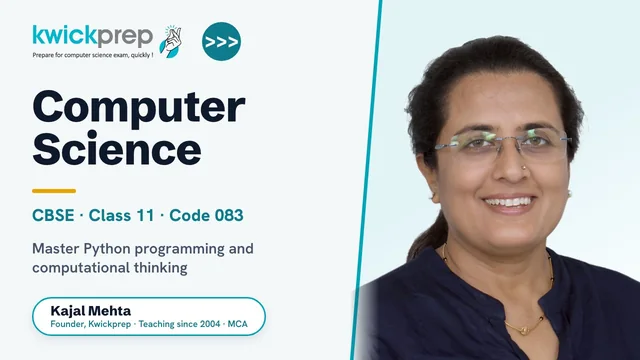
Master Python programming and computational thinking with the official CBSE Class 11 Computer Science (083) syllabus.
A complete preparation course for CBSE Class 11 Computer Science (Code 083), aligned to the official 2026-27 syllabus from cbseacademic.nic.in. Covers computer systems and organisation, problem-solving and Python programming, and society, law and ethics, building a strong foundation for the Class 12 board exam. Includes guided lab practice, a minimum of 20 Python programs for the report file, and an end-of-year project.
What you'll learn
- ✓Write, run and debug Python programs in both interactive and script mode
- ✓Apply computational thinking - breaking problems into algorithms, flowcharts and pseudocode
- ✓Use Python data types, operators, and control structures (conditionals, loops, nested loops)
- ✓Manipulate strings, lists, tuples and dictionaries with their built-in methods
- ✓Use Python modules such as math, random and statistics
- ✓Understand computer organisation, Boolean logic, number systems and encoding schemes
- ✓Convert between binary, octal, decimal and hexadecimal number systems
- ✓Apply cyber safety, cyber ethics and IT Act concepts responsibly
Full syllabus
Mapped to the official CBSE curriculum.
01Unit 1: Computer Systems and Organisation (10 marks)+
- Basic computer organisation: computer system, hardware, software, input/output devices, CPU, memory (primary, cache, secondary), units of memory (bit, byte, KB, MB, GB, TB, PB)
- Types of software: system software (OS, system utilities, device drivers), programming tools and language translators (assembler, compiler, interpreter), application software
- Operating System: functions of the OS, OS user interface
- Boolean logic: NOT, AND, OR, NAND, NOR, XOR, truth tables, De Morgan's laws, logic circuits
- Number systems: Binary, Octal, Decimal, Hexadecimal and conversion between them
- Encoding schemes: ASCII, ISCII, Unicode (UTF8, UTF32)
02Unit 2: Computational Thinking and Programming - 1 (45 marks)+
- Introduction to problem-solving: analysing the problem, developing an algorithm, coding, testing and debugging, flowcharts, pseudocode, decomposition
- Basics of Python: features, hello-world program, interactive vs script mode, character set, tokens (keyword, identifier, literal, operator, punctuator), variables, l-value and r-value, comments
- Data types: number (integer, float, complex), boolean, sequence (string, list, tuple), None, mapping (dictionary), mutable and immutable types
- Operators: arithmetic, relational, logical, assignment, augmented assignment, identity (is, is not), membership (in, not in)
- Expressions, statements, type conversion (implicit/explicit), operator precedence, expression evaluation, console input/output
- Errors: syntax errors, logical errors, run-time errors
- Flow of control: indentation, sequential, conditional and iterative flow
- Conditional statements: if, if-else, if-elif-else with flowcharts and simple programs
- Iterative statements: for loop, range(), while loop, break and continue, nested loops, pattern/series/factorial programs
- Strings: operations (concatenation, repetition, membership, slicing), traversal, built-in methods (len, upper, lower, count, find, index, split, replace, strip, etc.)
- Lists: indexing, operations, traversal, built-in methods (append, extend, insert, remove, pop, sort, min, max, sum), nested lists, searching
- Tuples: indexing, operations, built-in methods, tuple assignment, nested tuples, searching
- Dictionaries: accessing items by keys, mutability, traversal, built-in methods (keys, values, items, get, update, pop, etc.)
- Python modules: import statements; math, random and statistics modules
03Unit 3: Society, Law and Ethics (15 marks)+
- Digital footprints
- Digital society and netizen: net, communication and social media etiquettes
- Data protection: intellectual property rights (copyright, patent, trademark), IPR violations (plagiarism, infringement), open source software and licensing (Creative Commons, GPL, Apache)
- Cyber crime: hacking, eavesdropping, phishing, fraud emails, ransomware, cyber trolls, cyber bullying
- Cyber safety: safe web browsing, identity protection, confidentiality
- Malware: viruses, trojans, adware
- E-waste management: proper disposal of electronic gadgets
- Information Technology Act (IT Act)
- Technology and society: gender and disability issues in computing
Tools you'll use
Exam pattern
Total 100 marks: Theory 70 marks (Unit 1 - Computer Systems and Organisation: 10, Unit 2 - Computational Thinking and Programming-1: 45, Unit 3 - Society, Law and Ethics: 15) + Practical 30 marks.
Practical / project
Practical exam carries 30 marks: Lab Test - Python program (12 marks; 60% logic + 20% documentation + 20% code quality); Report File of minimum 20 Python programs (7 marks) plus Viva voce (3 marks); and a Project using most of the concepts learnt (8 marks).
Who it's for
Class 11 CBSE students taking Computer Science (083) who want to build a strong Python and computer-science foundation ahead of the Class 12 board exam.
What's included
- ✓Live, interactive online classes covering the full CBSE Class 11 Computer Science (083) syllabus, taught by Kajal Ma'am
- ✓Chapter-wise Kwick Notes that turn Python and computer-systems theory into clear, exam-ready points
- ✓Solved NCERT and textbook exercises with worked Python programs explained line by line
- ✓Topic-wise assignments and practice worksheets after each unit to build coding fluency
- ✓Dedicated doubt-solving sessions where every question is answered before moving on
- ✓Board-pattern theory paper practice with marking-scheme-based answer writing
- ✓Practical-file and Python lab program guidance, plus SQL query practice for the practical exam
- ✓Viva voce preparation and one-to-one feedback to keep each student exam-ready
Why study Computer Science?
CBSE Class 11 Computer Science (Subject Code 083) is where students build the real foundation of programming, with Python alone carrying 45 of the 70 theory marks, making it one of the most scoring subjects once concepts are clear. The year develops computational thinking, logic and coding habits that directly decide how comfortably a student handles Class 12 CS, where the same Python extends to file handling, data structures and SQL. Beyond marks, it builds genuine problem-solving ability rather than rote learning, so a strong Class 11 base means fewer gaps and higher confidence in the board year. For anyone aiming at engineering, computer applications or a tech career, this is the first proper step.
The Python programming, computational thinking and logic built in Class 11 CS form the entry point for B.Tech/B.E. Computer Science, BCA and B.Sc. (CS/IT) degrees, where Python remains a core language. The same foundation feeds directly into in-demand fields like software development, data science, artificial intelligence, machine learning and automation. Even for students who do not pursue a pure-coding career, the problem-solving and database basics are useful across engineering, analytics and modern IT-driven roles.
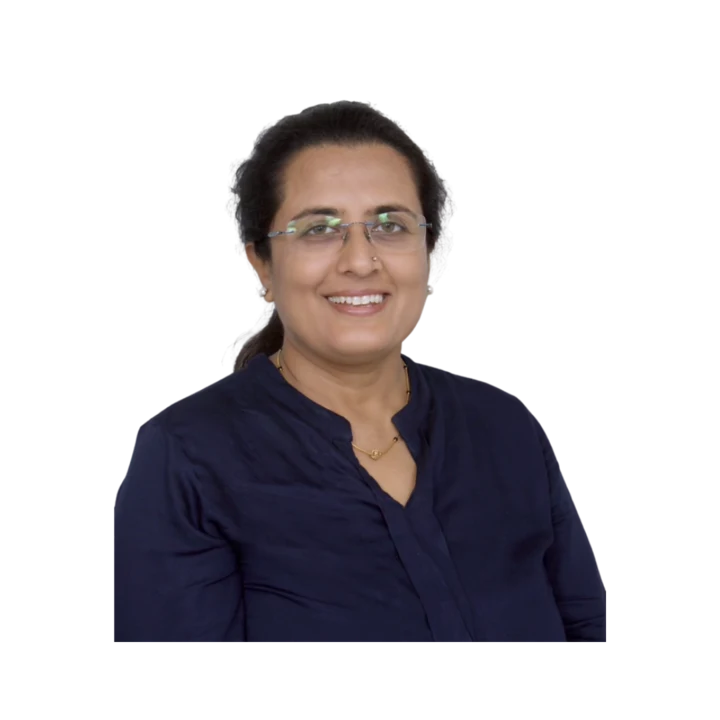
Learn directly from Kajal Ma'am
An MCA who has taught computer subjects since 2004, Kajal Mehta personally mentors every batch, turning dense theory into clear, exam-ready understanding.
The Kwickprep Method
Computer subjects are not learnt by memorising code. Since 2006, Kajal Ma'am has taught CBSE Class 11 Computer Science (CS) with one simple loop that turns logic into marks:
Concept in plain words
Every topic starts from why it exists and what problem it solves, before any code.
Worked through live with you
Kajal Ma'am writes and runs it on a shared screen, so you see it work, not just read it.
Board-pattern practice
You solve the exact question types that repeat in your board's paper, section by section.
Doubts till it clicks
Ask anything, any time in the live class. Nothing moves on until the concept is clear.
Exam & practical drill
Full papers, the practical file, the project and viva, rehearsed until you walk in confident.
Where this takes you
This is not just a subject to clear, it is a skill that carries forward:
- →Python the language behind data science, machine learning and AI.
- →SQL & databases run every app you use, from Instagram to your bank.
- →Networking how the internet itself works, from WhatsApp to video calls.
A strong score opens B.Tech Computer Science, BCA and data science, and the logic you build is exactly what JEE and CUET reward. We teach for the board first, and for the thinking that lasts after it.
What students say
“Excellent course material. Well experienced Dedicated teacher helped my son did well in CBSE exam today.”
“The Educator is very experienced and talented.”
“Learning with kwickprep has been a wonderful experience. It has a very user friendly interface and is aesthetically pleasing. It provides all the important points and the proper explanation of the topics without prevaricating from the original topic.”
Read all 36 verified student & parent reviews (4.9/5) or see the board results.
Course FAQs
Are the Class 11 Computer Science classes live or recorded?+
Do you offer both group batch and one-to-one classes?+
Is the course aligned to the latest CBSE syllabus?+
Who can join this course?+
Will you help with the practical exam, Python file and viva?+
Can I attend a demo before enrolling?+
Related courses
Computer Applications
Master computer fundamentals, cyber safety, and office tools for CBSE Class 9 Computer App
Computer Applications
Master web design with HTML, CSS, networking and cyber ethics for the CBSE Class 10 Comput
Computer Science
Master Python, file handling, data structures and SQL for the CBSE Class 12 CS (083) board
Free guides for this subject
CBSE Class 11 Computer Science Practical File, Python Programs with Output
Free CBSE Class 11 Computer Science (083) practical file programs in Python with their real output — prime numbers, stri
Open →Free resourceCBSE Class 11 Computer Science Syllabus 2026-27
Download the official CBSE Class 11 Computer Science (083) syllabus 2026-27 — unit-wise topics, marks weightage, and the
Open →CBSE Class 11 Computer Science · PracticCBSE Class 11 Computer Science Practical Viva Questions, with Answers
15 viva questions for the CBSE Class 11 Computer Science practical, each with the answer a student should be able to giv
Open →CBSE · Class 11 · Computer Science · WeiCBSE Class 11 Computer Science, Chapter-wise Weightage 2026-27
CBSE Class 11 Computer Science chapter-wise weightage for 2026-27: unit-wise marks table for all 3 units (70 theory mark
Open →What students & parents say
4.9/5 from 36 verified student & parent reviews. Below are three, unedited.
I'm deeply impressed by the supportive environment fostered by Kajal Ma'am during the Kwickrevision workshop. Her approach not only facilitates a thorough understanding of the subject matter but also encourages a collaborative and nurturing learning experience. This workshop stands out as one of the best I've ever attended, and I attribute much of that to Kajal Ma'am's exceptional guidance.
Learning with kwickprep has been a wonderful experience. It has a very user friendly interface and is aesthetically pleasing. It provides all the important points and the proper explanation of the topics without prevaricating from the original topic.
My experience with Kwickprep was really good. The course quality, teaching style, and study materials were excellent, and everything was explained in a clear and simple way. What I found most helpful was the last-minute theory material, it was extremely useful for quick revision and helped me cover the entire year's basic syllabus efficiently. The suggestions and lectures during that time were very informative and played a big role in boosting my preparation. I'm quite satisfied with the course overall, and it definitely helped me improve my results.
Book a free demo for Computer Science
See a real class before you decide. No pressure, no payment.
Book Free Demo on WhatsApp