

KwickAcademy Artificial Intelligence · 7 min · free
Probability for AI
Probability = favourable outcomes / total outcomes. It runs from 0 (impossible) to 1 (certain). AI predictions are probabilities, never certainties.
Follows the syllabus of: CBSE Class 9 Artificial Intelligence (417)
On screen in this lesson
Key words first
| Experiment: an action with uncertain results |
| Outcome: one possible result |
| Event: the outcome or outcomes we care about |
| Probability: how likely an event is, from 0 to 1 |
The probability formula
| P(event) = favourable outcomes / total outcomes |
| Favourable: outcomes where the event happens |
| All outcomes must be equally likely |
Worked examples
| Experiment | Event | Probability |
|---|---|---|
| Toss a coin | Heads | 1/2 = 0.5 |
| Roll a dice | Get a 4 | 1/6 |
| Roll a dice | Even number | 3/6 = 1/2 |
| Pick a month | Has 31 days | 7/12 |
Probability as a percentage
| Multiply by 100 to get a percentage |
| 1/2 = 0.5 = 50 percent |
| 7 out of 10 = 0.7 = 70 percent |
| Probabilities of all outcomes add up to 1 |
Pause and predict
| A bag has 3 red and 2 blue balls |
| You pick one without looking |
| What is P(blue)? |
| Answer: 2 / 5 = 0.4 = 40 percent |
Types of events
| Event | Probability | Example |
|---|---|---|
| Impossible | exactly 0 | Dice shows 7 |
| Unlikely | between 0 and 0.5 | Dice shows 6 |
| Even chance | exactly 0.5 | Coin shows heads |
| Likely | between 0.5 and 1 | Dice below 6 |
| Certain | exactly 1 | Dice below 7 |
Quick answers
A bag has 3 red and 2 blue balls. What is P(blue)?
2/5 = 0.4 = 40 percent.
Can AI be wrong at 0.97?
Yes. Humans still check.
KwickClips from this lesson
Short clips, one idea each. Good for revision the night before.
 What is P(4) on a dice?36 sec
 Can a dice show 7?35 sec
 70% chance of rain. Take an umbrella?37 sec
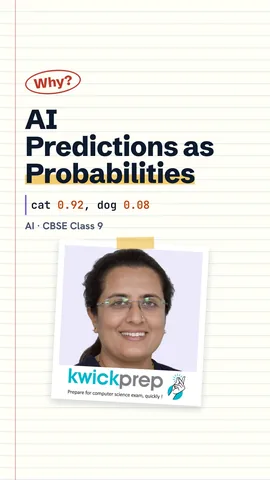 Does AI ever know for sure?38 sec
The full lesson, in text
Hello students, welcome to Kwickprep. Your weather app says seventy percent chance of rain. Should you carry an umbrella? And what does that number even mean? Today we learn to calculate probability and the types of events. We will see probability in weather, sports and traffic, and in every AI prediction.
Let us learn four words first. An experiment is an action whose result is not certain, like tossing a coin or rolling a dice. An outcome is one possible result, like getting heads. An event is the outcome, or group of outcomes, that we are interested in, like getting an even number. Probability is a number from zero to one that tells how likely an event is.
Here is the formula. The probability of an event equals the number of favourable outcomes divided by the total number of outcomes. Favourable outcomes are the ones where our event happens. This simple formula works when every outcome is equally likely, like a fair coin or a fair dice.
Let us calculate some. A coin has two outcomes, and one is heads, so the probability is one half, or zero point five. A dice has six faces, and only one shows four, so the probability is one sixth. Even numbers on a dice are two, four and six, so three out of six, which is one half. Seven of the twelve months have thirty one days, so picking one at random gives seven twelfths.
Probability is often shown as a percentage. To convert, multiply the probability by one hundred. So one half is zero point five, which is fifty percent. Seven out of ten is zero point seven, which is seventy percent. Also remember, the probabilities of all possible outcomes always add up to one.
Pause and predict. A bag has three red balls and two blue balls. You pick one ball without looking. What is the probability that it is blue? There are two blue balls out of five in total, so it is two fifths, which is zero point four, or forty percent.
Events can be sorted by their probability. An impossible event can never happen, so its probability is zero, like a dice showing seven. An unlikely event has a probability less than one half, like rolling a six, which is one sixth. An even chance is exactly one half, like a coin showing heads. A likely event is more than one half, like rolling a number below six, which is five sixths. A certain event always happens, so its probability is one, like rolling a number below seven.
We can picture these as a scale that runs from zero to one. At the bottom is zero, which means impossible. Next, anything below one half is unlikely. In the middle, one half is an even chance. Above one half, the event is likely. And at the very top is one, which means certain.
Now let us see probability in daily life, starting with weather. Seventy percent means that on days like today, it rained about seven times out of ten. So carry an umbrella. Ten percent chance means rain is unlikely, but not impossible. When the weather department warns of a cyclone with high probability, people near the coast are moved to safety in advance.
Sports also use probability all the time. A coin toss is fair because each captain has a one in two chance. During cricket broadcasts, a win predictor uses data from past matches to show each team's chance of winning. In basketball, a player who scores eighty free throws out of one hundred has a probability of zero point eight. So coaches pick that player for important shots.
Traffic is another good example. At office time on a weekday, a traffic jam is likely, so maps apps suggest leaving early. On a Sunday morning, a jam is unlikely, so you can leave at the normal time. On a rainy evening, delays become more likely, so taking the metro may be the better choice.
Here is the big idea of today. An AI model never knows the answer for sure, it estimates how likely each answer is. A photo app may say this picture is a cat with probability zero point nine two, and a dog with zero point zero eight. An email spam filter may say zero point nine seven spam, so it moves the email to the spam folder. A maps app may estimate an eighty percent chance that you reach by five in the evening.
How does a probability become a decision? Usually the AI simply picks the answer with the highest probability. A threshold is a cut off value, for example, block the email only if spam probability is above zero point nine. For risky tasks, like medical tests, the threshold is kept higher and results are checked carefully. And even zero point nine seven is not one, so the AI can still be wrong, which is why humans must review important decisions.
Let us revise what we learned today. Probability equals favourable outcomes divided by total outcomes. It runs from zero, which is impossible, to one, which is certain. Below one half is unlikely, one half is an even chance, and above one half is likely. Weather forecasts, sports and traffic apps all use probability. And every AI prediction is a probability, never a certainty. Tomorrow, check your weather app and decide about that umbrella.
Courses that teach this
| Course | Unit |
|---|---|
| CBSE Class 9 Artificial Intelligence (417) | Part B - Unit 3: Math for AI (Statistics & Probability) |
Voice-over in this lesson is AI-generated. The script is written and checked by Kajal Ma'am. Boards can revise a syllabus mid-year, so confirm anything you plan around against the official board circular. Keep your passwords, OTPs and ID numbers to yourself — we never ask for them. To reach Kajal Ma'am, use the WhatsApp button; sharing your number there is how we call you back.
Free to watch, no sign-up. Live classes with Kajal Ma'am are the paid course; these lessons stay free either way.