

KwickAcademy Artificial Intelligence · 8 min · free
Neural Networks: Parts, Working and Types
A neuron multiplies inputs by weights, adds a bias and applies an activation. Networks have input, hidden and output layers.
Follows the syllabus of: CBSE Class 10 Artificial Intelligence (417), CBSE Class 12 Artificial Intelligence (843)
On screen in this lesson
What is a neural network?
| A machine learning model inspired by the brain |
| Made of many small units called neurons |
| Neurons are connected in layers |
| Learns patterns from lots of examples |
Parts of a neuron
| Part | Meaning | Everyday idea |
|---|---|---|
| Inputs | values coming in | sunny? exam? |
| Weights | importance of each | exam matters more |
| Bias | extra push | your mood |
| Activation | decides the output | go or stay home |
Pause and predict
| Same neuron: sunny x1 = 1 |
| No exam tomorrow: x2 = 0 |
| z = 0.7 + 0 + 0.1 = 0.8 |
| 0.8 > 0, so output 1: go and play |
Common activation functions
| Function | Rule | Output range |
|---|---|---|
| Step | 1 if z > 0, else 0 | 0 or 1 |
| Sigmoid | smooth S curve | between 0 and 1 |
| ReLU | z if z > 0, else 0 | 0 or more |
Three kinds of layers
| Layer | Job | Example |
|---|---|---|
| Input layer | takes in the data | pixels of a photo |
| Hidden layers | find patterns | edges, shapes |
| Output layer | gives the answer | cat or dog |
Layers: key facts
| Hidden layers are hidden: we never see them directly |
| Each neuron connects to neurons in the next layer |
| More hidden layers means a deeper network |
| Many hidden layers is called deep learning |
Quick answers
Sunny (1), no exam (0), weights 0.7 and -0.9, bias 0.1: output?
z = 0.8, so output 1: go and play.
What are many hidden layers called?
Deep learning.
KwickClips from this lesson
Short clips, one idea each. Good for revision the night before.
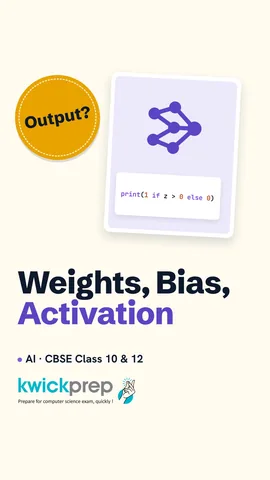 What does z come to?43 sec
 Why is the middle layer called hidden?40 sec
 What weights does a network start with?41 sec
 Which network creates new images?45 sec
The full lesson, in text
Hello students, welcome to Kwickprep. Your brain has billions of neurons, and none of them knows what a cat is. Together, they recognise a cat instantly. Today we build an artificial neuron, stack neurons into layers, watch data flow through a network, and see how it learns. Then we look at the types of networks and their impact on society.
Let us start with the meaning. A neural network is a machine learning model inspired by how the human brain works. It is made of many small units called artificial neurons, or nodes. These neurons are connected to each other in layers. Nobody writes the rules for it, because it learns patterns by itself from lots of examples.
Every artificial neuron has four parts. Think of deciding whether to play cricket this evening. Inputs are the values coming in, like, is it sunny, and is there an exam tomorrow? A weight shows how important each input is, and the exam matters more than the weather. The bias is an extra push up or down, like your mood that day. The activation function takes the total and decides the final output, go and play, or stay home.
Here is what happens inside one neuron. Each input is multiplied by its own weight. Then all the results are added, and the bias is added to the total, and we call this total z. The activation function then turns z into the output. For example, a step activation gives one if z is more than zero, and zero otherwise.
Let us calculate our cricket neuron. Input x1 is one because it is sunny, and x2 is one because there is an exam tomorrow. The sunny weight is zero point seven, the exam weight is minus zero point nine, and the bias is zero point one. So z is zero point seven, minus zero point nine, plus zero point one, which is minus zero point one. Z is not more than zero, so the output is zero, stay home and study.
Now pause and predict with a small change. It is still sunny, so x1 stays one. But there is no exam tomorrow, so x2 becomes zero. Now z is zero point seven plus zero plus zero point one, which is zero point eight. Zero point eight is more than zero, so the output is one, and you go and play.
There are a few popular activation functions. Step gives one if z is more than zero, and zero otherwise, just as we used. Sigmoid is a smooth S shaped curve that gives a value between zero and one, useful as a probability. ReLU, short for rectified linear unit, keeps z if it is positive, and gives zero otherwise, and it is very common in hidden layers.
Neurons are arranged in layers, and there are three kinds. The input layer takes in the data, for example the pixel values of a photo, and it does no calculation. Hidden layers sit in the middle and find patterns, such as edges, then shapes, then eyes and ears. The output layer gives the final answer, like cat or dog.
Remember a few key facts about layers. Hidden layers are called hidden because we only see the input and output, never the middle. Usually, each neuron sends its output to the neurons in the next layer. The more hidden layers a network has, the deeper it is. A network with many hidden layers is used in deep learning, which powers face unlock and voice assistants.
When data moves from input to output, it is called a forward pass. Let us follow a tiny network that predicts a test score from hours studied. The input is three hours. The hidden neuron has weight two and bias minus one, so it calculates three times two minus one, which is five. ReLU keeps five, because it is positive. The output neuron has weight zero point five and bias one, so five times zero point five plus one gives three point five.
Here is the same forward pass in Python. The variable x is the input, three hours. The variable h is the hidden neuron, and max of zero and the total works as ReLU. The variable y is the output neuron. It prints five and three point five, exactly what we calculated by hand.
So how does a network find good weights? It starts with random weights. It makes a prediction with a forward pass. It compares the prediction with the correct answer, and the difference is called the error, or loss. Backpropagation sends this error backwards and adjusts every weight a little to reduce it. This repeats many times, and one full round through all the training data is called an epoch.
There are several types of neural networks, each good at different data. A perceptron is a single neuron that makes simple yes or no decisions. A feedforward network passes data in one direction only, and works well on tables of data. A convolutional neural network, or CNN, is best for images, like face unlock. A recurrent neural network, or RNN, handles sequences like text and speech, where order matters. A generative adversarial network, or GAN, creates new data such as realistic images.
Neural networks already help society in many ways. In healthcare, they help doctors spot disease in X ray images and eye scans. Farmers can photograph a leaf with an app and learn which disease the crop has. Translation tools use them to convert text between Indian languages. Banks use them to catch fraud within seconds.
But there are serious concerns too. If the training data is unfair, the network learns that bias and gives unfair results. Networks are often a black box, so it is hard to explain why they decided something. GANs and similar models can make deepfakes, fake videos and voices of real people. Some jobs will change, and training big models uses a lot of electricity.
Let us revise what we learned today. A neuron multiplies inputs by weights, adds a bias, and applies an activation function. Networks have an input layer, hidden layers and an output layer. A network learns by a forward pass, measuring the loss, backpropagation, and repeating. The main types are perceptron, feedforward, CNN, RNN and GAN. They bring big benefits, but we must watch for bias, deepfakes and privacy problems.
Courses that teach this
| Course | Unit |
|---|---|
| CBSE Class 10 Artificial Intelligence (417) | Part B Unit 2: Advanced Concepts of Modelling in AI |
| CBSE Class 12 Artificial Intelligence (843) | Understanding Neural Networks |
Voice-over in this lesson is AI-generated. The script is written and checked by Kajal Ma'am. Boards can revise a syllabus mid-year, so confirm anything you plan around against the official board circular. Keep your passwords, OTPs and ID numbers to yourself — we never ask for them. To reach Kajal Ma'am, use the WhatsApp button; sharing your number there is how we call you back.
Free to watch, no sign-up. Live classes with Kajal Ma'am are the paid course; these lessons stay free either way.