
KwickAcademy Employability Skills · 6 min · free
Employability Skills III: Internet, web browsing and email basics
The internet is a worldwide network of networks; the web is the pages that travel on it, opened in a browser using a URL.
Follows the syllabus of: CBSE Class 11 Information Technology (802)
On screen in this lesson
What is the internet?
| Network: connected computers that share data |
| Internet: a worldwide network of networks |
| No single company or country owns it |
Ways to connect
| Type | Comes through | Used at |
|---|---|---|
| Mobile data | SIM, 4G or 5G | anywhere |
| Broadband | fibre cable | home, office |
| Wi-Fi | wireless router | inside a building |
Internet and WWW
| Internet: the network, like roads |
| WWW: web pages that travel on it, like buses |
| Email and video calls also use the internet |
Key web terms
| Term | Meaning | Example |
|---|---|---|
| Web page | one page | a result page |
| Website | related pages | cbse.gov.in |
| Web browser | app to open pages | Chrome, Firefox |
| URL | page address | https://... |
| Search engine | finds pages | Google, Bing |
Parts of a URL
| Part | Example | Meaning |
|---|---|---|
| Protocol | https:// | rules, secure |
| Domain name | cbse.gov.in | the website |
| Path | /results | one page |
Browsing smartly
| Search with short, exact keywords |
| Bookmark pages you visit often |
| Use tabs for related pages |
| Check https and spelling before login or payment |
Quick answers
A teacher puts 40 parent addresses in CC. What is the problem?
Everyone can see every address; BCC keeps them private.
What does https:// show?
The protocol, and that the connection is secure.
KwickClips from this lesson
Short clips, one idea each. Good for revision the night before.
The full lesson, in text
Hello students, welcome to Kwickprep. You type a website name, and in a second the page opens. How did it travel to you? Today we will learn what the internet is, how web browsing works, and how to write a proper email.
Let us start with the word itself. A network is two or more computers connected to share data. The internet is a huge network of networks, joining millions of computers across the world. No single company owns the internet.
To use the internet you need an internet service provider, like Jio, Airtel, BSNL or Vi. Mobile data comes through your SIM card, using 4G or 5G. Broadband comes through a fibre cable to your home or office. Wi-Fi shares that connection without wires inside a building.
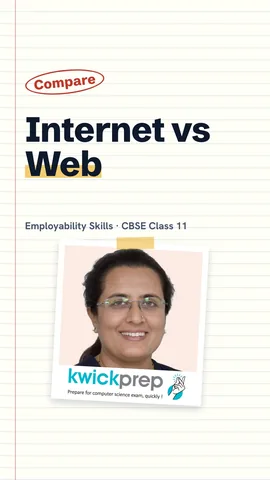
Many students think the internet and the web are the same. The internet is the network, like the roads of a city. The World Wide Web, or WWW, is the collection of web pages that travel on it, like the buses on those roads. Email and video calls also use the internet, but they are not web pages.
Now some words you must know. A web page is one document on the web. A website is a group of related web pages, like the CBSE website. A web browser is the app that opens web pages, like Chrome, Edge, Firefox or Safari. A URL is the full address of a page. A search engine, like Google or Bing, finds pages for you.
Let us break one URL into parts. The first part, https, is the protocol, the rules for sending the page, and the s means secure. The domain name, like cbse.gov.in, names the website. The last part is the path, which points to one page on that site.
Here is what happens when you open a page. You type the URL in the browser's address bar. The browser asks a DNS server for the site's number, called the IP address. DNS works like a phone contact list for websites. The browser then asks the web server for the page. The server sends the page, and the browser shows it.
A few habits make browsing faster and safer. Use short, exact keywords in a search engine, like Class 11 IT syllabus. Bookmark pages you visit often, so you can open them in one click. Open related pages in tabs instead of new windows. Check for https and the correct spelling of the site before you log in or pay.
Now, email. Email means electronic mail, a message sent over the internet. To use it, you need an email account from a service like Gmail or Outlook. Every email address has a username, then the at sign, then a domain. In riya.sharma at example dot com, riya dot sharma is the username.
Every email has the same parts. To holds the main person who must read it. CC means carbon copy, for people who should also know. BCC means blind carbon copy, and other people cannot see these names. The subject is a short line that tells what the email is about. The body is the message, and an attachment is a file sent along with it.
After you receive an email, you can act on it. Reply sends your answer only to the sender. Reply all sends your answer to the sender and everyone in To and CC. Forward sends the email to someone new, with its attachments.
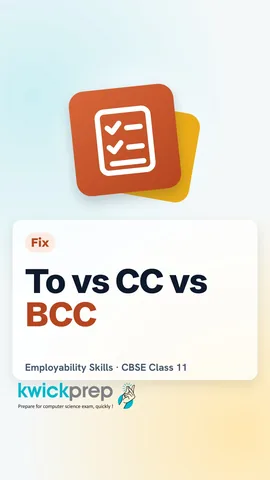
Let us pause and predict. A teacher emails forty parents about a trip. She puts all their addresses in CC. What problem does this create? Every parent can now see every other parent's email address. She should have used BCC to keep them private.
Etiquette means polite rules of behaviour, and emails need them too. Always write a clear subject line. Start with a greeting and end with your name. Keep it short, and avoid writing in all capital letters, which looks like shouting. Check spelling and the attachment before you press Send.
Let us revise what we learned today. The internet is a worldwide network of networks. The web is the pages on it, opened in a browser using a URL. DNS turns a domain name into an IP address. An email has To, CC, BCC, subject, body and attachments. Use BCC for privacy, and follow email etiquette.
Courses that teach this
| Course | Unit |
|---|---|
| CBSE Class 11 Information Technology (802) | Part A, Unit 3: ICT Skills-III |
Voice-over in this lesson is AI-generated. The script is written and checked by Kajal Ma'am. Boards can revise a syllabus mid-year, so confirm anything you plan around against the official board circular. Keep your passwords, OTPs and ID numbers to yourself — we never ask for them. To reach Kajal Ma'am, use the WhatsApp button; sharing your number there is how we call you back.
Free to watch, no sign-up. Live classes with Kajal Ma'am are the paid course; these lessons stay free either way.