
KwickCards Exams and revision
Exams and revision: 151 revision cards
Every card below is written out in full underneath its picture, so you can read it, search it and copy from it. Free, no sign-up.
Programming
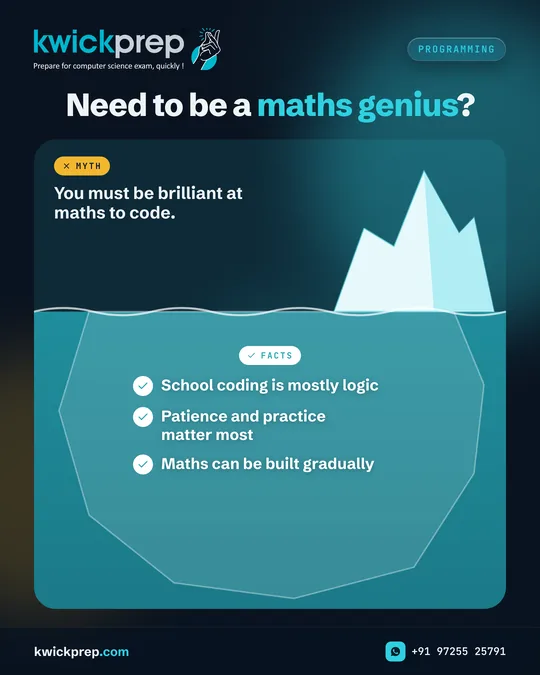
Need to be a maths genius?
- School coding is mostly logic
- Patience and practice matter most
- Maths can be built gradually
Myth: You must be brilliant at maths to code.
Many students avoid coding because they think they are 'not good at maths'.
Most school-level programming needs logical thinking, patience and practice far more than advanced maths. Breaking a problem into steps, spotting patterns and debugging calmly are the real skills.
Some fields, such as machine learning or graphics, do use more mathematics, and you can build that gradually. But nobody should skip coding out of fear. Start with small programs and let confidence grow.
Tech Terms
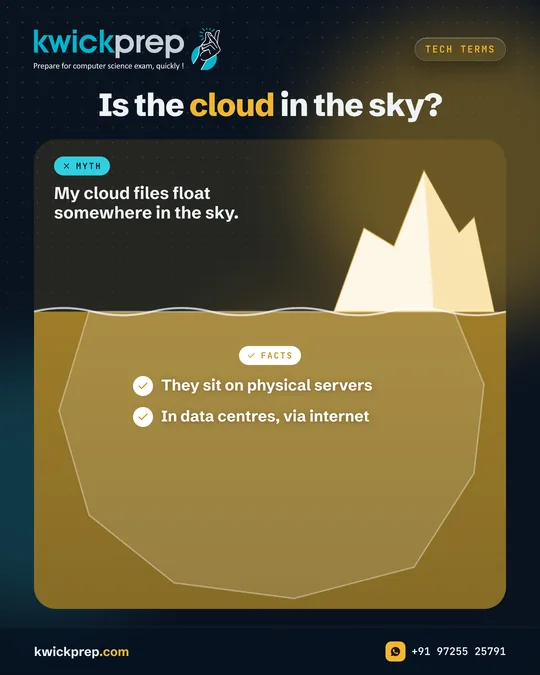
Is the cloud in the sky?
- They sit on physical servers
- In data centres, via internet
Myth: My cloud files float somewhere in the sky.
The word 'cloud' makes it sound like data floats somewhere above us.
In reality, cloud data lives in data centres: large buildings full of servers, with power, cooling and security systems. When you save a file to cloud storage, it travels over the internet to these servers.
The name comes from how networks were drawn in diagrams, using a cloud shape to represent the internet. Understanding the real picture helps you think more clearly about data privacy and storage.
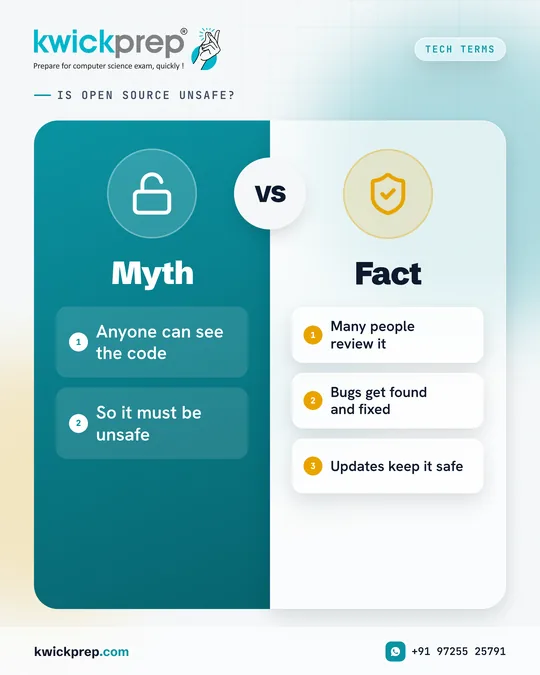
Is open source unsafe?
Myth
- Anyone can see the code
- So it must be unsafe
Fact
- Many people review it
- Bugs get found and fixed
- Updates keep it safe
Some students assume that if code is public, it must be easy to attack.
Open source software can be reviewed by many developers, which helps bugs and security issues get found and fixed. Widely used projects such as Linux and Python are trusted around the world.
That said, no software is automatically safe, open or closed. Download from official sources, keep software updated, and prefer well-maintained projects. Good security comes from good practices, not from hiding the code.
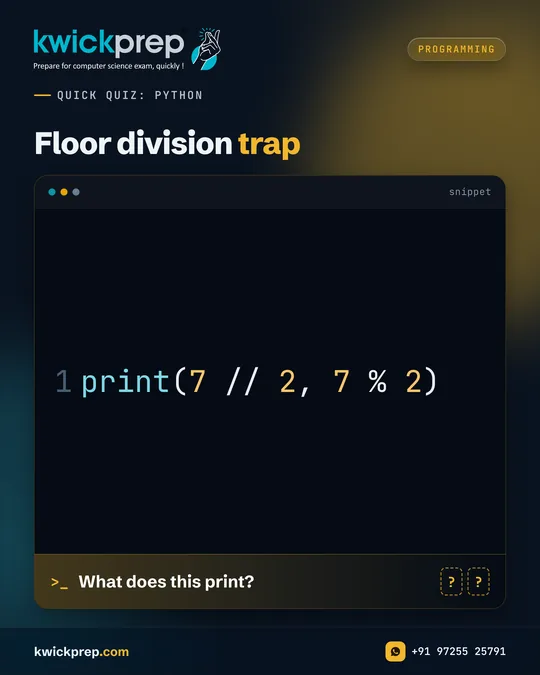
Quick quiz: Python
Floor division trap
What does this print?
print(7 // 2, 7 % 2)A small question that trips up many students.
Output: 3 1
In Python, // is floor division, so 7 // 2 gives 3. The % operator gives the remainder, so 7 % 2 gives 1. print() separates the two values with a space, so the output is 3 1.
The single / operator would give 3.5. Knowing the difference between /, // and % is essential for CBSE CS, IP and AI practicals. Try it yourself in Python!
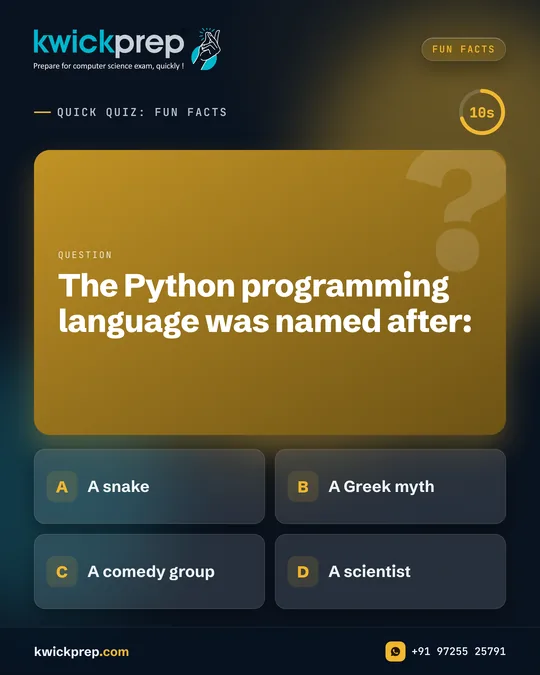
Quick quiz: fun facts
The Python programming language was named after:
- A snake
- A Greek myth
- A comedy group
- A scientist
Fun computing trivia.
Answer: (C) A comedy group.
Guido van Rossum, who created Python, named it after the British comedy series Monty Python's Flying Circus. The snake came later, mostly through logos and book covers.
Python went on to become one of the most widely used programming languages, and it is the language used in CBSE Computer Science, Informatics Practices and AI. Did you guess correctly? Tell us in the comments.
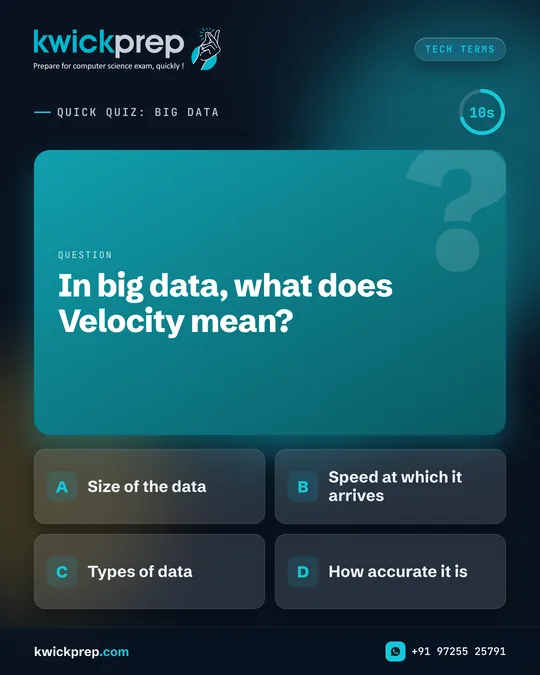
Quick quiz: big data
In big data, what does Velocity mean?
- Size of the data
- Speed at which it arrives
- Types of data
- How accurate it is
Big data vocabulary check.
Answer: (B) Speed at which it arrives.
Big data is commonly described using Vs. Volume is how much data there is, Velocity is how fast it is generated and arrives, Variety is the range of formats such as text, images and video, and Veracity is how trustworthy the data is.
Think of live traffic updates or streaming comments: data flowing in every second is high velocity.
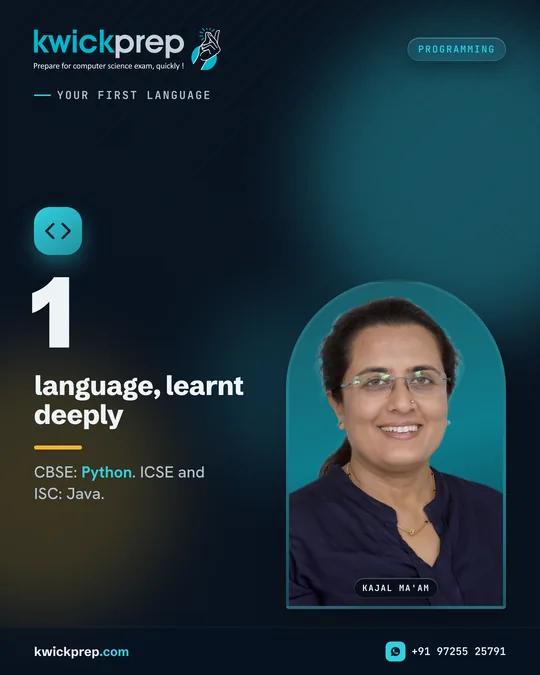
Your first language
1 language, learnt deeply
CBSE: Python. ICSE and ISC: Java.
Python, Java, C or C++? Students often lose months deciding.
Here is the honest answer: pick the language your board uses, and learn it deeply. For CBSE CS, IP and AI that is Python; for ICSE and ISC it is Java. Loops, conditions, functions and problem solving transfer to every language you learn later.
Kwickprep teaches Python, Java, C and C++ alongside board syllabi, live online with Kajal Ma'am.
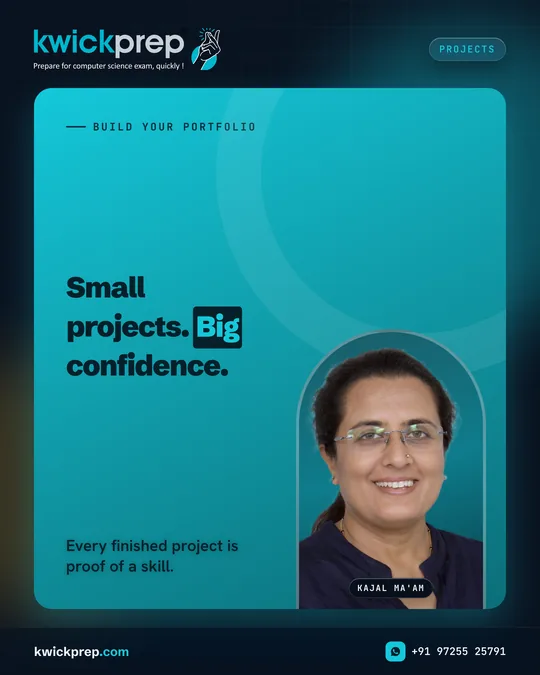
Build your portfolio
Every finished project is proof of a skill.
Small projects. Big confidence.
A mark sheet shows what you scored. A project shows what you can build.
Even simple projects, like a quiz game, a marks calculator or an image classifier made with Teachable Machine, teach you more than hours of passive reading. Keep a folder of your work with a short note on each project.
This habit strengthens your practical file, prepares you for the viva, and gives you something real to talk about later. Kajal Ma'am guides students through projects step by step.
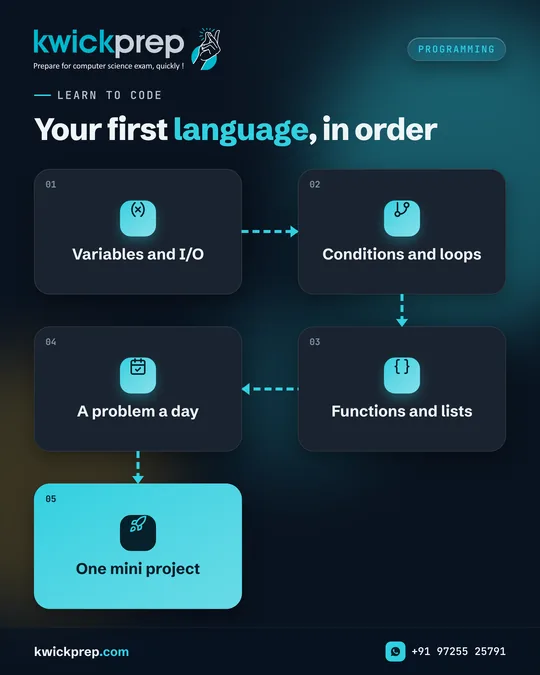
Learn to code
Your first language, in order
- Variables and I/O
- Conditions and loops
- Functions and lists
- A problem a day
- One mini project
Learning to code is less about talent and more about a good sequence.
Begin with the basics: variables, data types and input/output. Then master decisions and loops, which is where real logic begins. Move on to functions and lists, so your programs become organised. Next, solve small problems daily rather than cramming. Finally, build a mini project that uses everything together.
Consistency beats intensity. Thirty focused minutes a day will take you further than one long weekend session.
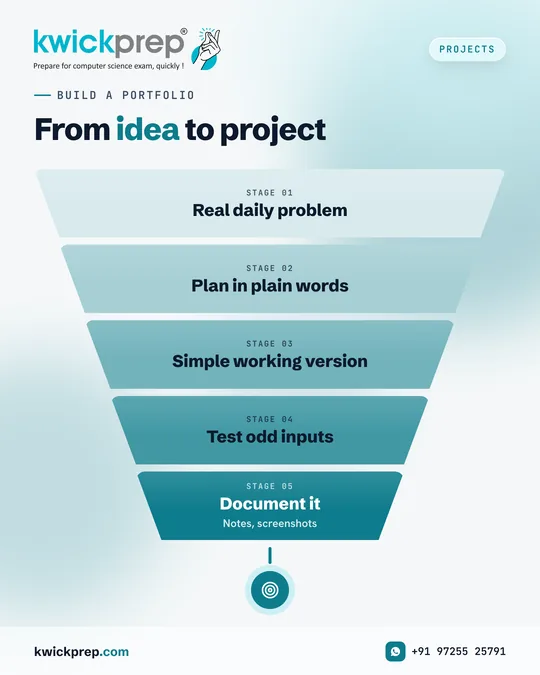
Build a portfolio
From idea to project
- Real daily problem
- Plan in plain words
- Simple working version
- Test odd inputs
- Document it
A portfolio is simply a collection of work that shows what you can do. Here is how to build your first entry.
Pick a small, real problem from your school or home. Plan what the program should do in plain words. Build a basic working version first, then improve it. Test it with unusual inputs. Finally, write a short description with screenshots, and save your code in an organised folder or a code-hosting site.
One finished project is worth more than five abandoned ones.
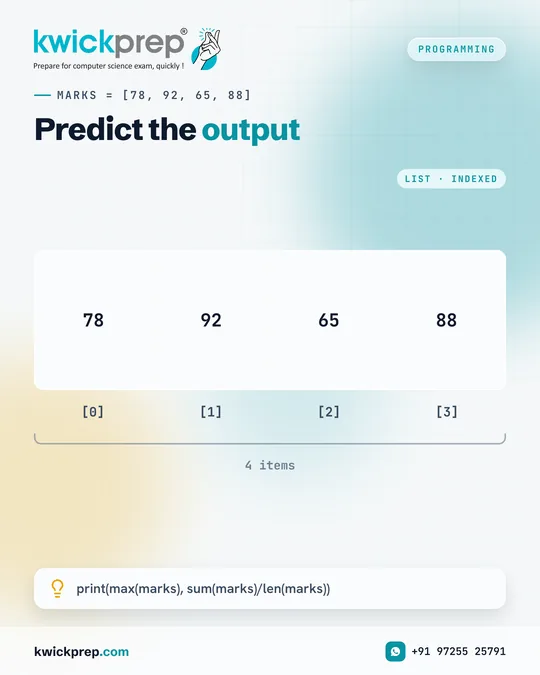
marks = [78, 92, 65, 88]
Predict the output
- 78
- 92
- 65
- 88
print(max(marks), sum(marks)/len(marks))
A quick output question using lists and built-in functions, very common in CBSE CS and IP exams.
Output:
92 80.75
max() returns the largest value, 92. sum() adds the marks to 323, and dividing by len(), which is 4, gives 80.75. Since / always returns a float in Python, the average prints as 80.75.
Practise predicting output before running code. It builds exactly the careful reading that exam questions reward.
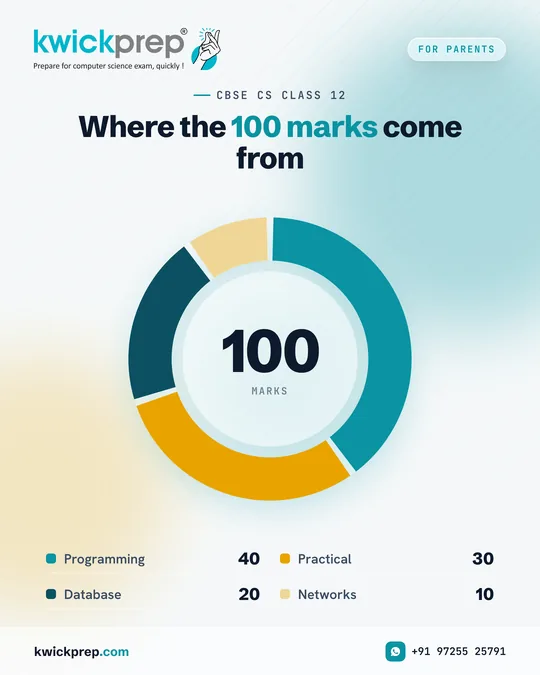
CBSE CS Class 12
Where the 100 marks come from
100 marks
- Programming
- Practical
- Database
- Networks
A single total rarely tells the full story of how your child is doing in Computer Science.
CBSE Class 12 CS is 70 marks theory plus 30 marks practical. A child can do well in practicals yet lose marks in theory, or the other way around.
Look at where marks were lost, not just how many. That is where the real improvement plan begins.
When you understand where marks come from, your conversations with your child become calmer, more specific and far more useful.
Share this with a parent who may find it helpful.
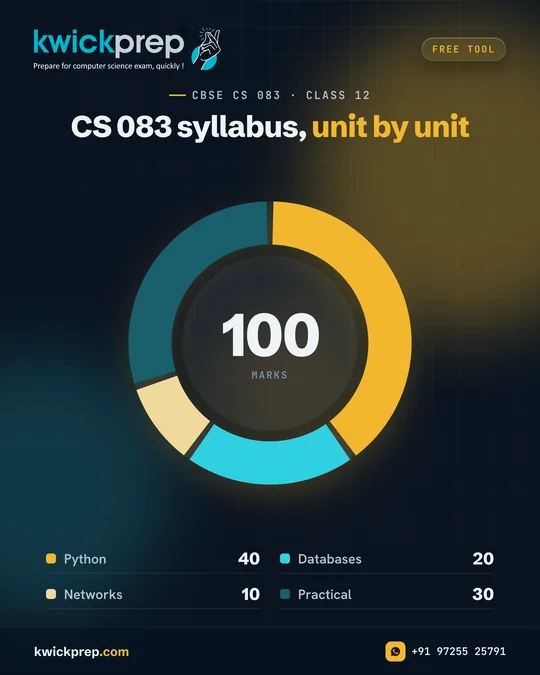
The full split: Computational Thinking and Programming 40, Database Management 20, Computer Networks 10, and Practical 30.
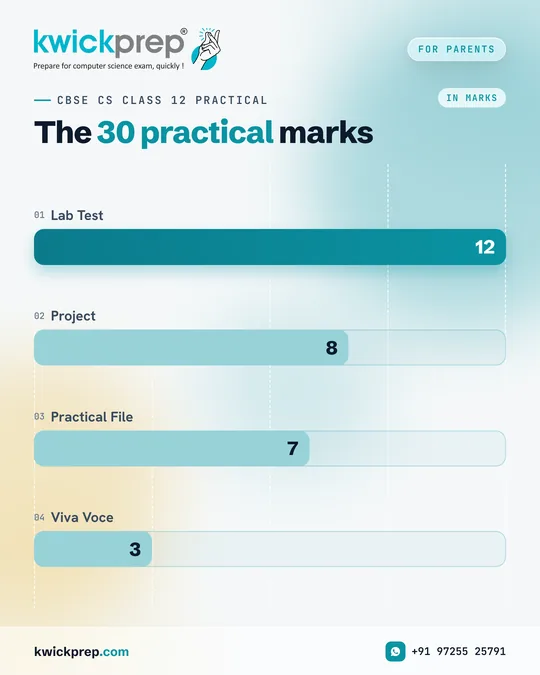
CBSE CS Class 12 practical
The 30 practical marks
- Lab Test
- Project
- Practical File
- Viva Voce
Practical and project season often arrives just as theory revision peaks, and many children feel stretched.
You do not need to know Python or SQL to help. Your support is about structure: time, space and gentle deadlines.
In CBSE Computer Science, the practical carries 30 marks, a meaningful share that rewards children who start early and prepare for the viva calmly.
A project your child genuinely understands is one they can explain with confidence, and that confidence shows in the viva.
Save this for later, and share it with your family.
The 30 practical marks split into Lab Test 12 (Python 8 and SQL 4), Project 8, Practical File 7 and Viva Voce 3.
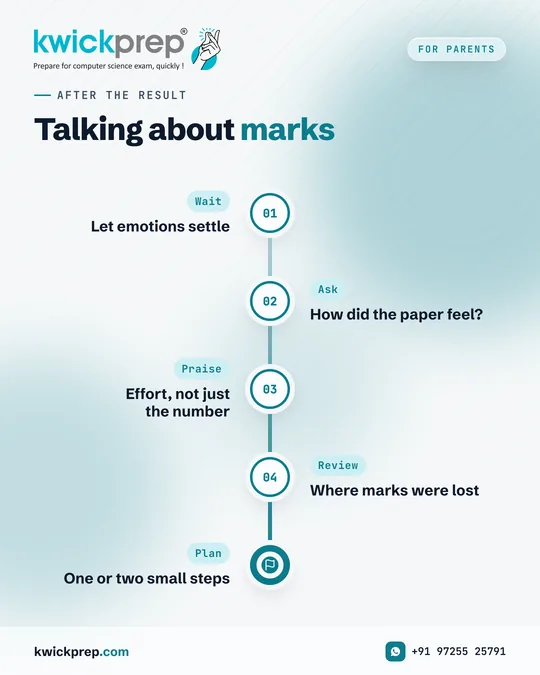
After the result
Talking about marks
- Let emotions settle
- How did the paper feel?
- Effort, not just the number
- Where marks were lost
- One or two small steps
The conversation after a test result can shape how your child feels about the next one.
Whether the marks are high or disappointing, what matters most is that your child leaves the conversation feeling understood and ready to try again.
A marks discussion is most useful when it becomes a plan, not a verdict.
How we talk about marks teaches children how to handle setbacks for the rest of their lives, far beyond a single exam.
If this helped, share it with another parent in your circle.
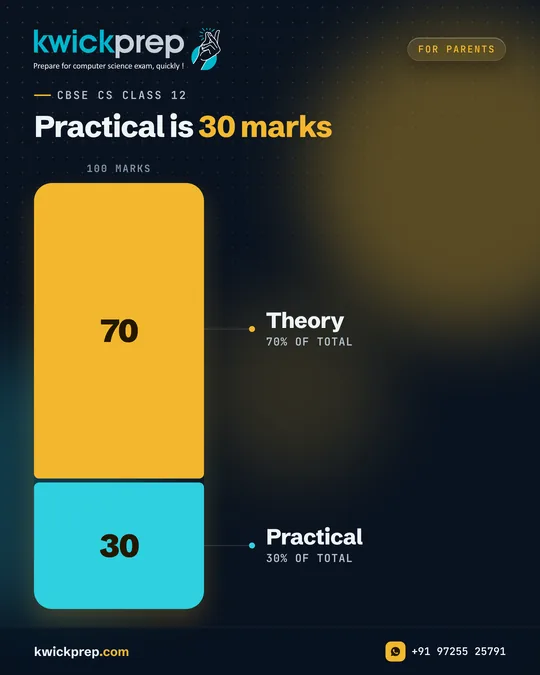
CBSE CS Class 12
Practical is 30 marks
- Theory
- Practical
The practical and project are sometimes treated as the easy part of Computer Science. They are not extras, they are marks.
In CBSE Class 12 Computer Science, practical work carries 30 of the 100 marks, including the project, practical file and viva.
Starting early lets your child build a project they genuinely understand and explain confidently.
At Kwickprep, practical and viva preparation are part of the plan, not an afterthought.
A project your child genuinely understands is one they can explain with confidence, and that confidence shows in the viva.
Share this with a parent who may find it helpful.
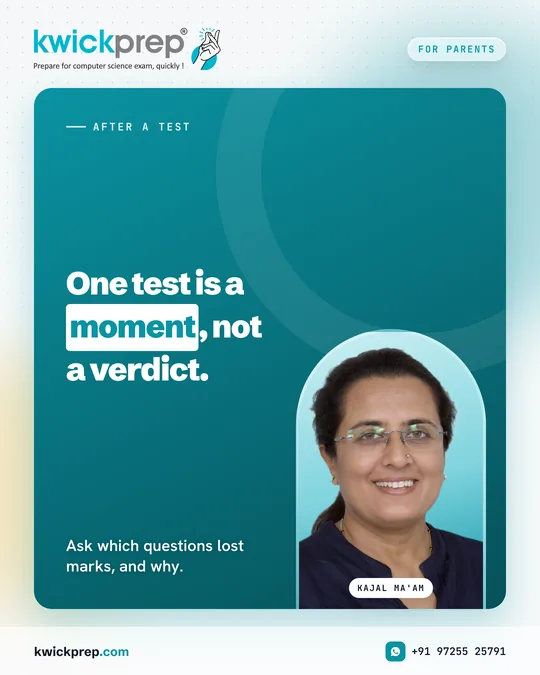
After a test
Ask which questions lost marks, and why.
One test is a moment, not a verdict.
When a test result disappoints, both parent and child can feel it deeply.
A single test shows where your child stood on that day, on those questions. It does not decide their future.
The most useful response is curiosity: which questions lost marks, and why? Was it a concept gap, a silly error or time pressure?
Once you know the reason, the next step becomes clear, and your child learns that setbacks can be worked through.
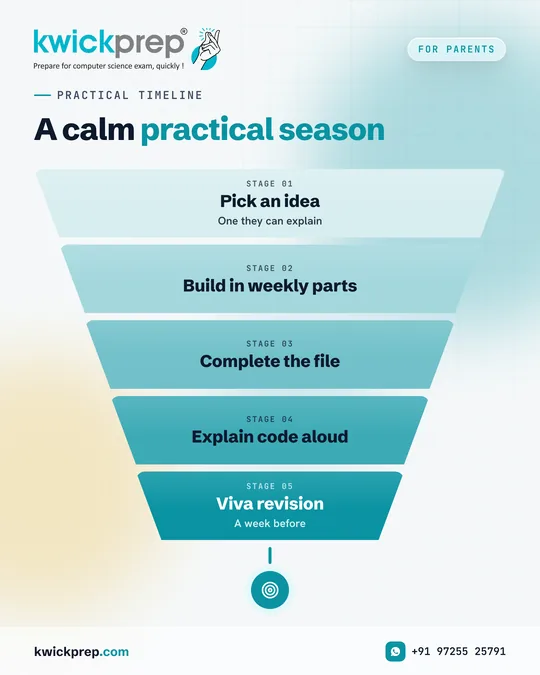
Practical timeline
A calm practical season
- Pick an idea
- Build in weekly parts
- Complete the file
- Explain code aloud
- Viva revision
Practical season becomes stressful mainly when everything is left for the final weeks.
This simple timeline spreads the work out so your child can build a project they truly understand.
In CBSE Class 12 Computer Science, practical work carries 30 marks, so a calm plan is well worth it.
A project your child genuinely understands is one they can explain with confidence, and that confidence shows in the viva.
If this helped, share it with another parent in your circle.
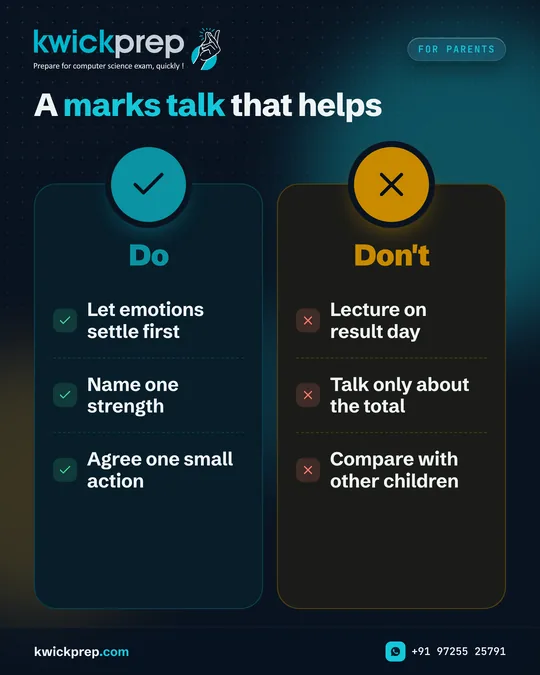
Marks Talk
A marks talk that helps
Do
- Let emotions settle first
- Name one strength
- Agree one small action
Don't
- Lecture on result day
- Talk only about the total
- Compare with other children
Result day conversations can easily turn into lectures. This simple sequence keeps them supportive and useful.
The aim is not to avoid discussing marks, but to help your child leave the conversation with a plan and their confidence intact.
How we talk about marks teaches children how to handle setbacks for the rest of their lives, far beyond a single exam.
Save this for later, and share it with your family.
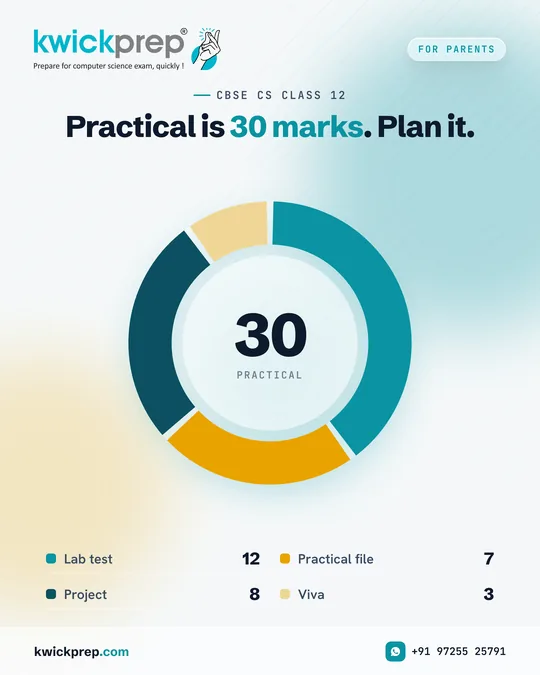
CBSE CS CLASS 12
Practical is 30 marks. Plan it.
30 practical
- Lab test
- Practical file
- Project
- Viva
Practicals are sometimes seen as marks that come automatically. Often, they are rushed in the final weeks.
A project your child built in a hurry is hard to explain confidently in a viva. Starting early allows understanding, not just completion.
Thirty marks deserve a plan.
A project your child genuinely understands is one they can explain with confidence, and that confidence shows in the viva.
Save this post so you can return to it when you need it.
Practical 30 marks break up as lab test 12, practical file 7, project 8 and viva 3 (CBSE CS Class 12).
Marks Talk
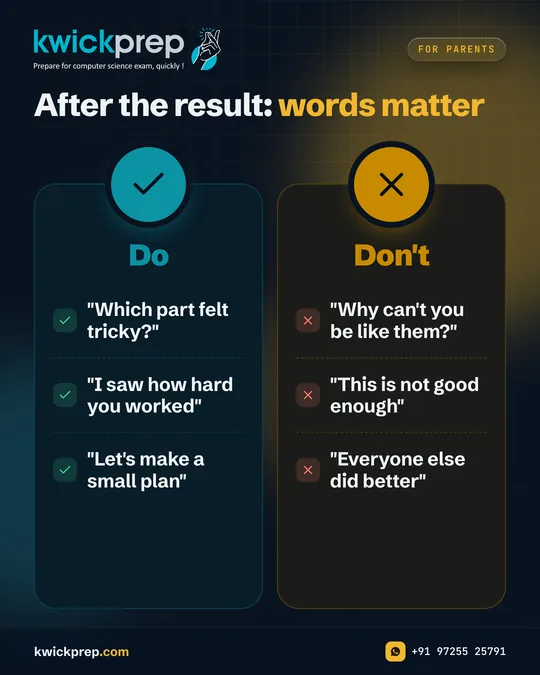
After the result: words matter
Do
- "Which part felt tricky?"
- "I saw how hard you worked"
- "Let's make a small plan"
Don't
- "Why can't you be like them?"
- "This is not good enough"
- "Everyone else did better"
The words we choose after a result can shape how children approach the next exam.
Supportive questions invite reflection and a plan. Comparisons and labels usually create fear and avoidance.
You can be honest about disappointing marks while still making your child feel capable of improving.
How we talk about marks teaches children how to handle setbacks for the rest of their lives, far beyond a single exam.
If this helped, share it with another parent in your circle.
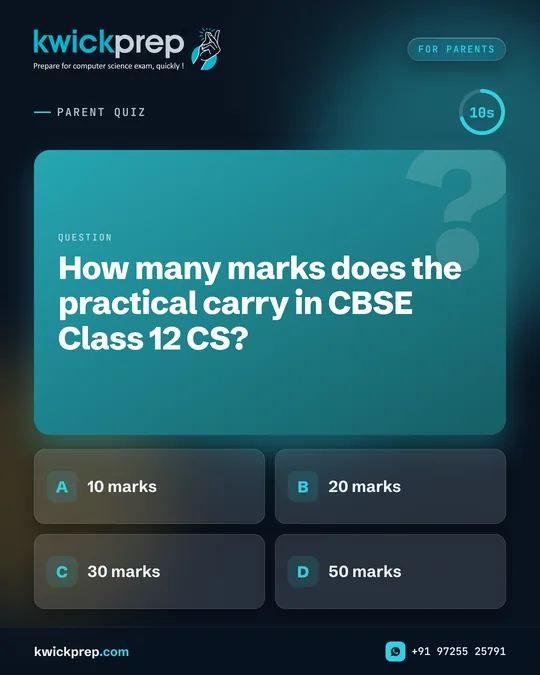
PARENT QUIZ
How many marks does the practical carry in CBSE Class 12 CS?
- 10 marks
- 20 marks
- 30 marks
- 50 marks
Test yourself, then check below.
Answer: (C) 30 marks.
CBSE Class 12 Computer Science is 70 marks theory and 30 marks practical, which includes the project, practical file and viva.
That is a meaningful share, which is why an early start on projects helps so much.
A project your child genuinely understands is one they can explain with confidence, and that confidence shows in the viva.
Save this post so you can return to it when you need it.
CBSE CS 083 CLASS 12
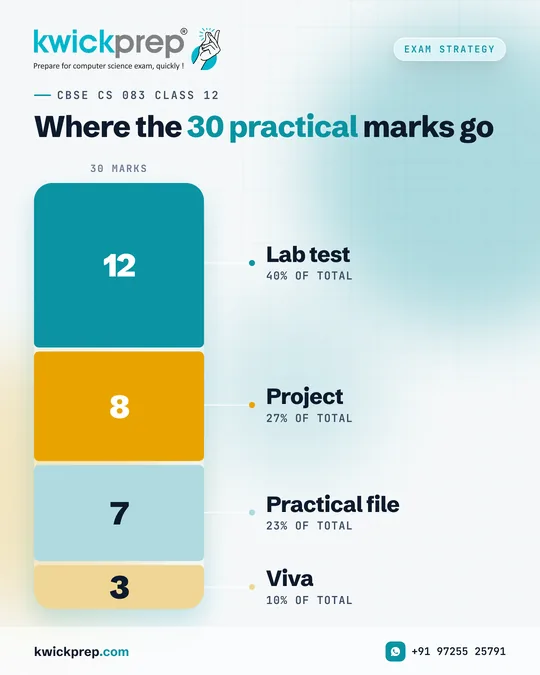
Where the 30 practical marks go
- Lab test
- Project
- Practical file
- Viva
Thirty marks are decided before you even sit the theory paper.
CBSE Computer Science Class 12 practicals give 12 marks to the lab test, 8 to the project, 7 to your practical file and 3 to the viva. The file needs a minimum of 15 Python programs plus SQL query sets, and the project is Python and SQL based.
Start the file now, one program at a time. Practise programs without looking at notes, test them with tricky inputs, and be ready to explain how your project works. Kajal Ma'am guides students on practical files and project work along with theory in every batch.
PRACTICE METHOD
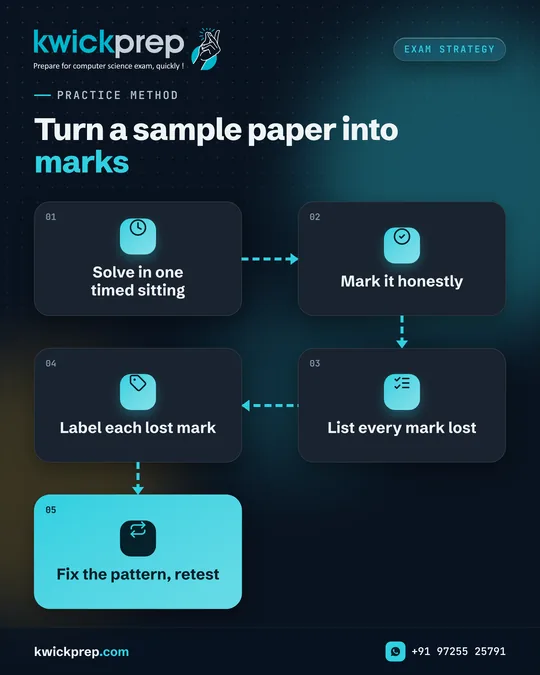
Turn a sample paper into marks
- Solve in one timed sitting
- Mark it honestly
- List every mark lost
- Label each lost mark
- Fix the pattern, retest
Solving sample papers only helps if you learn from them.
Sit the paper in one go with a timer, exactly like the board exam. Then mark it honestly using the marking scheme, not your memory of what you meant. After each test, list every mark you lost and label it: a concept gap, a silly slip or a time problem.
Concept gaps go back to your notes. Silly slips need a checklist before you submit. Time problems need more timed practice. Retest the same area a week later.
Kajal Ma'am uses KwickSolution question banks and board-style papers in every batch so students revise with purpose.
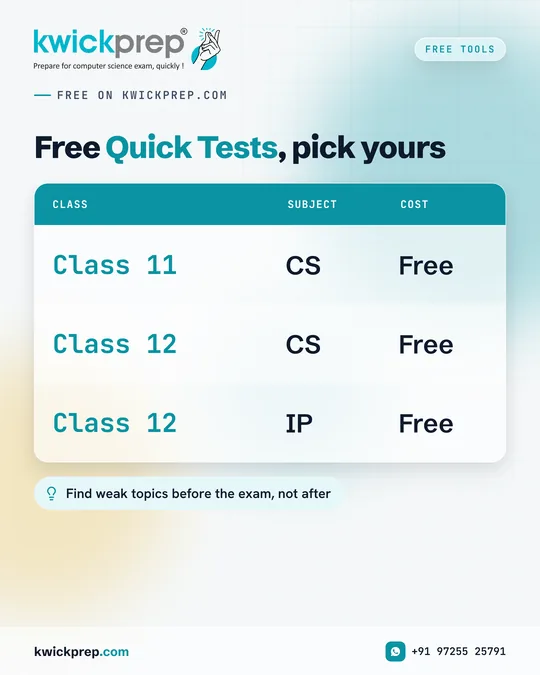
FREE ON KWICKPREP.COM
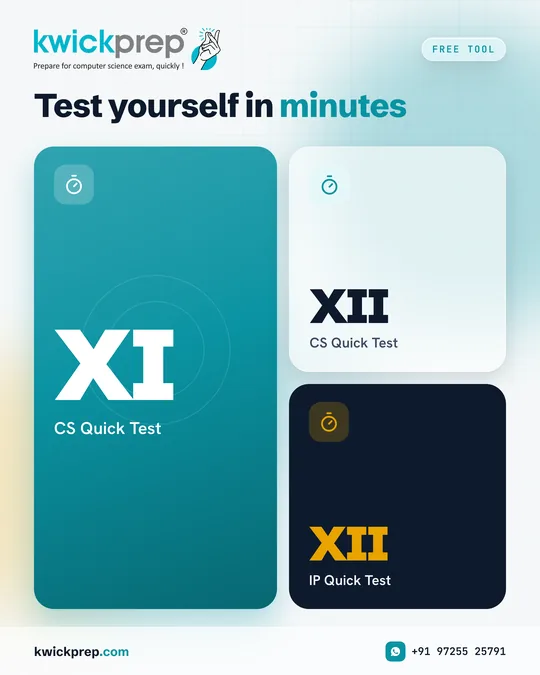
Free Quick Tests, pick yours
| Class | Subject | Cost |
|---|---|---|
| Class 11 | CS | Free |
| Class 12 | CS | Free |
| Class 12 | IP | Free |
Find weak topics before the exam, not after
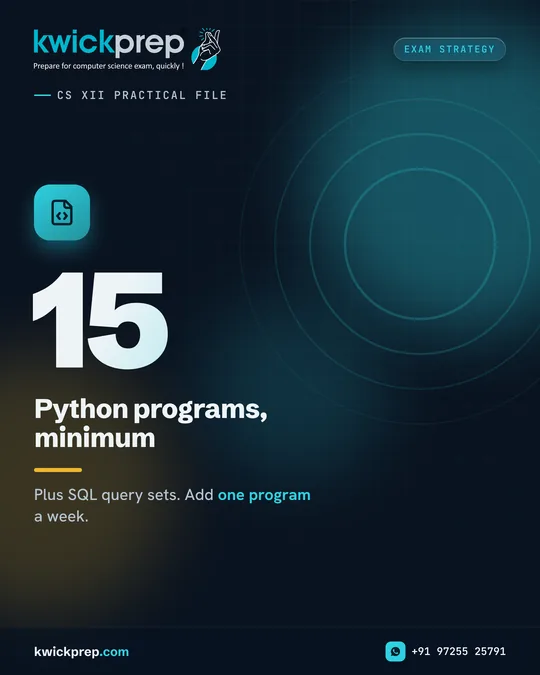
CS XII PRACTICAL FILE
15 Python programs, minimum
Plus SQL query sets. Add one program a week.
Your practical file is worth 7 marks, and it cannot be finished in one night.
The CBSE Computer Science Class 12 practical file needs at least 15 Python programs plus SQL query sets. Students who leave it for the final week usually copy programs they do not understand, and that shows up in the viva.
A calmer plan: add one program a week as you finish each chapter, run it, and write the output neatly. By the time the lab test arrives, the file is done and the programs are already in your head.
Kajal Ma'am guides students on practical files and project work along with theory in every batch.
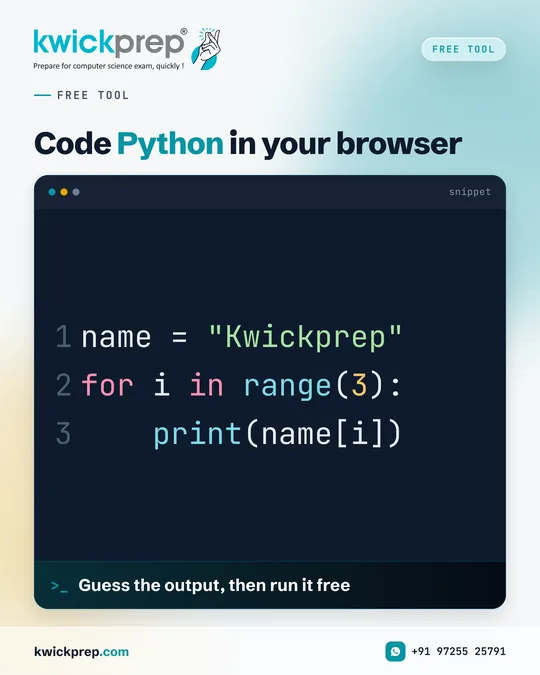
FREE TOOL
Code Python in your browser
Guess the output, then run it free
name = "Kwickprep"
for i in range(3):
    print(name[i])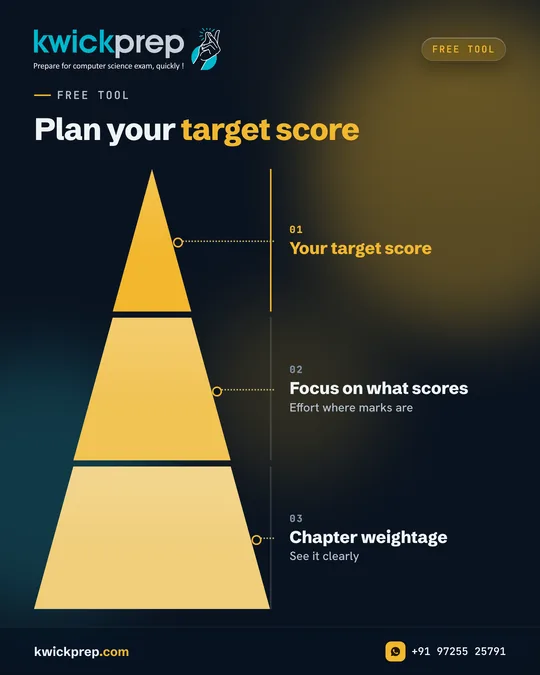
FREE TOOL
Plan your target score
- Your target score
- Focus on what scores
- Chapter weightage
FREE TOOL
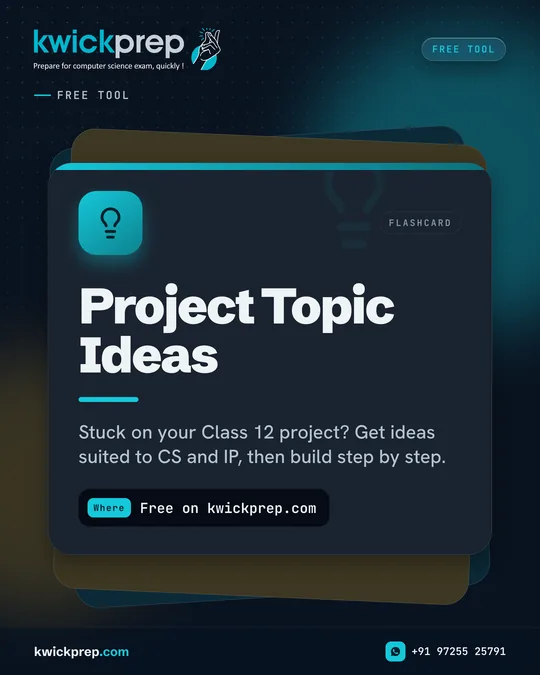
- Project Topic Ideas
- Stuck on your Class 12 project? Get ideas suited to CS and IP, then build step by step.
WhereFree on kwickprep.com
Every Class 12 CS and IP student faces this question: what should my project be?
Free Tool
Test yourself in minutes
- CS Quick Test
- CS Quick Test
- IP Quick Test
CBSE CS 083 · CLASS 12
CS 083 syllabus, unit by unit
100 marks
- Python
- Databases
- Networks
- Practical
The first step to scoring well is knowing exactly what is in your syllabus.
FREE ONLINE QUIZ
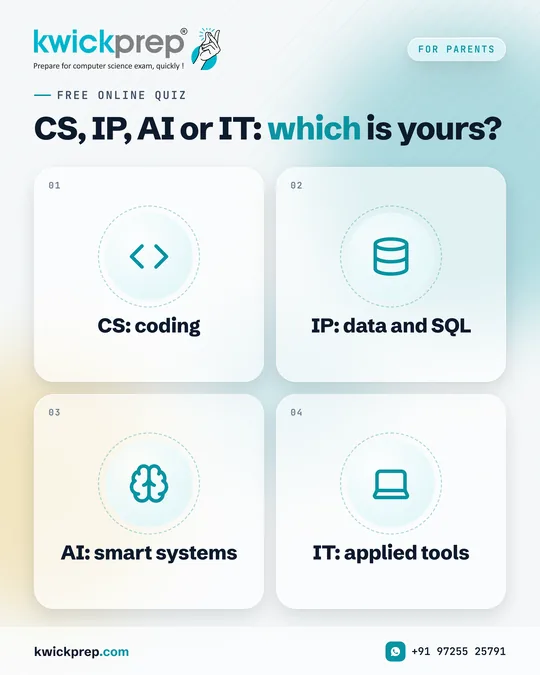
CS, IP, AI or IT: which is yours?
- CS: coding
- IP: data and SQL
- AI: smart systems
- IT: applied tools
Choosing between Computer Science, Informatics Practices, AI and IT for Class 11? It is a big decision, and it is normal to feel unsure.
Written by Kajal Mehta (Kajal Ma'am), MCA, teaching computer subjects since 2004. All KwickCards