
KwickCards Exams and revision
Exams and revision: 151 revision cards
Every card below is written out in full underneath its picture, so you can read it, search it and copy from it. Free, no sign-up.
Board Pattern
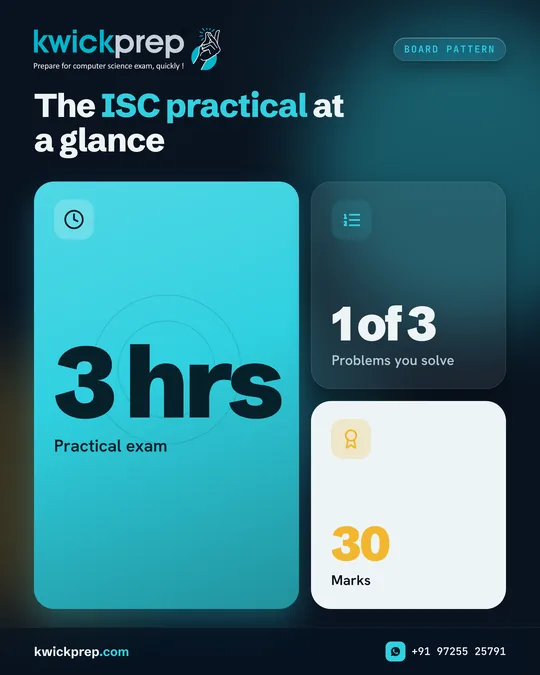
The ISC practical at a glance
- Practical exam
- Problems you solve
- Marks
The ISC Computer Science practical is 3 hours and 30 marks.
You choose one of three problems and write a working Java program, assessed on planning, coding, output and viva. The planning step is where calm students win: a clear algorithm makes coding smooth.
Practise one full problem every week under time.
At Kwickprep, Kajal Ma'am maps every lesson to your board's exact pattern, so your study time goes where the marks are. Live online classes, small batches or one-to-one.
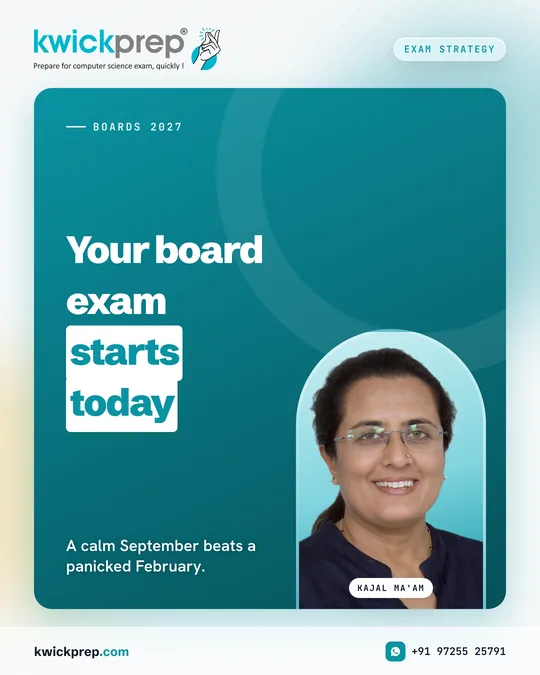
BOARDS 2027
A calm September beats a panicked February.
Your board exam starts today
The boards feel far away in September. They are not.
Students who build steady habits now have time to finish practicals, write sample papers and still sleep well in February. Those who wait end up rushing.
Start with one small step this week: plan your month. We can help you build it.
Kajal Ma'am helps every Kwickprep student build an exam strategy suited to their board, their target and the time they have left this session.
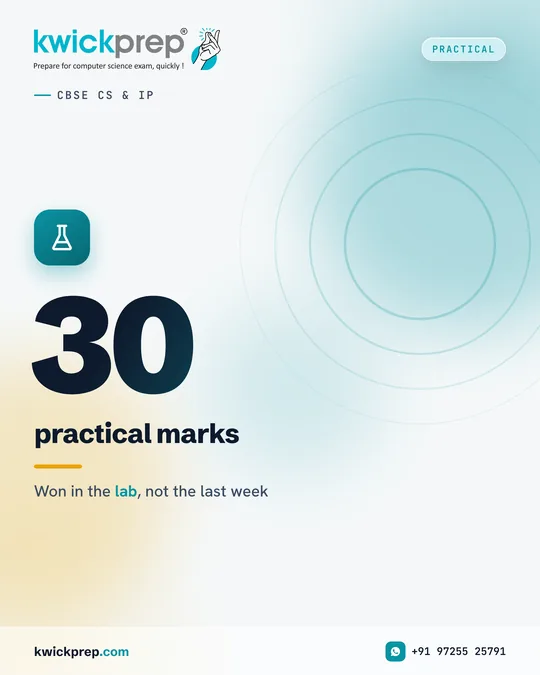
CBSE CS & IP
30 practical marks
Won in the lab, not the last week
Practical marks are often the most predictable marks you can earn.
A complete file, a project you understand and a calm viva can protect a big part of your score before the theory paper even begins. Kajal Ma'am personally guides every batch through file, project and viva preparation.
Start your file this week.
In Kwickprep's live online batches, Kajal Ma'am personally guides your practical file, project and viva, so nothing is left for the final weeks before the exam.
Viva Prep
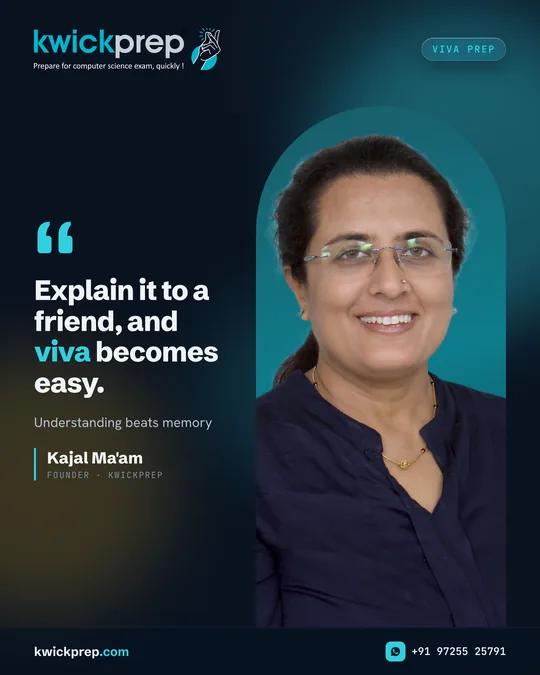
Understanding beats memory
Explain it to a friend, and viva becomes easy.
Viva is not a test of memory. It is a conversation about your own work.
Students who wrote and ran their programs themselves answer naturally. That's why at Kwickprep, we practise explaining code aloud, not just writing it.
Tonight, pick one program from your file and explain it in your own words.
Kwickprep students rehearse viva questions in class with Kajal Ma'am, speaking answers aloud until explaining their own work feels natural and calm.
REVISION MINDSET
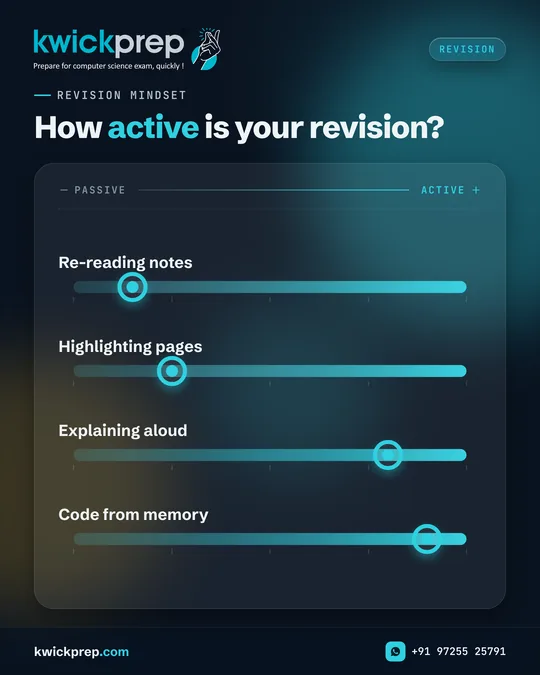
How active is your revision?
Turning pages is not the same as revising.
The most effective revision asks your brain to recall: close the book, write the syntax, explain the concept, solve without hints. It feels harder, and that is exactly why it works.
MARKS PLANNING
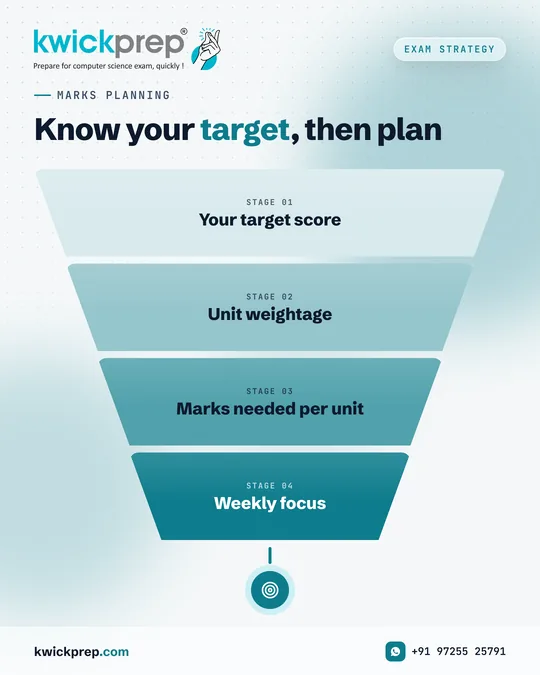
Know your target, then plan
- Your target score
- Unit weightage
- Marks needed per unit
- Weekly focus
A target turns vague studying into a clear plan.
FOCUS
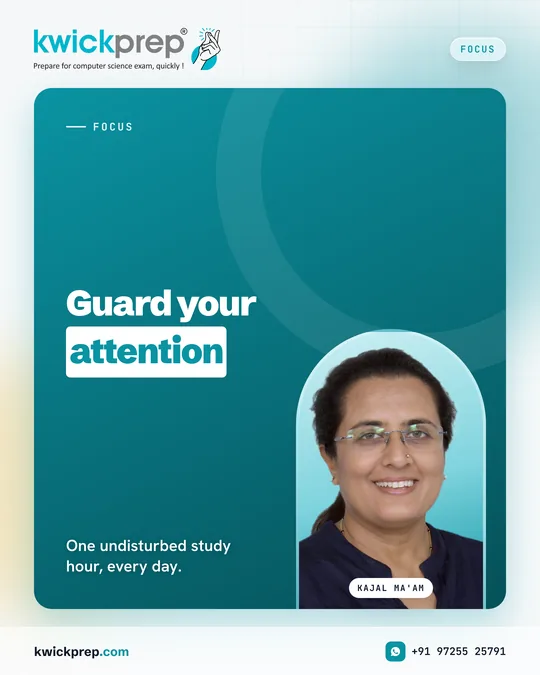
One undisturbed study hour, every day.
Guard your attention
Every notification is a small interruption, and interruptions add up.
Students who protect even one hour of undisturbed study each day notice the difference within weeks: faster learning, fewer repeated mistakes and less stress.
Tonight, keep your phone outside the room for one study session. See what changes.
Small, live online batches at Kwickprep keep you engaged and accountable, and recorded versions of classes let you revise without endless searching or scrolling.
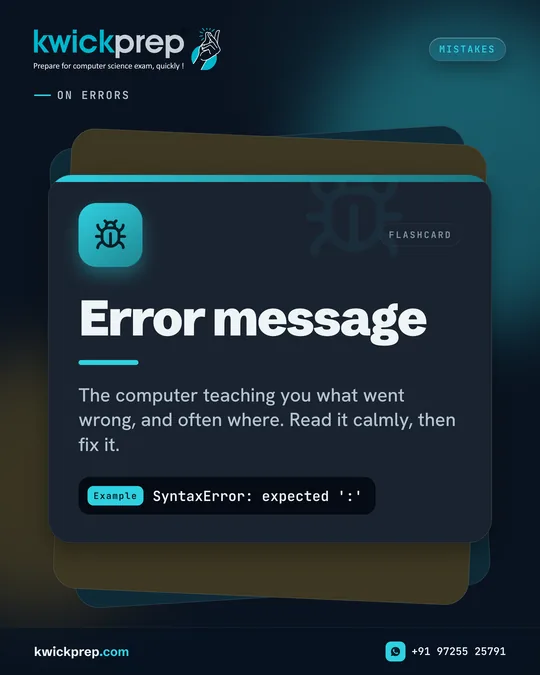
ON ERRORS
- Error message
- The computer teaching you what went wrong, and often where. Read it calmly, then fix it.
ExampleSyntaxError: expected ':'
Red error text on the screen is not failure.
It tells you exactly what went wrong and often where. Students who learn to read errors patiently become independent programmers, and that independence shows in lab tests and theory answers alike.
Next time you see an error, pause, read it fully, then fix it.
In Kwickprep classes, errors are treated as learning moments. Kajal Ma'am helps you read them, understand them and fix them on your own.
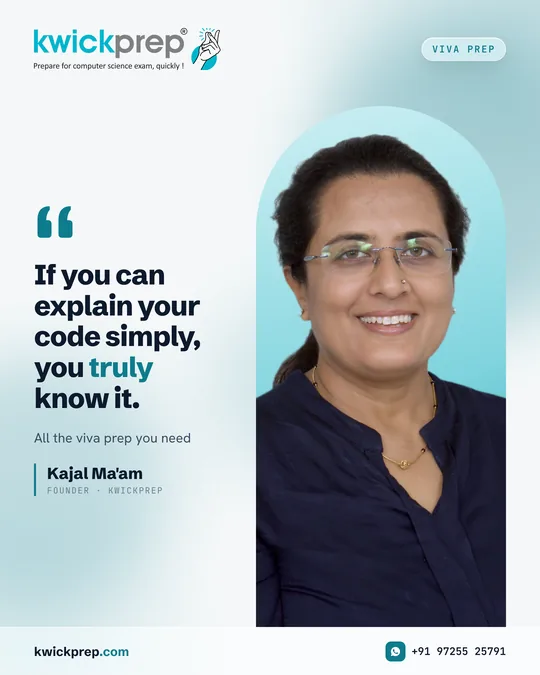
Viva Prep
All the viva prep you need
If you can explain your code simply, you truly know it.
Viva often worries students more than it should.
The secret is understanding, not memorising. When you have written and run your own programs, the questions become a friendly conversation about your work.
Pick one program from your file tonight and explain it aloud in simple words.
Kwickprep students rehearse viva questions in class with Kajal Ma'am, speaking answers aloud until explaining their own work feels natural and calm.
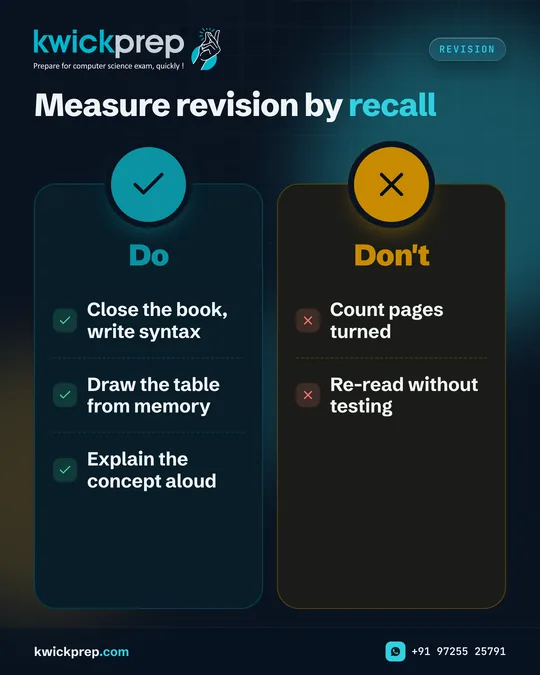
Revision
Measure revision by recall
Do
- Close the book, write syntax
- Draw the table from memory
- Explain the concept aloud
Don't
- Count pages turned
- Re-read without testing
Many students confuse reading with revising.
True revision checks what your memory can produce without help. Close the book, write the syntax, draw the table, explain the concept. Then open the book and check.
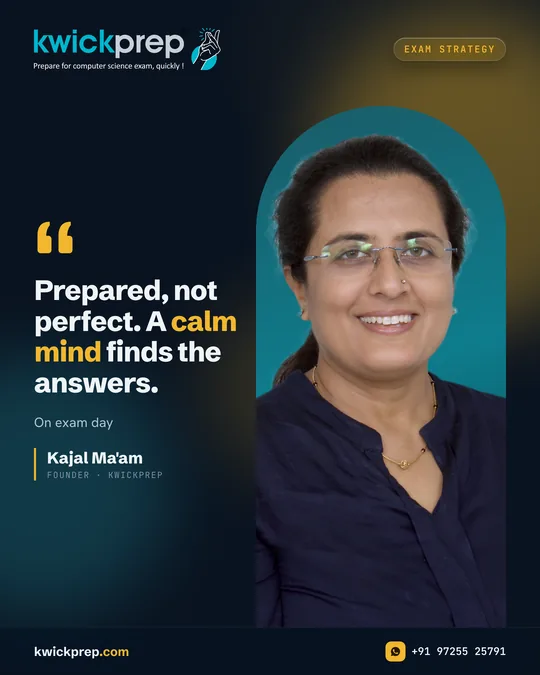
Exam Strategy
On exam day
Prepared, not perfect. A calm mind finds the answers.
Perfection is not required on exam day. Preparation is.
Students who arrive calm, with a plan for their time and a steady routine, write their best answers. Worry uses up the very focus you need to recall what you already know.
Practise calm in every mock test, and it will be there on the day.
Kajal Ma'am helps every Kwickprep student build an exam strategy suited to their board, their target and the time they have left this session.
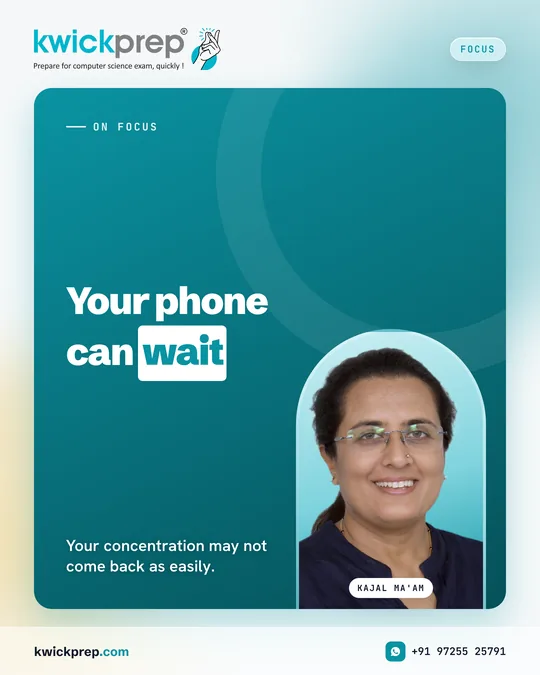
ON FOCUS
Your concentration may not come back as easily.
Your phone can wait
A small change in phone habits can make a big change in results.
Concentration takes time to build and seconds to break. Keeping the phone away during study blocks lets deep learning happen.
Try a phone-free study session tonight and notice how much more you finish.
Small, live online batches at Kwickprep keep you engaged and accountable, and recorded versions of classes let you revise without endless searching or scrolling.
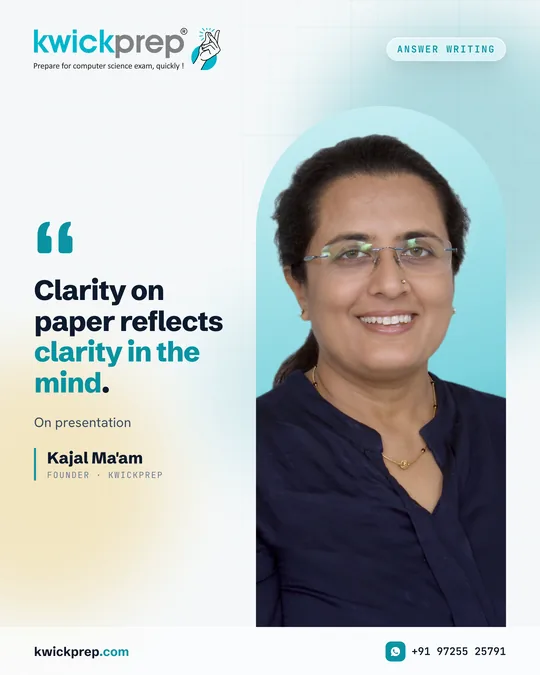
Answer Writing
On presentation
Clarity on paper reflects clarity in the mind.
Examiners read many answer sheets. Neat ones stand out.
Clear spacing, underlined keywords, indented code and tidy tables show that you know what you are saying. Presentation does not replace content, but it lets your content be seen.
Practise presentation in every sample paper from now on.
Kajal Ma'am reviews answer presentation in Kwickprep's small batches, so good habits are corrected early and carried confidently into the board exam hall.
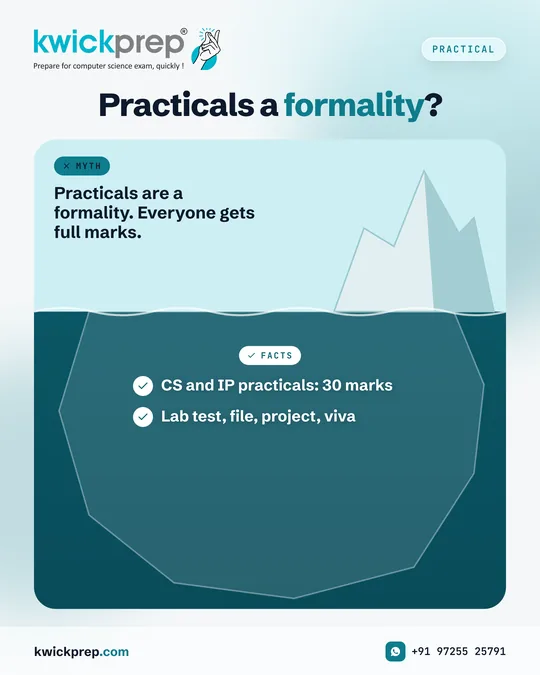
Practical
Practicals a formality?
- CS and IP practicals: 30 marks
- Lab test, file, project, viva
Myth: Practicals are a formality. Everyone gets full marks.
Treating practicals casually is one of the costliest mistakes in Class 12.
Thirty marks depend on your lab test, practical file, project and viva. Students who prepare seriously secure them; those who don't often lose marks they could easily have earned.
Start your file this week and practise explaining each program.
In Kwickprep's live online batches, Kajal Ma'am personally guides your practical file, project and viva, so nothing is left for the final weeks before the exam.
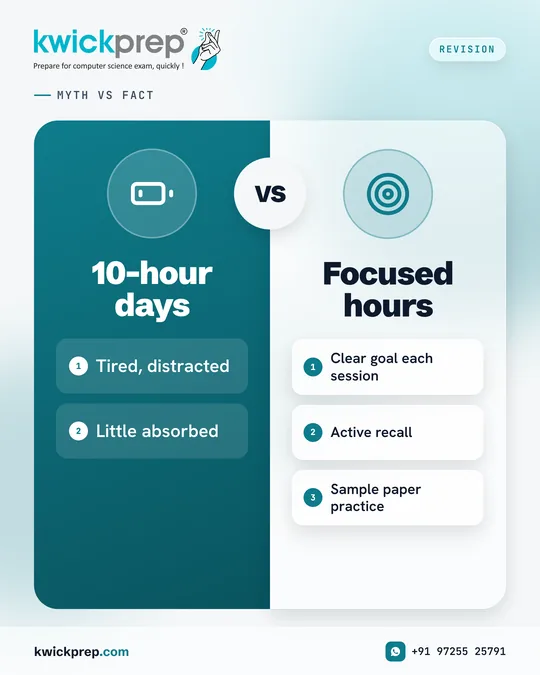
MYTH VS FACT
10-hour days
- Tired, distracted
- Little absorbed
Focused hours
- Clear goal each session
- Active recall
- Sample paper practice
Long hours look impressive. Focused hours get results.
A tired mind reading for the tenth hour absorbs very little. Shorter sessions with clear goals, testing yourself and reviewing mistakes build stronger memory.
Plan fewer, better hours this week and track what you actually finish.
Kwickprep students revise with KwickNotes and recorded classes, following a plan Kajal Ma'am builds around their board and their weak areas.
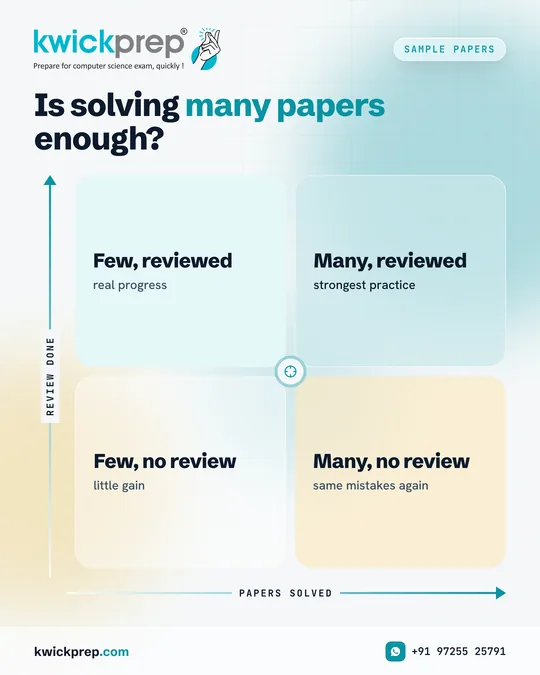
Sample Papers
Is solving many papers enough?
- Few, reviewed
- Many, reviewed
- Few, no review
- Many, no review
Quantity of papers is not the same as quality of practice.
Ten papers without review can repeat the same mistakes ten times. Three papers with honest review can remove those mistakes for good.
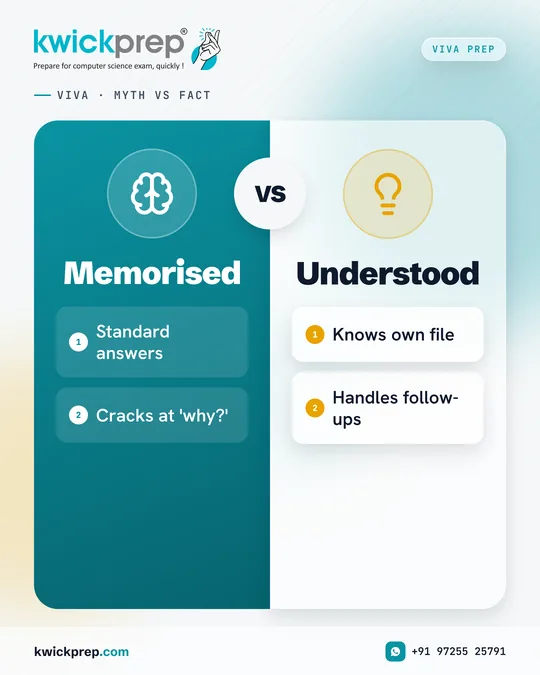
VIVA · MYTH VS FACT
Memorised
- Standard answers
- Cracks at 'why?'
Understood
- Knows own file
- Handles follow-ups
Memorised answers crack under a simple follow-up question.
Examiners often ask 'why did you use this?' or 'what happens if you change that?'. Only real understanding answers those comfortably.
Explain one program from your file aloud tonight, in your own words.
Kwickprep students rehearse viva questions in class with Kajal Ma'am, speaking answers aloud until explaining their own work feels natural and calm.
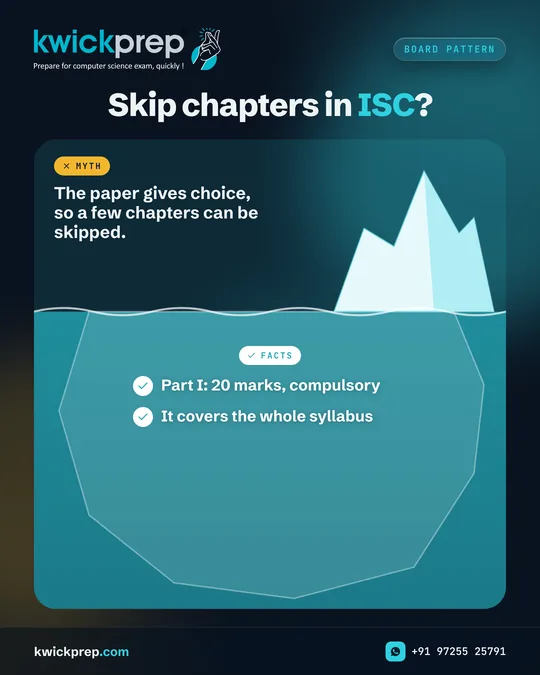
Board Pattern
Skip chapters in ISC?
- Part I: 20 marks, compulsory
- It covers the whole syllabus
Myth: The paper gives choice, so a few chapters can be skipped.
Selective study is risky in ISC Computer Science.
While Part II gives choices within sections, Part I's compulsory short answers can come from anywhere in the syllabus. Skipped chapters can cost easy marks.
Cover every chapter at least at the level of definitions and short answers.
At Kwickprep, Kajal Ma'am maps every lesson to your board's exact pattern, so your study time goes where the marks are. Live online classes, small batches or one-to-one.
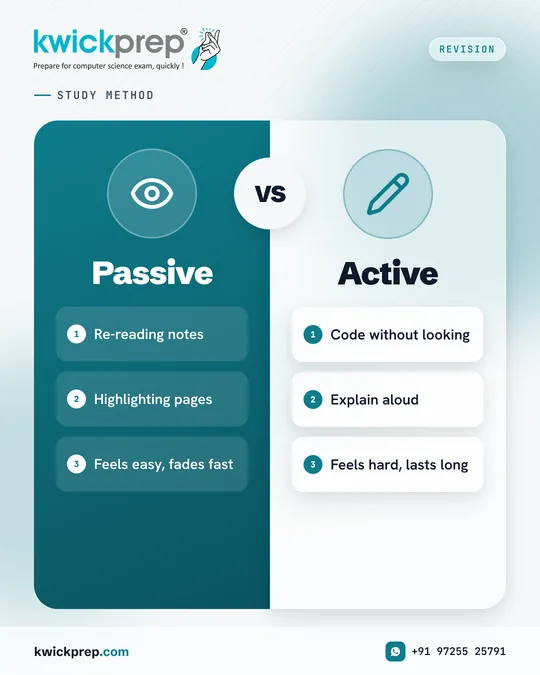
STUDY METHOD
Passive
- Re-reading notes
- Highlighting pages
- Feels easy, fades fast
Active
- Code without looking
- Explain aloud
- Feels hard, lasts long
Not all revision is equal.
Passive revision feels comfortable, which is why it is tempting. Active revision makes your brain work to recall, which is exactly what builds memory for the exam hall.
Swap one passive session for an active one this week.
Kwickprep students revise with KwickNotes and recorded classes, following a plan Kajal Ma'am builds around their board and their weak areas.
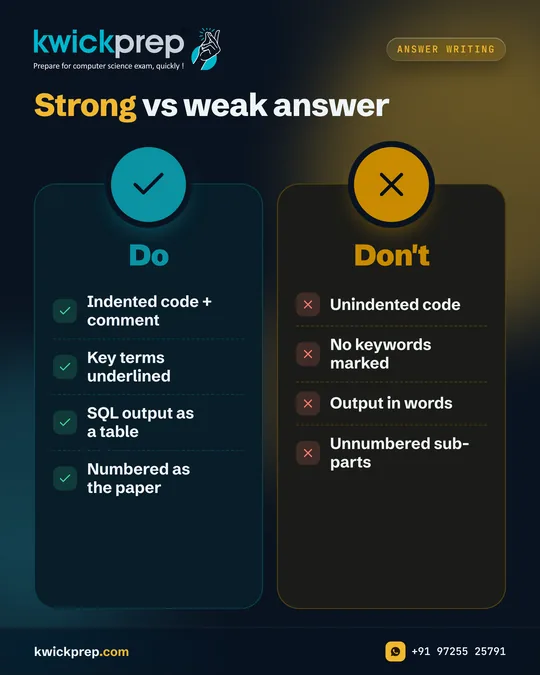
Answer Writing
Strong vs weak answer
Do
- Indented code + comment
- Key terms underlined
- SQL output as a table
- Numbered as the paper
Don't
- Unindented code
- No keywords marked
- Output in words
- Unnumbered sub-parts
The same knowledge can look very different on paper.
A strong answer helps the examiner see your understanding instantly. Small presentation habits, practised in every test, add up across a whole paper.
Compare your last test answers with the Do column.
Kajal Ma'am reviews answer presentation in Kwickprep's small batches, so good habits are corrected early and carried confidently into the board exam hall.
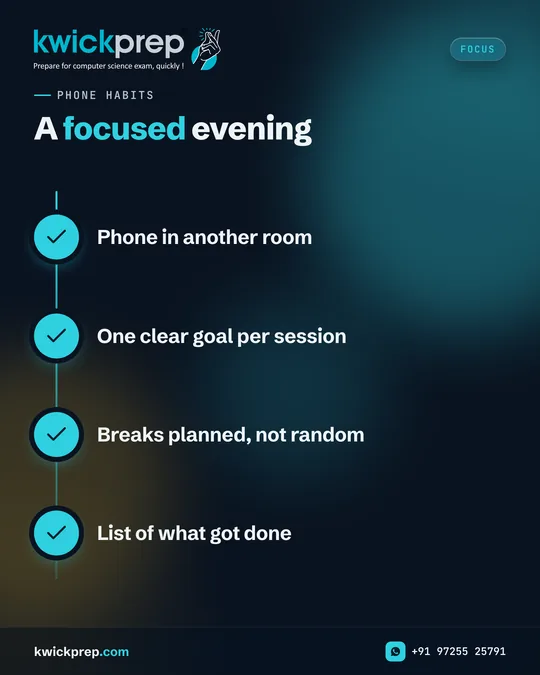
PHONE HABITS
A focused evening
- Phone in another room
- One clear goal per session
- Breaks planned, not random
- List of what got done
Two students, same evening, very different results.
The difference isn't intelligence. It's environment. A few simple rules around the phone turn scattered hours into productive ones.
Try this checklist tonight, and keep it going for a full week before you judge it.
Small, live online batches at Kwickprep keep you engaged and accountable, and recorded versions of classes let you revise without endless searching or scrolling.
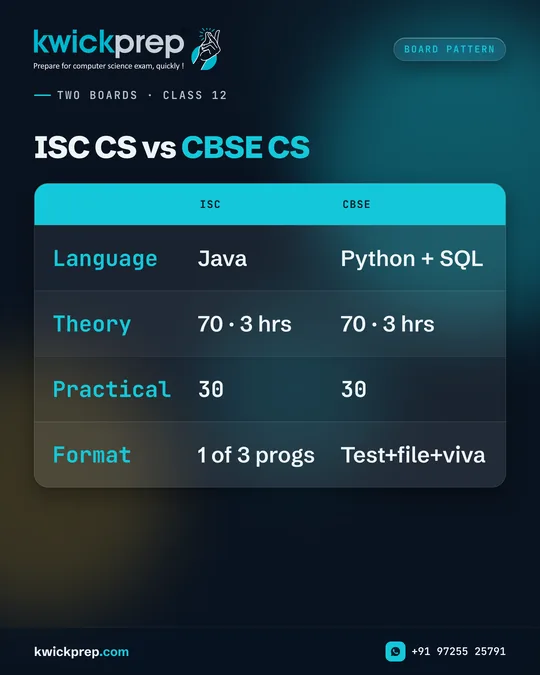
TWO BOARDS · CLASS 12
ISC CS vs CBSE CS
| ISC | CBSE | |
|---|---|---|
| Language | Java | Python + SQL |
| Theory | 70 · 3 hrs | 70 · 3 hrs |
| Practical | 30 | 30 |
| Format | 1 of 3 progs | Test+file+viva |
Two boards, same 70 + 30 shape, different languages and styles.
ISC students write Java for one of three problems in the practical. CBSE students write Python and SQL, supported by a file, project and viva.
Kwickprep teaches both, and Kajal Ma'am knows the details of each.
At Kwickprep, Kajal Ma'am maps every lesson to your board's exact pattern, so your study time goes where the marks are. Live online classes, small batches or one-to-one.
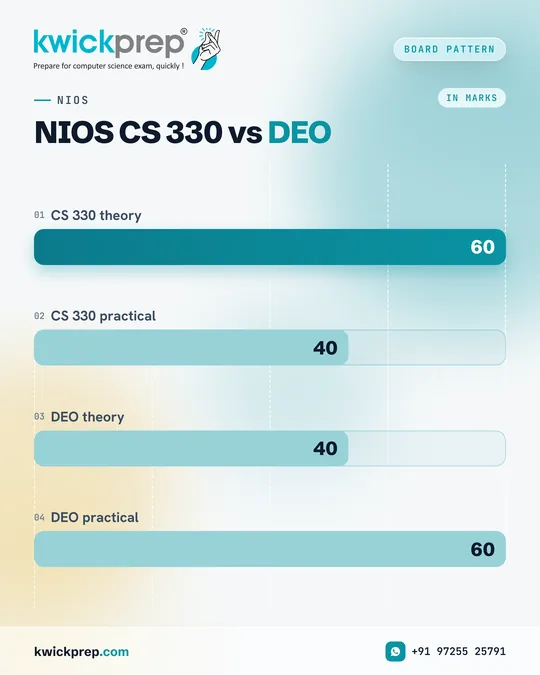
NIOS
NIOS CS 330 vs DEO
- CS 330 theory
- CS 330 practical
- DEO theory
- DEO practical
NIOS learners, your two computer options assess very differently.
CS 330 leans towards theory and C++ programming. Data Entry Operations leans towards practical skills in office tools. In both, the Tutor Marked Assignment plays a real part in your final result.
Choose the one that matches your goals, and prepare for its specific pattern.
At Kwickprep, Kajal Ma'am maps every lesson to your board's exact pattern, so your study time goes where the marks are. Live online classes, small batches or one-to-one.
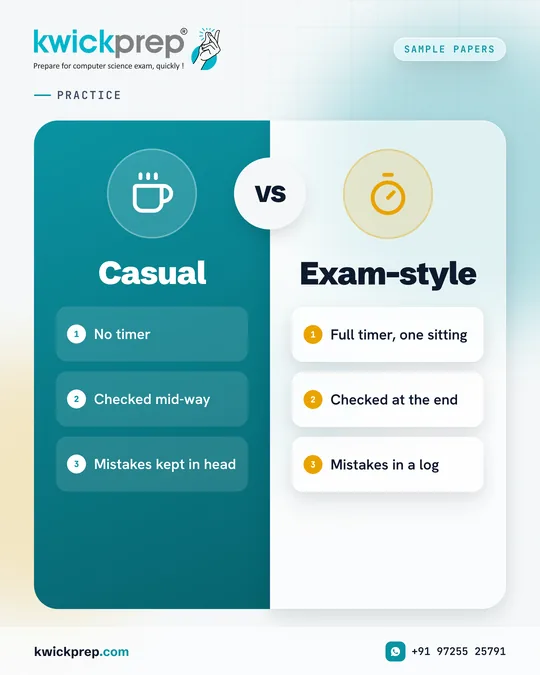
PRACTICE
Casual
- No timer
- Checked mid-way
- Mistakes kept in head
Exam-style
- Full timer, one sitting
- Checked at the end
- Mistakes in a log
Practice becomes powerful when it feels like the real exam.
Timed, uninterrupted papers build stamina and pacing. Written mistake logs turn each paper into a lesson.
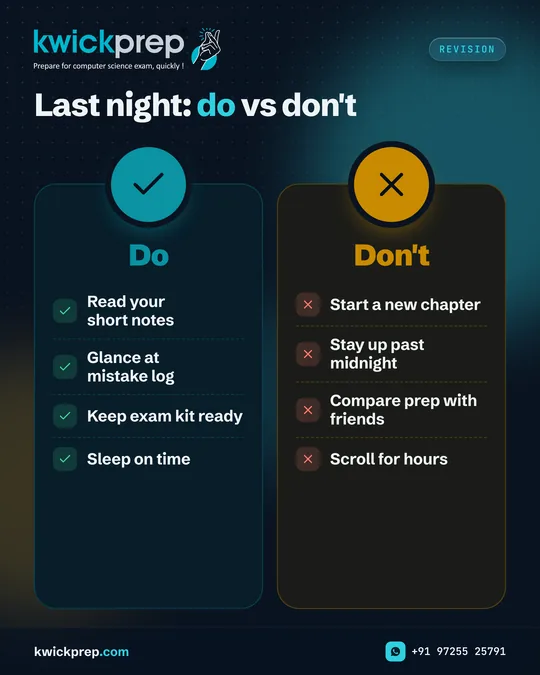
Revision
Last night: do vs don't
Do
- Read your short notes
- Glance at mistake log
- Keep exam kit ready
- Sleep on time
Don't
- Start a new chapter
- Stay up past midnight
- Compare prep with friends
- Scroll for hours
The night before an exam can add confidence or take it away.
What you do in these last hours shapes how clearly you think tomorrow. Keep it calm, familiar and short.
Save this for the night before your first paper.
Kwickprep students revise with KwickNotes and recorded classes, following a plan Kajal Ma'am builds around their board and their weak areas.
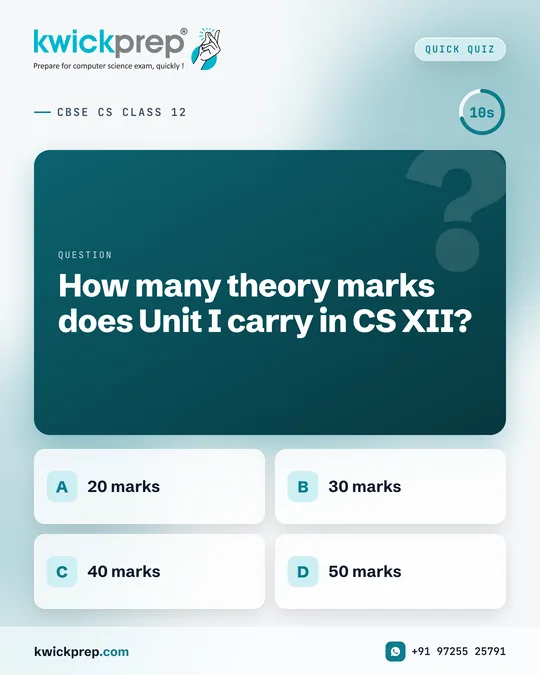
CBSE CS CLASS 12
How many theory marks does Unit I carry in CS XII?
- 20 marks
- 30 marks
- 40 marks
- 50 marks
Test yourself before scrolling down!
In CBSE CS Class 12, how many theory marks does Unit I (Programming-2) carry?
Answer: C) 40 marks
Unit I Computational Thinking and Programming-2 carries 40 of the 70 theory marks. Database Management carries 20 and Computer Networks 10.
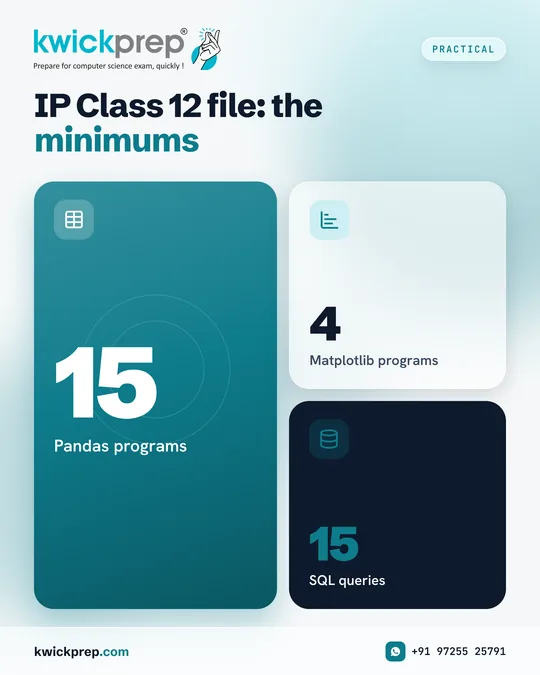
Practical
IP Class 12 file: the minimums
- Pandas programs
- Matplotlib programs
- SQL queries
Is your IP practical file on track? Check it against these minimums.
The IP Class 12 file needs at least 15 Pandas programs, 4 Matplotlib programs and 15 SQL queries.
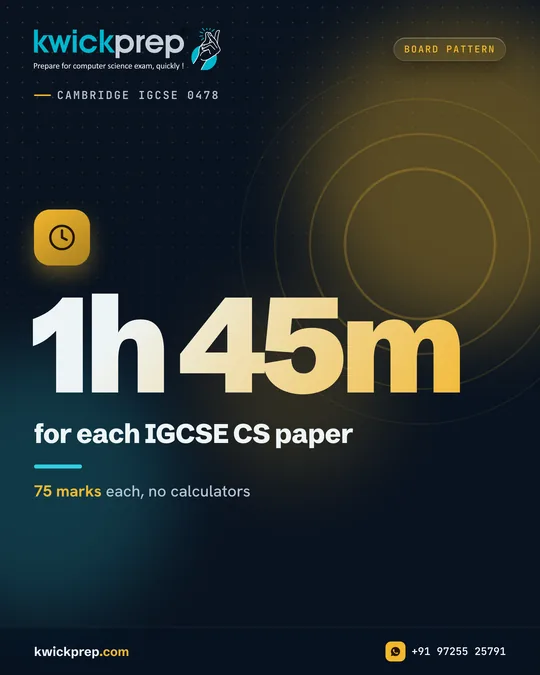
CAMBRIDGE IGCSE 0478
1h 45m for each IGCSE CS paper
75 marks each, no calculators
How long is each IGCSE Computer Science 0478 paper? The answer is on the image: 1 hour 45 minutes.
Both Paper 1 and Paper 2 are 1 hour 45 minutes, 75 marks each, worth 50% of the total. No calculators are allowed.
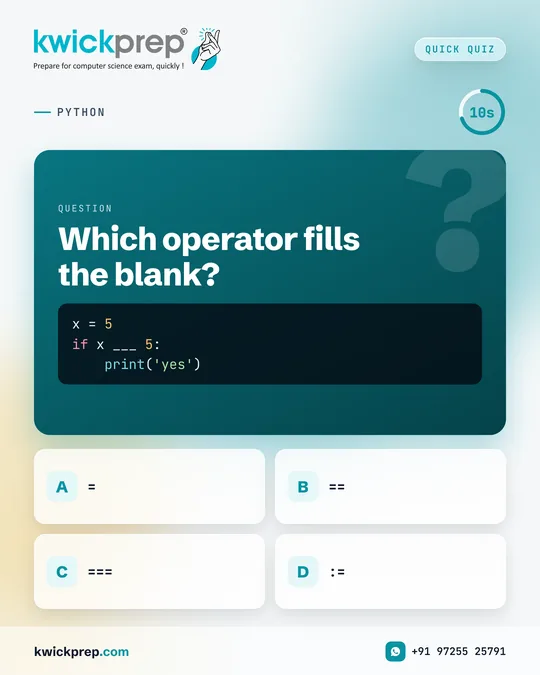
PYTHON
Which operator fills the blank?
- =
- ==
- ===
- :=
x = 5
if x ___ 5:
    print('yes')
Test yourself before scrolling down!
Which operator checks equality in a Python if condition?
Answer: B) ==
A single = assigns a value. == compares two values. Mixing them up is one of the most common silly mistakes in CS papers.
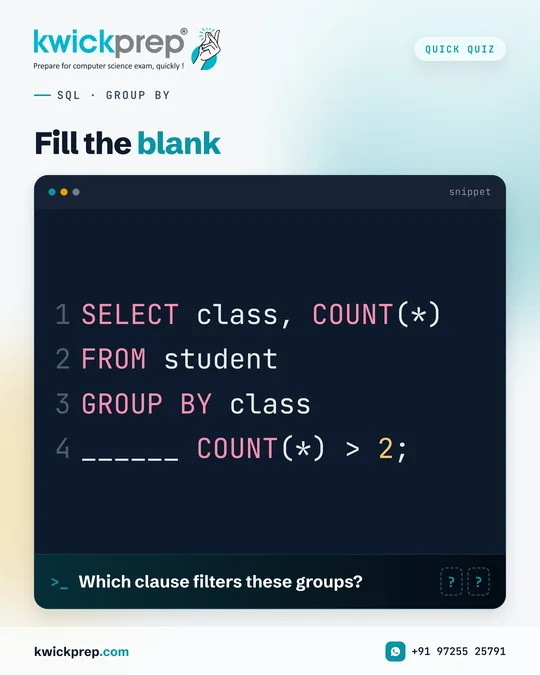
SQL · GROUP BY
Fill the blank
Which clause filters these groups?
SELECT class, COUNT(*)
FROM student
GROUP BY class
______ COUNT(*) > 2;
Test yourself before scrolling down!
Which clause filters groups after GROUP BY in SQL?
Answer: HAVING
WHERE filters rows before grouping; HAVING filters groups after GROUP BY. This is also a favourite viva question.
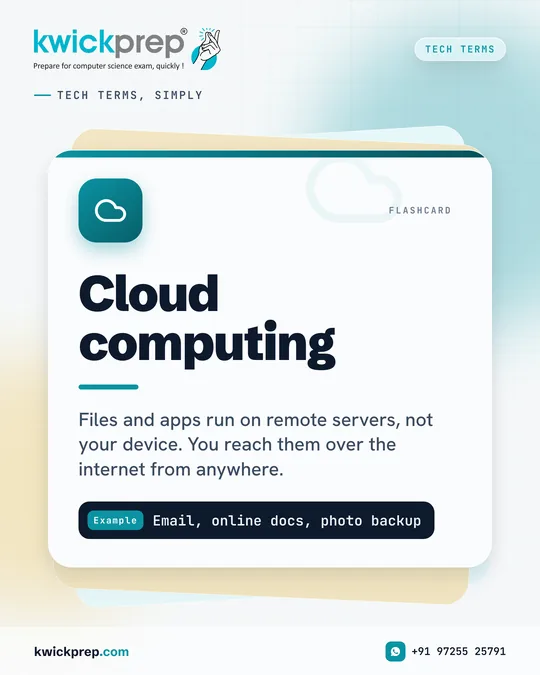
Tech terms, simply
- Cloud computing
- Files and apps run on remote servers, not your device. You reach them over the internet from anywhere.
ExampleEmail, online docs, photo backup
When people say something is 'in the cloud', they simply mean it is stored or running on someone else's computers, called servers, which you reach over the internet.
Email, online document editors and photo backups are everyday examples. You do not need to own powerful hardware; you use what you need and access it from any device.
For CS and IT students, cloud skills are increasingly useful because many modern apps are built and deployed this way. Knowing the basic idea is a great start.
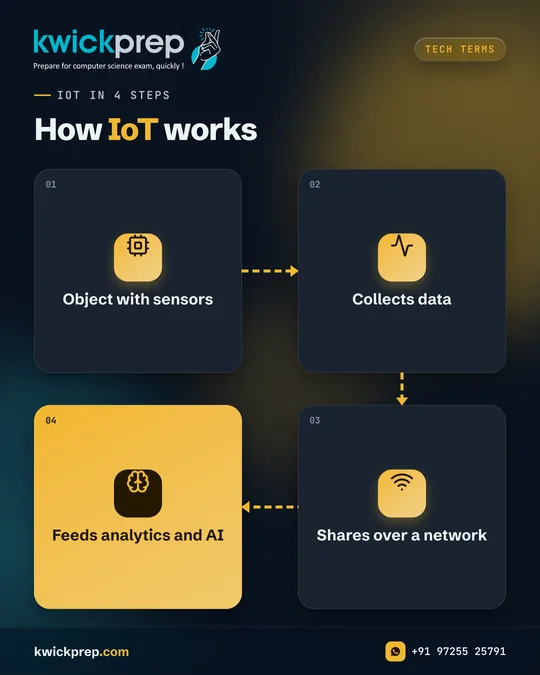
IoT in 4 steps
How IoT works
- Object with sensors
- Collects data
- Shares over a network
- Feeds analytics and AI
IoT stands for Internet of Things: everyday objects fitted with sensors and connected to the internet so they can collect and share data.
Think of a smart watch counting steps, a smart bulb you control from your phone, or sensors in farms that report soil moisture. Each device gathers data, sends it over a network, and something acts on it.
IoT links neatly with what you learn in school: sensors produce data, and data science and AI help make sense of it.
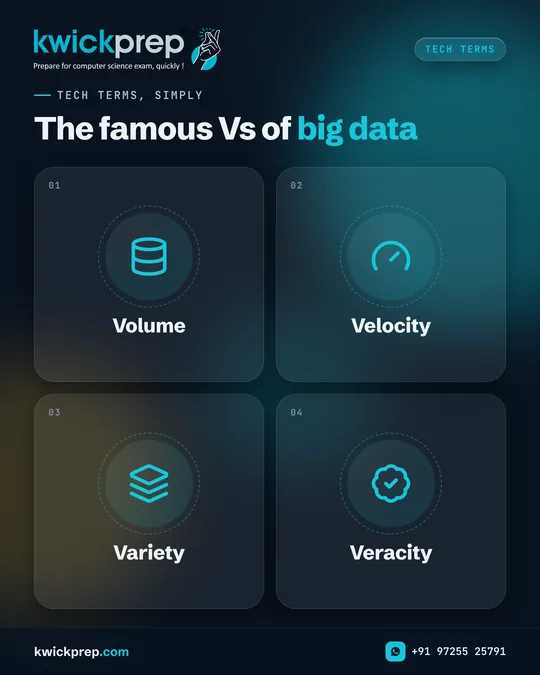
Tech terms, simply
The famous Vs of big data
- Volume
- Velocity
- Variety
- Veracity
Big data describes data sets so large, fast-moving or varied that ordinary tools struggle to handle them.
It is commonly described using Vs: Volume (how much data), Velocity (how fast it arrives), Variety (text, images, video, sensor readings) and Veracity (how trustworthy it is). You will meet big data in the CBSE Class 12 AI syllabus too.
Social media platforms, online shopping sites and weather systems all handle big data every second. Understanding it helps you see why data skills are so valued.
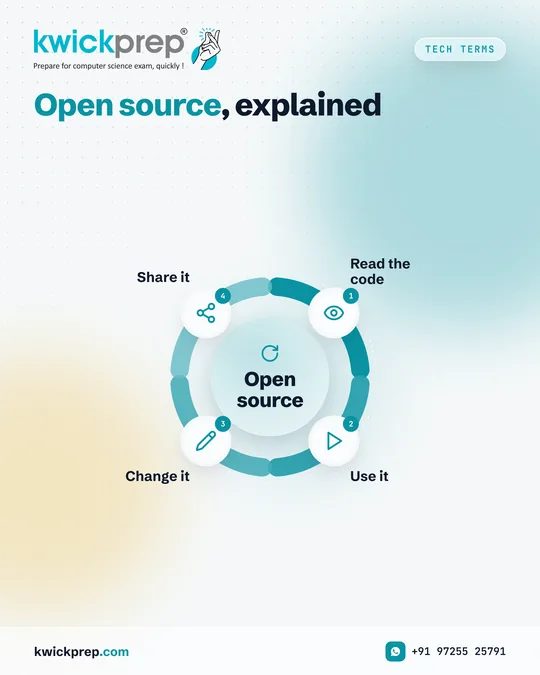
Tech Terms
Open source, explained
Open source
- Read the code
- Use it
- Change it
- Share it
Open source software is software whose source code is made publicly available, usually under a licence that lets anyone study, use, modify and share it.
You already use it: Python itself is open source, and so are Linux and many tools used in data science. Developers around the world contribute improvements, fix bugs and add features.
For students, open source is a wonderful classroom. You can read real code written by experienced programmers and, as your skills grow, even contribute small fixes of your own.
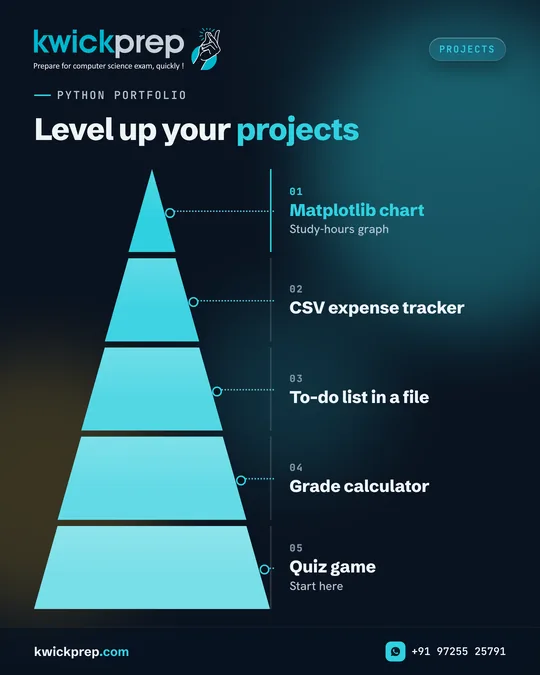
Python portfolio
Level up your projects
- Matplotlib chart
- CSV expense tracker
- To-do list in a file
- Grade calculator
- Quiz game
The best way to learn Python is to build something small and finish it.
Start with a quiz game that keeps score, a marks calculator that gives grades, or a to-do list that saves tasks to a file. As you grow, try a simple expense tracker using CSV files, or a chart of your own study hours using Matplotlib.
Each project teaches loops, conditions, functions and file handling in a way no worksheet can. Keep your code tidy and write a short note on what each project does.
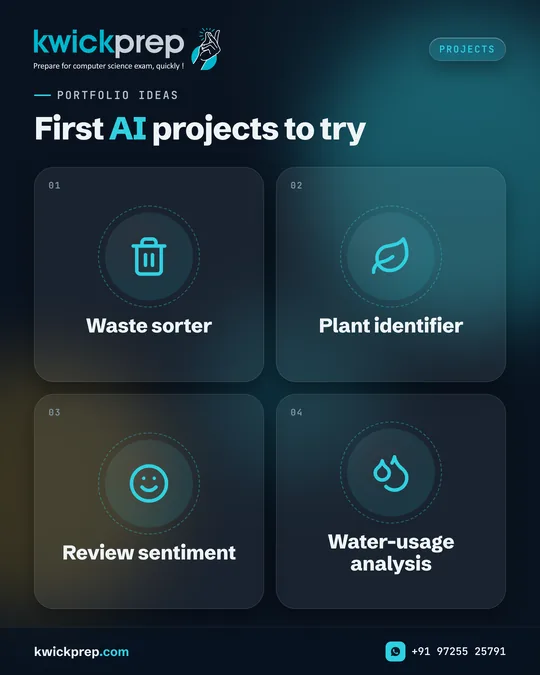
Portfolio ideas
First AI projects to try
- Waste sorter
- Plant identifier
- Review sentiment
- Water-usage analysis
You do not need expensive hardware to build your first AI project.
CBSE AI suggests friendly tools such as Teachable Machine and Machine Learning for Kids, where you can train an image or sound classifier in a browser. In Class 12 AI, Orange Data Mining lets you build models visually.
Pair the tool with a real problem, ideally linked to the Sustainable Development Goals: sorting waste, identifying plant leaves, or analysing water usage. Sorting product reviews into happy or unhappy (sentiment analysis) is a great NLP starter too. Scope the problem clearly first. That is the AI Project Cycle in action.
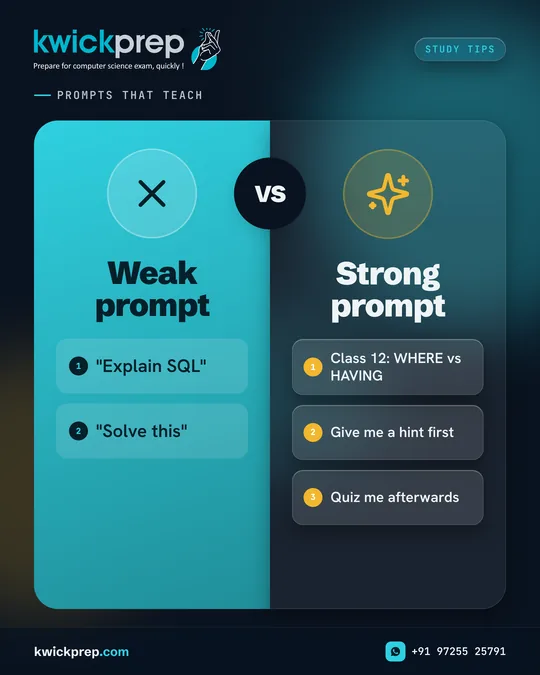
Prompts that teach
Weak prompt
- "Explain SQL"
- "Solve this"
Strong prompt
- Class 12: WHERE vs HAVING
- Give me a hint first
- Quiz me afterwards
The quality of an AI tool's answer depends heavily on the quality of your question.
Instead of 'explain SQL', try 'explain the difference between WHERE and HAVING in SQL with one small example suitable for Class 12'. Instead of 'solve this', try 'give me a hint for this problem, not the full answer'.
Good prompts give context, set the level and ask for learning rather than just answers. And remember to check the response against your textbook before relying on it.
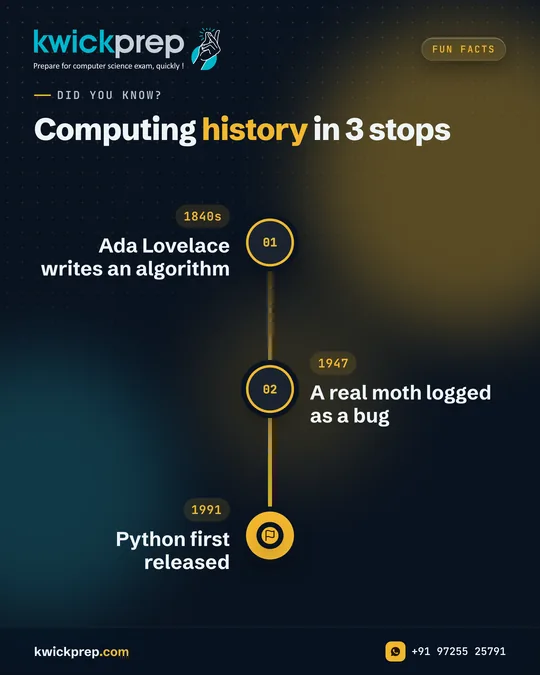
Did you know?
Computing history in 3 stops
- Ada Lovelace writes an algorithm
- A real moth logged as a bug
- Python first released
Computing has some wonderful stories behind everyday words.
Ada Lovelace wrote about an algorithm for Charles Babbage's proposed Analytical Engine in the 1840s, and is often called the first computer programmer. In 1947, engineers working on the Harvard Mark II found a real moth in the machine and taped it into their logbook as a 'bug'. And Python, first released in 1991, was named after the comedy group Monty Python, not the snake.
History makes the subject more human. Which fact surprised you most?
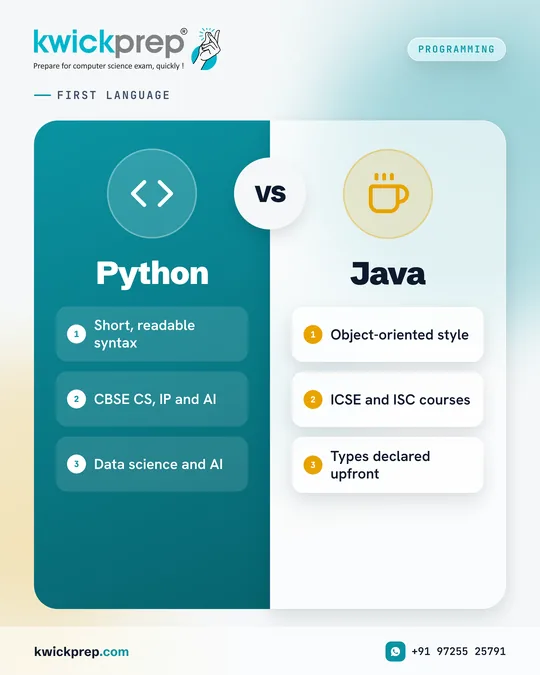
First language
Python
- Short, readable syntax
- CBSE CS, IP and AI
- Data science and AI
Java
- Object-oriented style
- ICSE and ISC courses
- Types declared upfront
Which should you learn first? It often depends on your board.
Python has clean, readable syntax, so beginners can focus on logic instead of punctuation. It is used in CBSE CS, IP and AI, and widely in data science.
Java is more structured and strictly object-oriented. It is the language of ICSE Computer Applications and ISC Computer Science, and teaches discipline around types and classes.
The good news: once you truly understand programming logic in one language, learning the second becomes much easier.
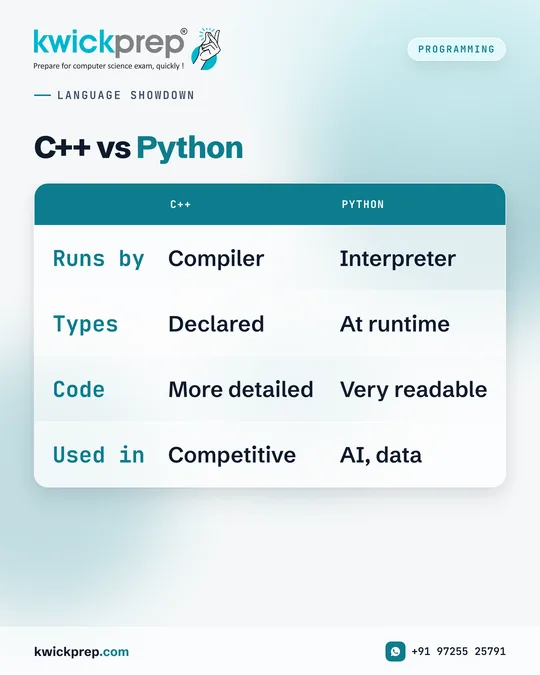
Language showdown
C++ vs Python
| C++ | Python | |
|---|---|---|
| Runs by | Compiler | Interpreter |
| Types | Declared | At runtime |
| Code | More detailed | Very readable |
| Used in | Competitive | AI, data |
C++ and Python are both powerful, but they feel very different to write.
C++ is compiled before running and usually runs very fast. You declare variable types and have closer control over memory, which is why it is used in games, systems software and competitive programming.
Python is interpreted, with dynamic typing and short, readable code. It is a favourite for data science, AI, automation and teaching.
Learning both over time gives you speed and simplicity in your toolkit.
Written by Kajal Mehta (Kajal Ma'am), MCA, teaching computer subjects since 2004. All KwickCards