

KwickCards Exams and revision
Exams and revision: 151 revision cards
Every card below is written out in full underneath its picture, so you can read it, search it and copy from it. Free, no sign-up.
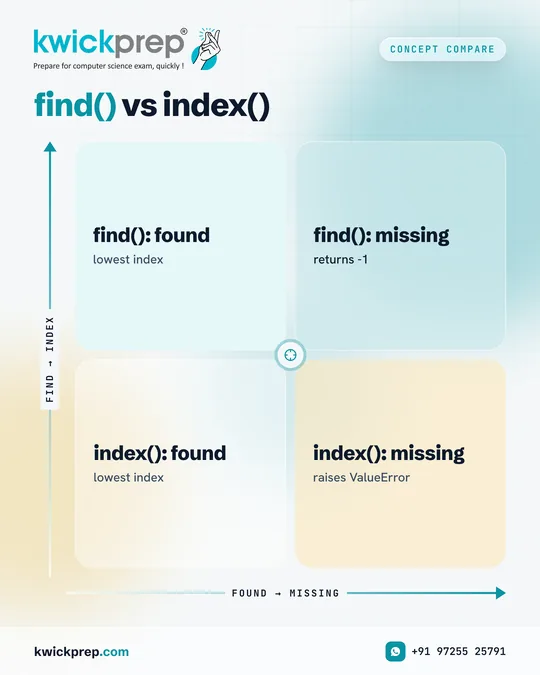
Concept Compare
find() vs index()
- find(): found
- find(): missing
- index(): found
- index(): missing
Same job when the item exists. Very different when it does not.
Both methods search from the left and return the first position. The difference appears when the substring is missing: find() calmly returns -1, while index() stops the program with ValueError. Lists and tuples have index() but no find(). Questions often ask for the output of 'python'.find('z'), which is -1.
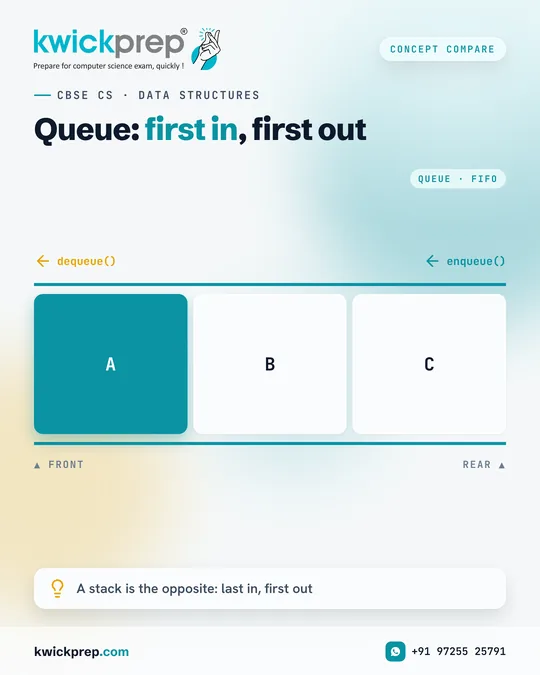
CBSE CS · DATA STRUCTURES
Queue: first in, first out
- A
- B
- C
A stack is the opposite: last in, first out
A queue serves items in the order they arrived.
A is enqueued first, so A is dequeued first: that is FIFO, like a line at a ticket counter. New items join at the rear. A stack works the opposite way. In Class 12 CS, the stack is implemented with a Python list using append() for push and pop() for pop, with an empty check that prints 'Underflow'. Knowing both helps you write sharper definitions in theory answers.
Save this post for revision and share it with a classmate preparing for the same exam.
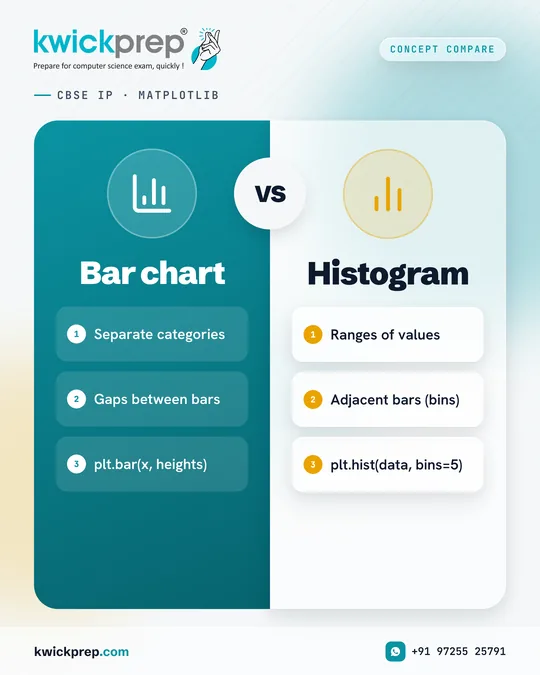
CBSE IP · MATPLOTLIB
Bar chart
- Separate categories
- Gaps between bars
- plt.bar(x, heights)
Histogram
- Ranges of values
- Adjacent bars (bins)
- plt.hist(data, bins=5)
They look similar, but they answer different questions.
A bar chart compares distinct categories, such as sales per month or marks per subject. A histogram groups continuous numeric data into ranges and shows how often values fall in each range. In Matplotlib, bar() needs both x values and heights, while hist() needs only the data and optionally the bins. Expect this in case-based questions.
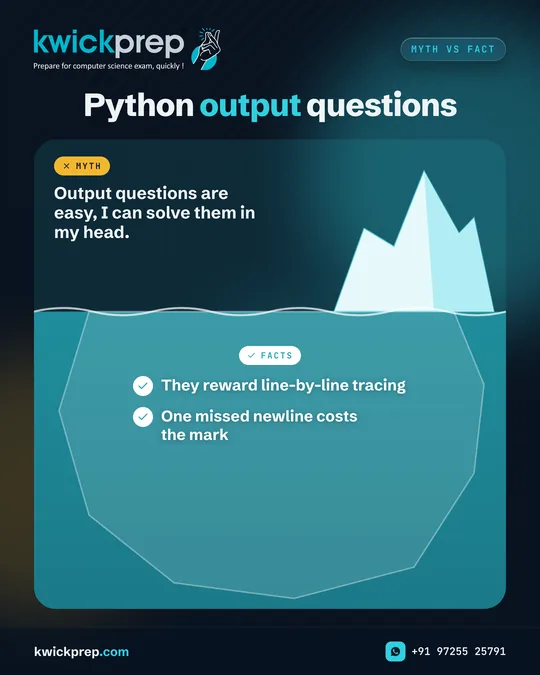
Myth vs Fact
Python output questions
- They reward line-by-line tracing
- One missed newline costs the mark
Myth: Output questions are easy, I can solve them in my head.
Easy-looking questions are where confident students lose marks.
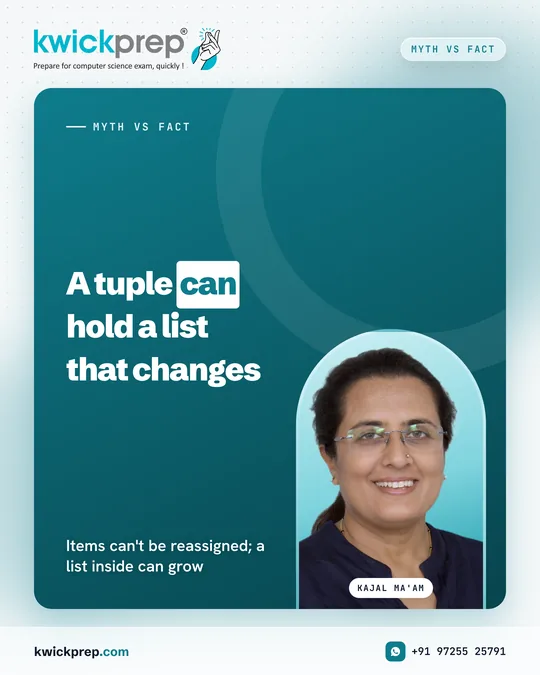
MYTH VS FACT
Items can't be reassigned; a list inside can grow
A tuple can hold a list that changes
Immutability is about the tuple's references, not everything inside.
t = (1, [2, 3]); t[1].append(4) works, and t becomes (1, [2, 3, 4]). But t[1] = [9] raises TypeError. The tuple still holds the same list object; only that list's contents changed. This detail shows deep understanding and helps in tricky objective questions. It is also why such a tuple cannot be used as a dictionary key.
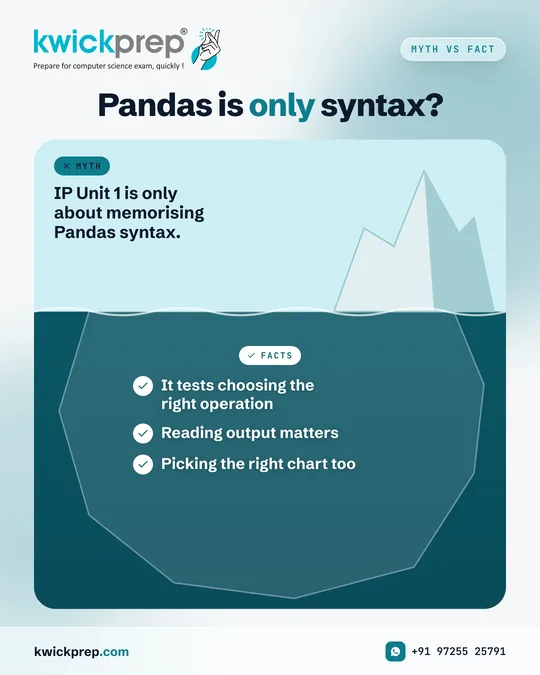
Myth vs Fact
Pandas is only syntax?
- It tests choosing the right operation
- Reading output matters
- Picking the right chart too
Myth: IP Unit 1 is only about memorising Pandas syntax.
Syntax alone will not carry you through case-based questions.
Class 12 IP questions often describe a dataset and ask what a statement returns, or which function suits a task. Knowing why loc includes the end label, why drop() needs assigning back, or why a histogram fits marks distribution is what earns marks. Practise explaining your code in one line, not just writing it.
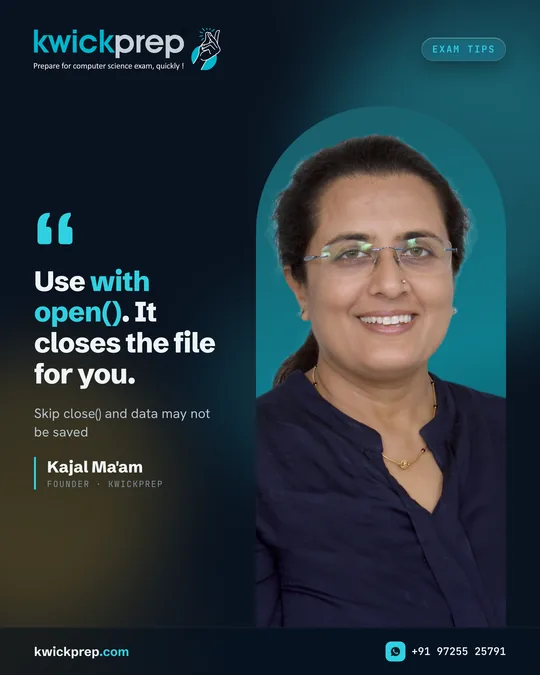
Exam Tips
Skip close() and data may not be saved
Use with open(). It closes the file for you.
A small habit that protects your data and your marks.
Data written to a file is often buffered and fully saved only when the file is closed or flushed. In exam answers, examiners look for either f.close() or a with block. The with statement is the cleaner choice because it closes the file even if an error occurs. Make it your default in every file handling program.
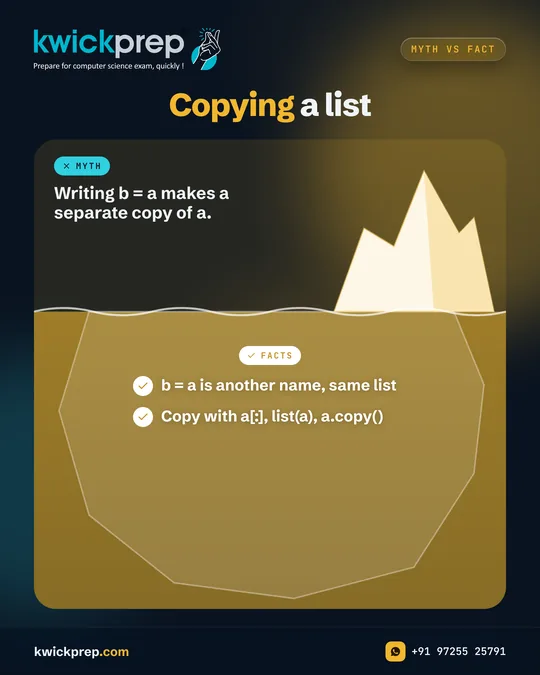
Myth vs Fact
Copying a list
- b = a is another name, same list
- Copy with a[:], list(a), a.copy()
Myth: Writing b = a makes a separate copy of a.
This one misunderstanding causes many wrong outputs.
With b = a, both names refer to the same object, so a change through one appears in the other. Slicing a[:], list(a) and a.copy() create a new shallow copy. Check with the is operator: b is a returns True for aliasing and False after copying. Nested lists need extra care, but for Class 11 and 12 the shallow copy idea is key.
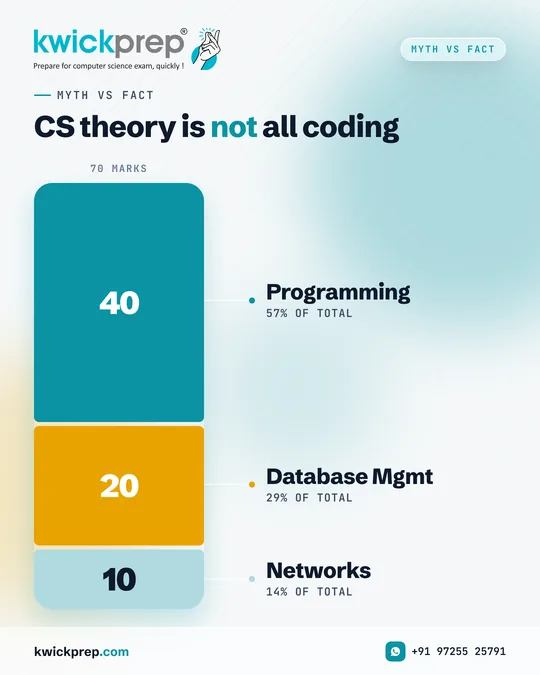
MYTH VS FACT
CS theory is not all coding
- Programming
- Database Mgmt
- Networks
Programming is the biggest unit, but it is not the whole paper.
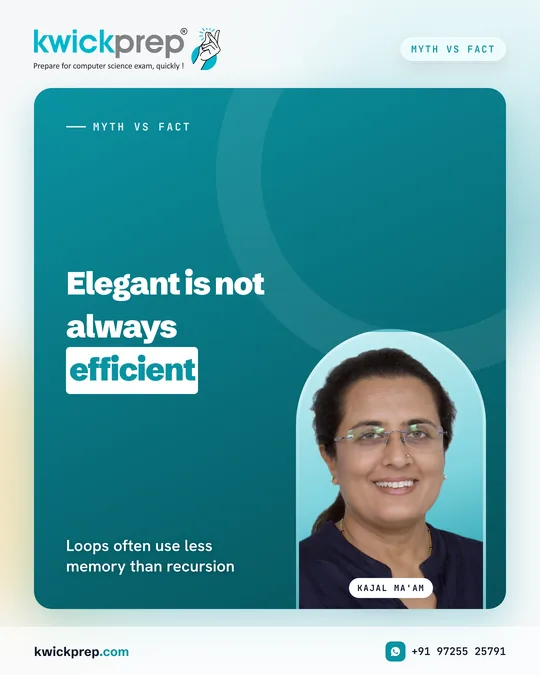
MYTH VS FACT
Loops often use less memory than recursion
Elegant is not always efficient
Elegant is not automatically efficient.
Every recursive call adds a new frame to the call stack, and very deep recursion raises RecursionError in Python. Loops avoid that overhead. Recursion shines for naturally self-similar problems and makes code short and readable. For exams, be able to write factorial or sum of digits both ways and explain the base case clearly.
Save this post for revision and share it with a classmate preparing for the same exam.
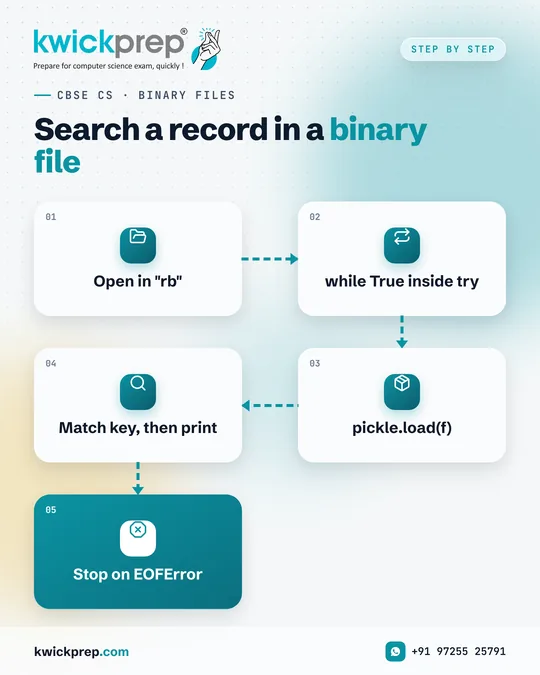
CBSE CS · BINARY FILES
Search a record in a binary file
- Open in "rb"
- while True inside try
- pickle.load(f)
- Match key, then print
- Stop on EOFError
A 3 to 5 mark program, broken into five clear steps.
Searching records stored with pickle follows the same structure every time. Keep a found flag set to False before the loop and make it True on a match, then print 'Record not found' after the loop if it is still False. Once this skeleton is in your hands, updating and counting records are small variations of it.
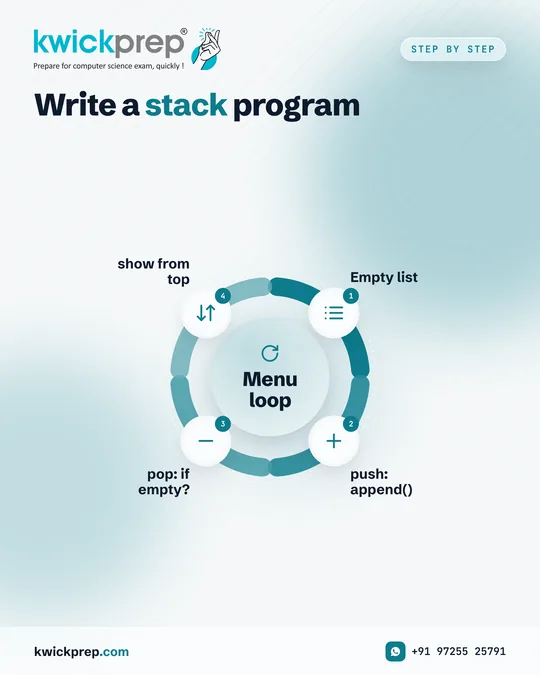
Step by Step
Write a stack program
Menu loop
- Empty list
- push: append()
- pop: if empty?
- show from top
Stack questions follow a pattern. Learn the pattern once.
Board questions often give a scenario, such as pushing records that meet a condition, and ask for push and pop functions. Keep function names and parameters exactly as the question states. In pop, check if the stack is empty and print a message like 'Stack Empty' instead of letting Python raise an error. Display from the last element to the first.
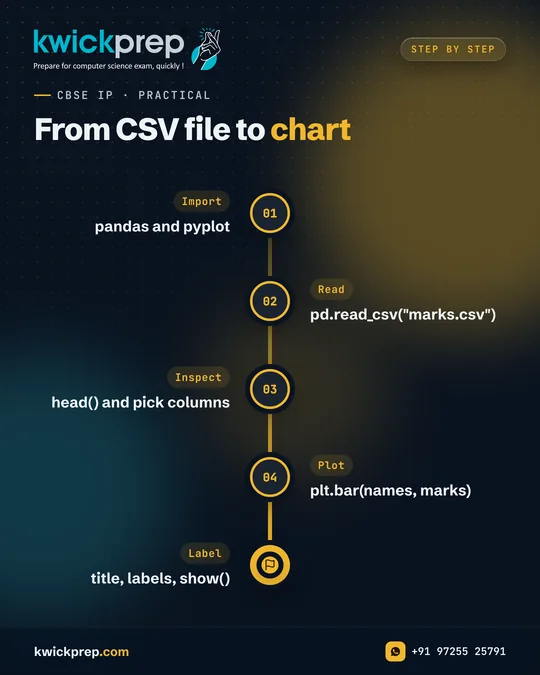
CBSE IP · PRACTICAL
From CSV file to chart
- pandas and pyplot
- pd.read_csv("marks.csv")
- head() and pick columns
- plt.bar(names, marks)
- title, labels, show()
A complete mini-workflow that mirrors IP practical tasks.
Real data analysis in Class 12 IP moves in this order: import, read, inspect, select, visualise. Practising the whole flow on one small CSV file connects Pandas and Matplotlib in your mind instead of treating them as separate chapters. It also makes a good base for your IP project work.
Save this post for revision and share it with a classmate preparing for the same exam.
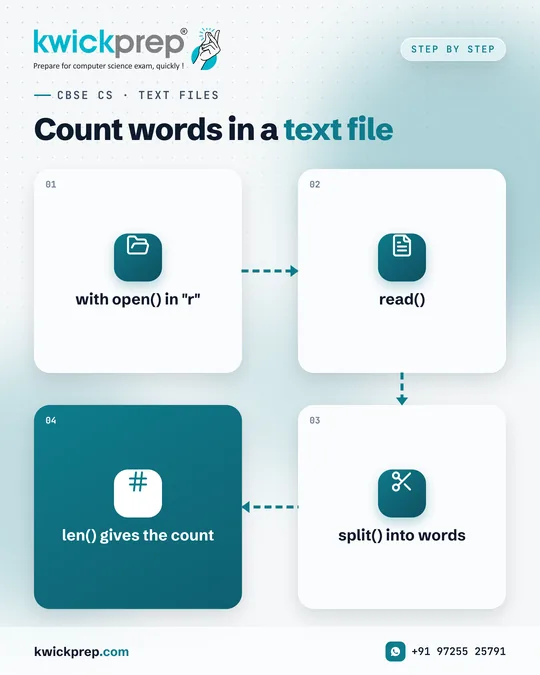
CBSE CS · TEXT FILES
Count words in a text file
- with open() in "r"
- read()
- split() into words
- len() gives the count
Counting questions are a staple of text file handling.
Variations include counting lines starting with a letter, words of a given length, or occurrences of 'the'. The steps stay the same; only the condition inside the loop changes. Use readlines() when the question is about lines, and read().split() when it is about words. Remember to compare in lowercase when case should not matter.
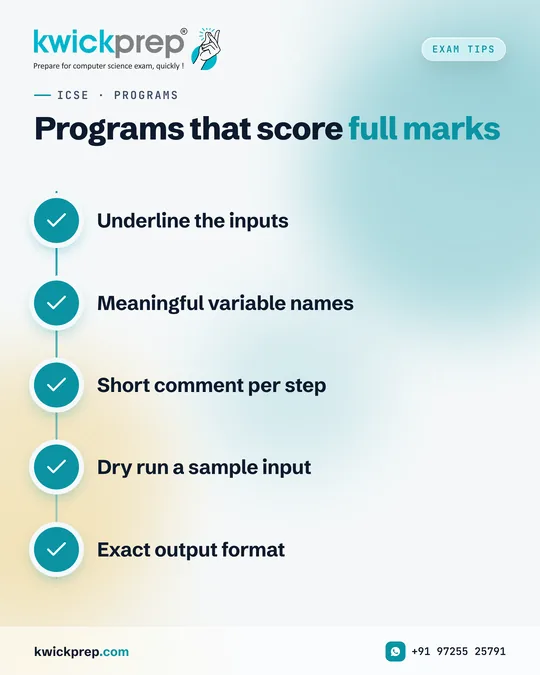
ICSE · PROGRAMS
Programs that score full marks
- Underline the inputs
- Meaningful variable names
- Short comment per step
- Dry run a sample input
- Exact output format
Correct logic is only part of the marks. Presentation matters too.
In ICSE Computer Applications, examiners look for clear, readable programs. Meaningful names like sum and count, short comments, and proper indentation make your logic easy to follow.
Always dry run your program with one sample input. It catches most off-by-one errors in loops.
Kajal Ma'am trains students on exactly this, program by program, with KwickAssignment practice sets.
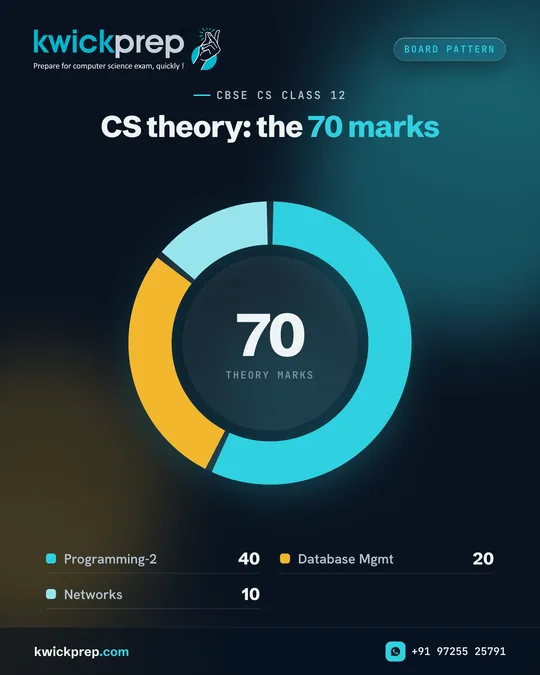
CBSE CS CLASS 12
CS theory: the 70 marks
70 theory marks
- Programming-2
- Database Mgmt
- Networks
Before you plan revision, know where the marks live.
In CBSE Computer Science Class 12, Unit I (Python programming) alone carries 40 of the 70 theory marks. Database Management brings 20 and Computer Networks 10. That tells you where daily practice must go: code first, SQL next, networks as steady scoring.
Print this split and keep it on your desk. Every week, ask yourself: did my study hours match the weightage?
At Kwickprep, Kajal Ma'am maps every lesson to your board's exact pattern, so your study time goes where the marks are. Live online classes, small batches or one-to-one.
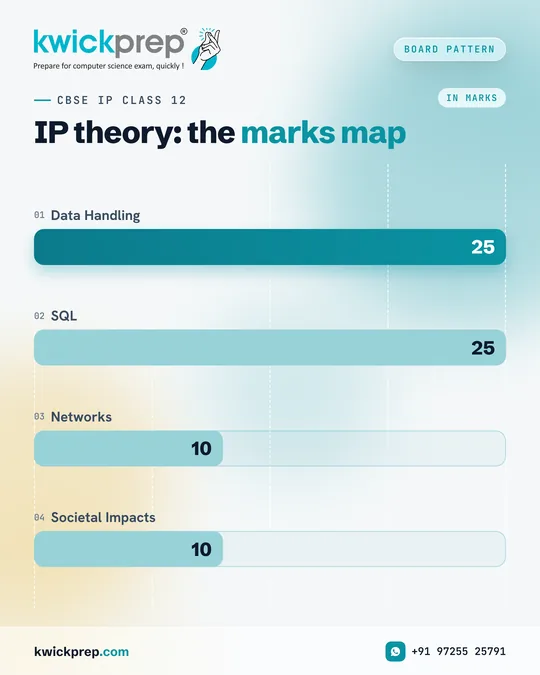
CBSE IP CLASS 12
IP theory: the marks map
- Data Handling
- SQL
- Networks
- Societal Impacts
IP students, here is your scoring map, based on the 2025-26 CBSE syllabus.
Data Handling and SQL together carry 50 of the 70 theory marks. If Pandas and SQL queries feel natural to you, most of the paper is already in your hands. Networks and Societal Impacts are shorter chapters that reward clean, precise definitions.
Plan your weeks around this map, not around which chapter feels easiest.
At Kwickprep, Kajal Ma'am maps every lesson to your board's exact pattern, so your study time goes where the marks are. Live online classes, small batches or one-to-one.
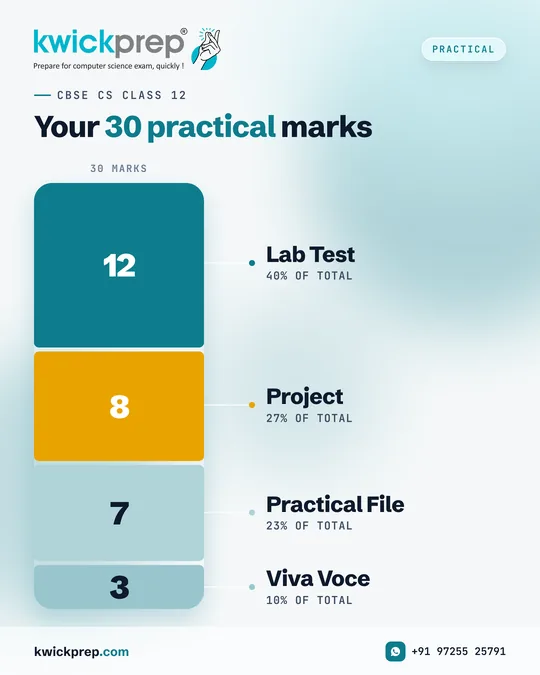
CBSE CS CLASS 12
Your 30 practical marks
- Lab Test
- Project
- Practical File
- Viva Voce
Thirty marks are decided before you even sit the theory paper.
CBSE CS Class 12 practicals give 12 marks to the lab test, 7 to your practical file, 8 to the project and 3 to viva. The file needs a minimum of 15 Python programs plus SQL query sets, and the project is Python-SQL based.
Start the file now, one program at a time, and March will feel calm instead of rushed.
In Kwickprep's live online batches, Kajal Ma'am personally guides your practical file, project and viva, so nothing is left for the final weeks before the exam.
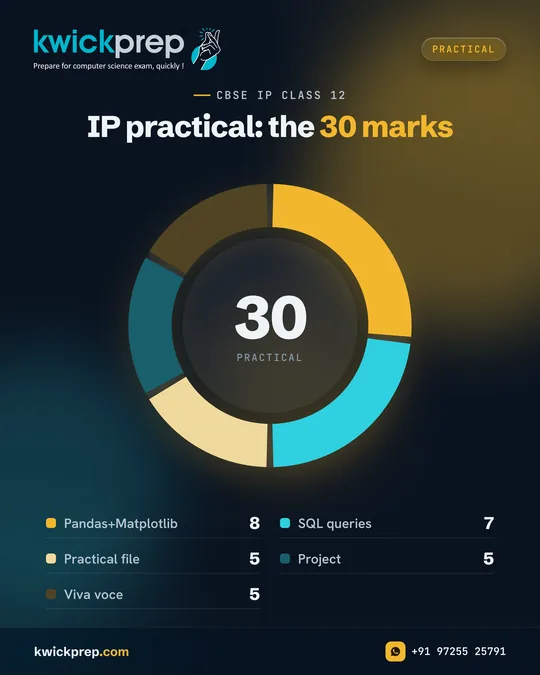
CBSE IP CLASS 12
IP practical: the 30 marks
30 practical
- Pandas+Matplotlib
- SQL queries
- Practical file
- Project
- Viva voce
Your IP practical is not a formality. It is 30 marks.
The file needs at least 15 Pandas programs, 4 Matplotlib programs and 15 SQL queries. The project can be individual or a 2-3 member group, analysing real-world data with Python libraries and charts.
Practise every program by typing it yourself. In the lab test, fingers that have typed df.groupby() before move much faster.
In Kwickprep's live online batches, Kajal Ma'am personally guides your practical file, project and viva, so nothing is left for the final weeks before the exam.
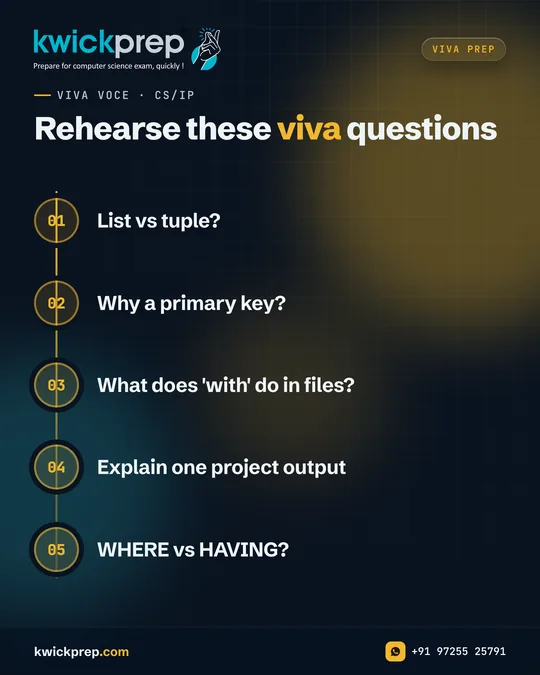
VIVA VOCE · CS/IP
Rehearse these viva questions
- List vs tuple?
- Why a primary key?
- What does 'with' do in files?
- Explain one project output
- WHERE vs HAVING?
Viva is where confident students quietly collect full marks.
Examiners usually ask from your own file and project. So the best preparation is simple: open your practical file, pick any program, and explain it aloud in two sentences. Then do the same for your project's main screen or output.
Practise these five questions with a friend this week. Speak, don't memorise.
Kwickprep students rehearse viva questions in class with Kajal Ma'am, speaking answers aloud until explaining their own work feels natural and calm.
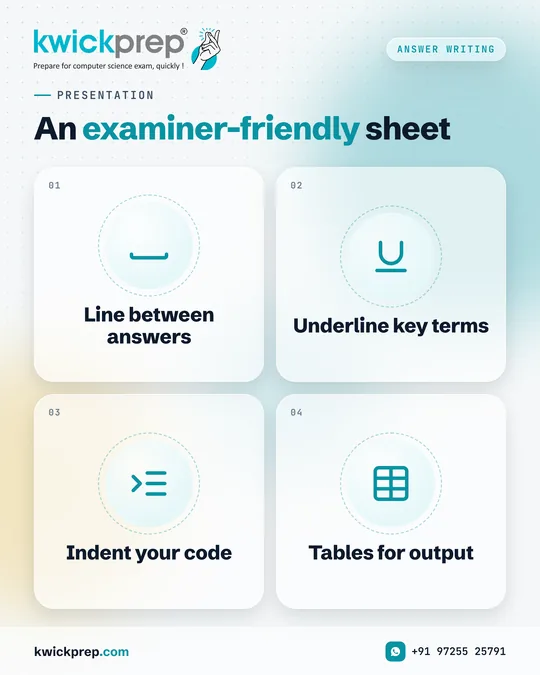
PRESENTATION
An examiner-friendly sheet
- Line between answers
- Underline key terms
- Indent your code
- Tables for output
Examiners read hundreds of copies. Make yours easy to mark.
A correct answer buried in a messy page can lose marks it deserves. Clean spacing, underlined keywords and indented code show that you understand, not just remember.
From your next sample paper, practise presentation along with content. It becomes a habit within a few weeks.
Kajal Ma'am reviews answer presentation in Kwickprep's small batches, so good habits are corrected early and carried confidently into the board exam hall.
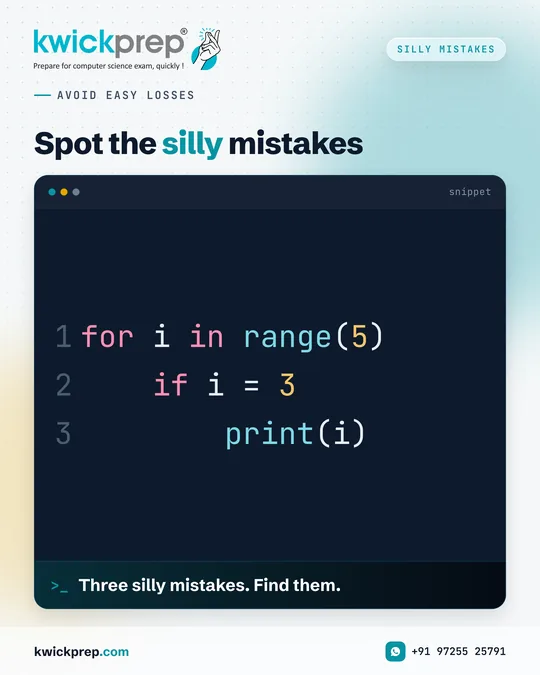
AVOID EASY LOSSES
Spot the silly mistakes
Three silly mistakes. Find them.
for i in range(5)
    if i = 3
        print(i)
Most lost marks in Computer Science are not from hard questions.
They slip away in tiny things: a missing colon, a wrong operator, an unclosed quote. The good news is that silly mistakes are a habit, and habits can be changed.
After every test, make a 'my mistakes' list. Read it before the next paper. Watch how quickly it shrinks.
In Kwickprep classes, common slips are pointed out the moment they happen, so they are fixed long before the board paper instead of repeated in it.
Answer: three mistakes. A missing colon after range(5), a missing colon after the if, and = instead of == in the condition.
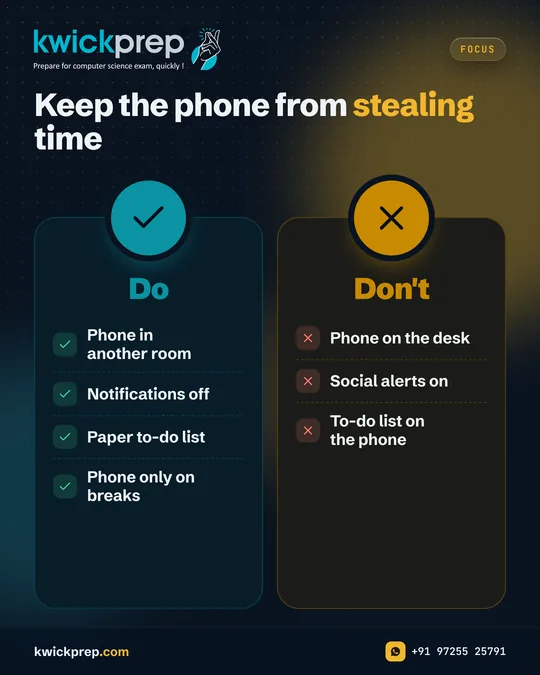
Focus
Keep the phone from stealing time
Do
- Phone in another room
- Notifications off
- Paper to-do list
- Phone only on breaks
Don't
- Phone on the desk
- Social alerts on
- To-do list on the phone
Your phone is built to catch your attention. Your study plan needs that attention more.
You don't need to quit your phone. You need boundaries. A simple rule like 'phone in another room for 45 minutes' can double what you finish in an evening.
Try it for seven days and notice how much more your revision covers.
Small, live online batches at Kwickprep keep you engaged and accountable, and recorded versions of classes let you revise without endless searching or scrolling.
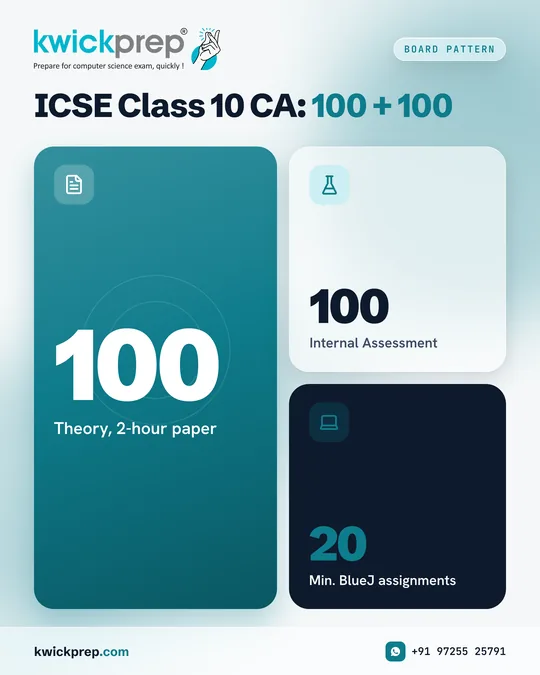
Board Pattern
ICSE Class 10 CA: 100 + 100
- Theory, 2-hour paper
- Internal Assessment
- Min. BlueJ assignments
ICSE Computer Applications students, your year has two equally important halves.
The theory paper is 2 hours for 100 marks. Internal Assessment is another 100 marks, judged half by your teacher and half by a visiting external examiner, based on at least 20 lab assignments.
Keep every assignment documented with variable descriptions and output. That record carries real marks.
At Kwickprep, Kajal Ma'am maps every lesson to your board's exact pattern, so your study time goes where the marks are. Live online classes, small batches or one-to-one.
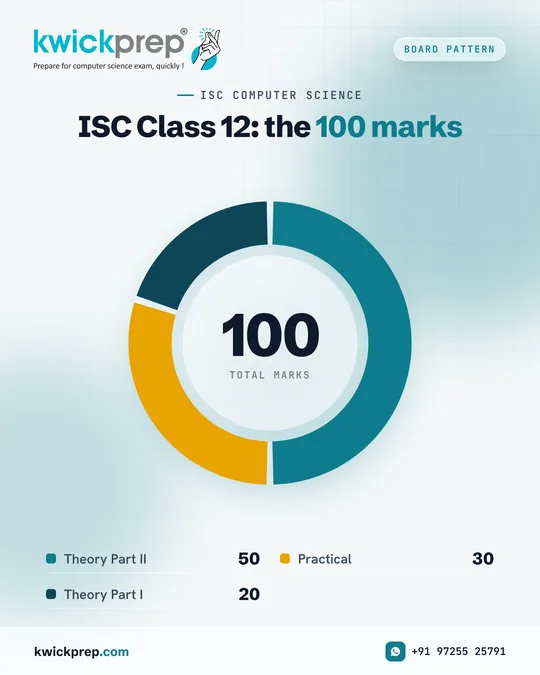
ISC COMPUTER SCIENCE
ISC Class 12: the 100 marks
100 total marks
- Theory Part II
- Practical
- Theory Part I
ISC Computer Science rewards students who know the paper's shape.
Part I is compulsory and covers the whole syllabus, so no chapter can be skipped. Part II lets you choose within sections. In the practical, you write a working Java program for one of three given problems, checked by a visiting examiner.
Practise choosing quickly: read all three problems, pick the one you can fully test.
At Kwickprep, Kajal Ma'am maps every lesson to your board's exact pattern, so your study time goes where the marks are. Live online classes, small batches or one-to-one.
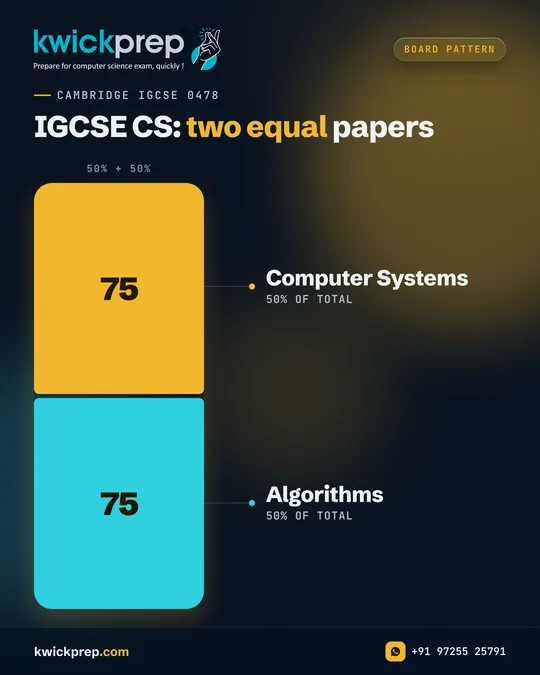
CAMBRIDGE IGCSE 0478
IGCSE CS: two equal papers
- Computer Systems
- Algorithms
IGCSE Computer Science has no coursework, so both papers matter fully.
Paper 1 covers Topics 1-6, Paper 2 covers Topics 7-10 with a 15-mark scenario question you can answer in pseudocode or your chosen language. No calculators are allowed.
Build your Paper 2 strength by writing real programs every week. Scenario questions reward students who have actually coded.
At Kwickprep, Kajal Ma'am maps every lesson to your board's exact pattern, so your study time goes where the marks are. Live online classes, small batches or one-to-one.
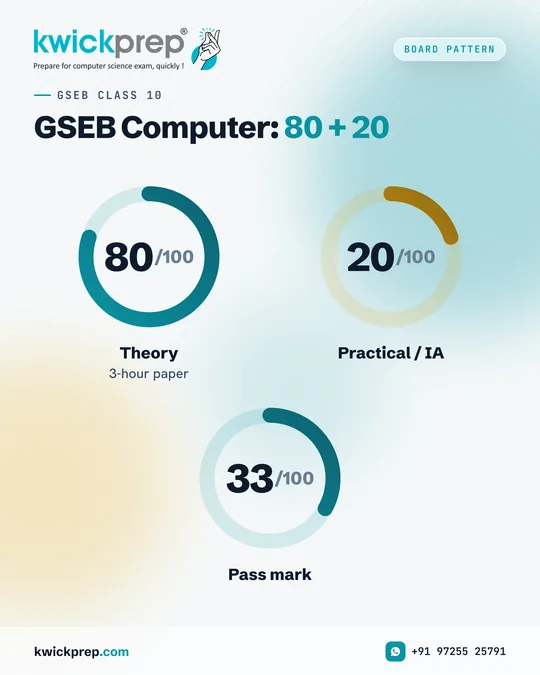
GSEB CLASS 10
GSEB Computer: 80 + 20
- Theory
- Practical / IA
- Pass mark
GSEB students, here is your Class 10 Computer paper at a glance.
The 80-mark theory paper mixes objective and descriptive questions, and practical work covers HTML pages, Calc spreadsheets and small C programs. Always check the latest GSEB SSC blueprint for the year, since weightage can be updated.
Practise both kinds of question: quick MCQs for speed, written answers for depth.
At Kwickprep, Kajal Ma'am maps every lesson to your board's exact pattern, so your study time goes where the marks are. Live online classes, small batches or one-to-one.
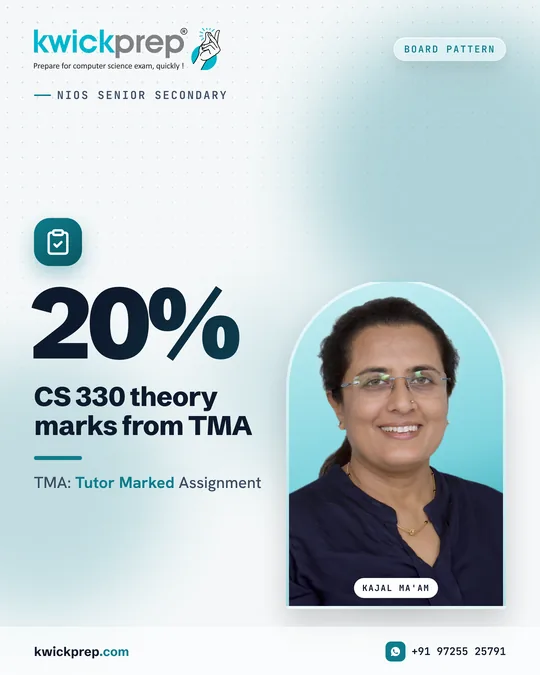
NIOS SENIOR SECONDARY
20% CS 330 theory marks from TMA
TMA: Tutor Marked Assignment
NIOS learners, your Tutor Marked Assignment is not extra homework. It counts.
For Computer Science 330, TMA is 20% of theory marks. In Senior Secondary Data Entry Operations, the public exam covers 60% of lessons while TMA carries 40% weightage for the rest.
Treat each TMA like a mini exam: read the lesson, answer neatly, submit before the deadline.
At Kwickprep, Kajal Ma'am maps every lesson to your board's exact pattern, so your study time goes where the marks are. Live online classes, small batches or one-to-one.
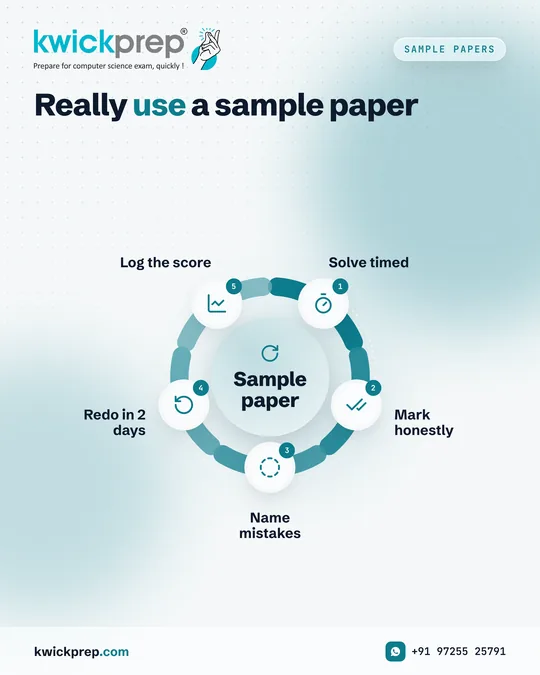
Sample Papers
Really use a sample paper
Sample paper
- Solve timed
- Mark honestly
- Name mistakes
- Redo in 2 days
- Log the score
Solving sample papers is good. Learning from them is better.
Many students finish a paper, check the score, and move on. The real value is in the review: why did I lose that mark, and will it happen again?
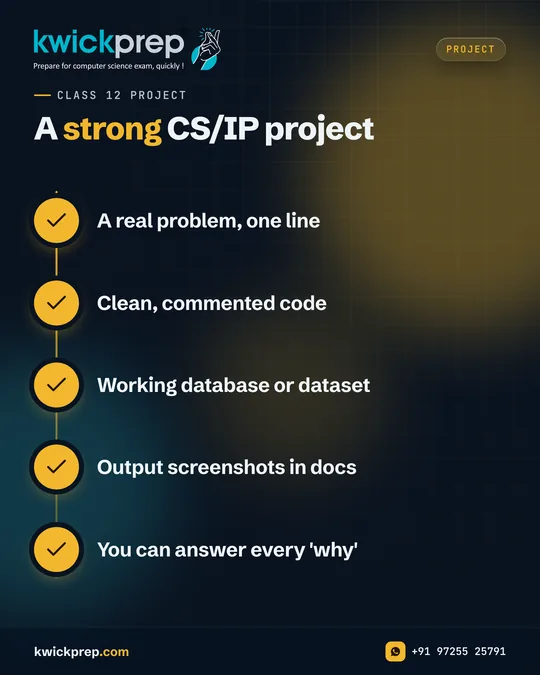
CLASS 12 PROJECT
A strong CS/IP project
- A real problem, one line
- Clean, commented code
- Working database or dataset
- Output screenshots in docs
- You can answer every 'why'
A good project is not the biggest one. It is the one you truly understand.
Examiners value a working, well-documented project that you can explain confidently in viva. Borrowed complexity usually shows up the moment questions begin.
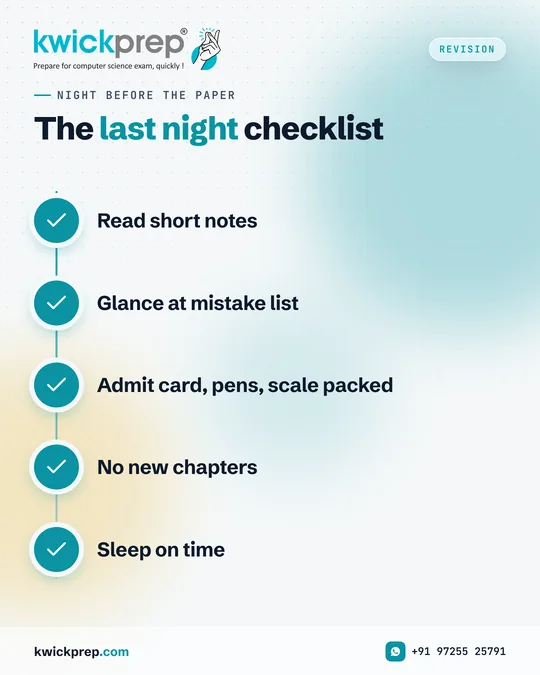
NIGHT BEFORE THE PAPER
The last night checklist
- Read short notes
- Glance at mistake list
- Admit card, pens, scale packed
- No new chapters
- Sleep on time
The night before the paper is for calm, not panic.
This is not the time to open a chapter you never studied. It is the time to strengthen what you already know and prepare your mind to perform.
Lay out your exam kit, read your short notes, and go to bed early. Tomorrow's version of you will thank you.
Kwickprep students revise with KwickNotes and recorded classes, following a plan Kajal Ma'am builds around their board and their weak areas.
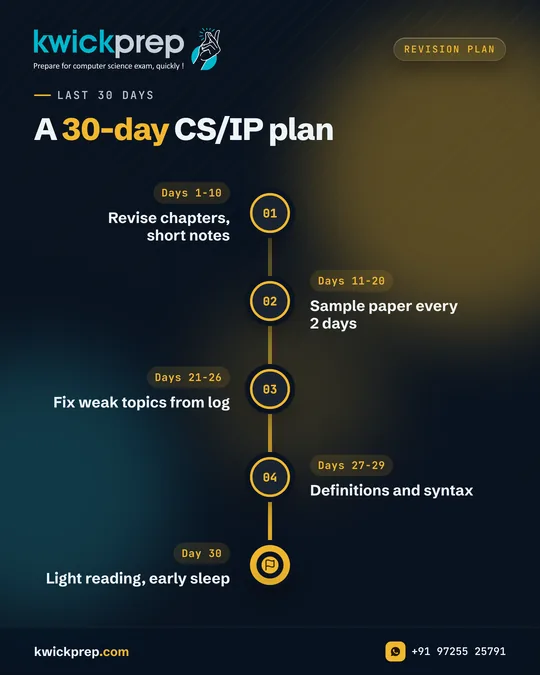
LAST 30 DAYS
A 30-day CS/IP plan
- Revise chapters, short notes
- Sample paper every 2 days
- Fix weak topics from log
- Definitions and syntax
- Light reading, early sleep
Thirty days is enough time if every day has a job.
The last month is not for learning everything again. It is for revising in layers: first cover, then test, then fix, then polish. Each layer makes the next one faster.
Save this plan and adjust the dates to your own board timetable once it is announced.
Kwickprep offers live online classes in small groups or one-to-one, taught personally by Kajal Ma'am, with KwickNotes, KwickSolution and recorded revision.
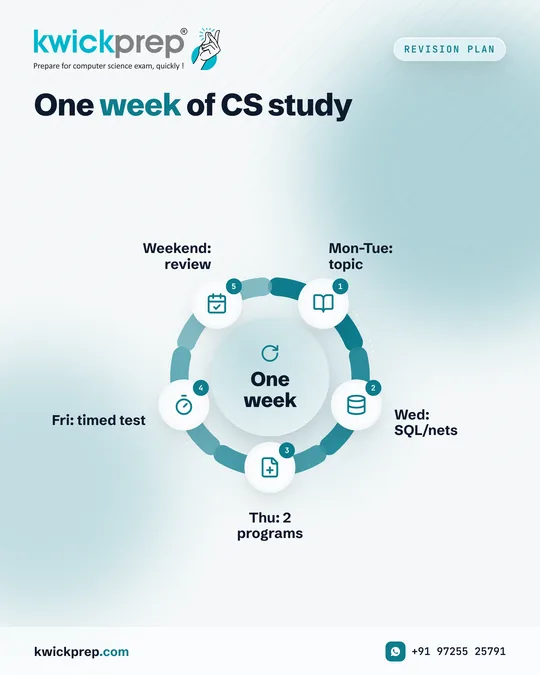
Revision Plan
One week of CS study
One week
- Mon-Tue: topic
- Wed: SQL/nets
- Thu: 2 programs
- Fri: timed test
- Weekend: review
A good week is planned, not hoped for.
This simple rhythm keeps learning, practice, practicals and testing moving together so nothing piles up. It works whether you study CS, IP or IT.
Write it into your planner today and give it three weeks before judging the result.
Kwickprep offers live online classes in small groups or one-to-one, taught personally by Kajal Ma'am, with KwickNotes, KwickSolution and recorded revision.
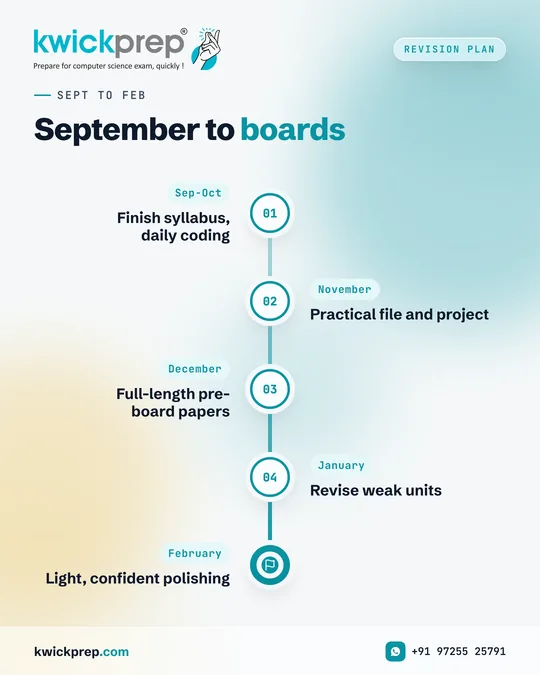
SEPT TO FEB
September to boards
- Finish syllabus, daily coding
- Practical file and project
- Full-length pre-board papers
- Revise weak units
- Light, confident polishing
The board exams of Feb-Mar 2027 are closer than they look.
A month-wise plan turns a huge syllabus into manageable pieces. Starting now, with practicals finished by November, leaves winter free for serious paper practice.
Pin this to your wall and tick off each month as you go.
Kwickprep offers live online classes in small groups or one-to-one, taught personally by Kajal Ma'am, with KwickNotes, KwickSolution and recorded revision.
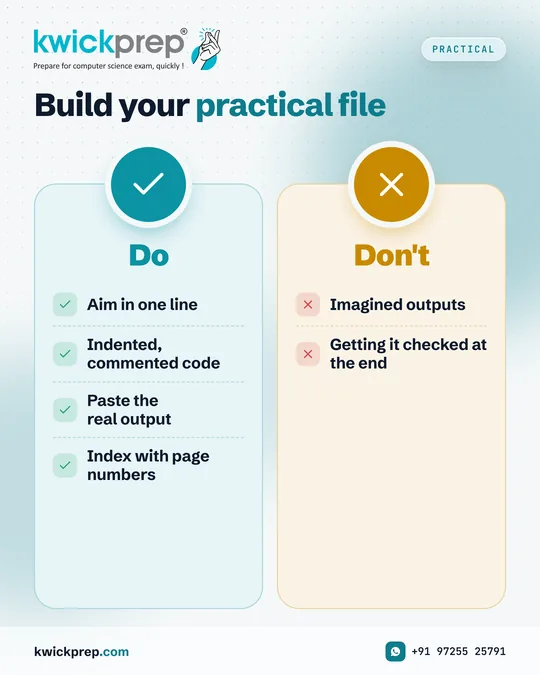
Practical
Build your practical file
Do
- Aim in one line
- Indented, commented code
- Paste the real output
- Index with page numbers
Don't
- Imagined outputs
- Getting it checked at the end
Your practical file is marked, and it also becomes your viva guide.
A neat, honest file with real outputs shows that you actually ran every program. Examiners notice. And during viva, you will be asked about what is inside it.
Add two programs this week and keep the index updated.
In Kwickprep's live online batches, Kajal Ma'am personally guides your practical file, project and viva, so nothing is left for the final weeks before the exam.
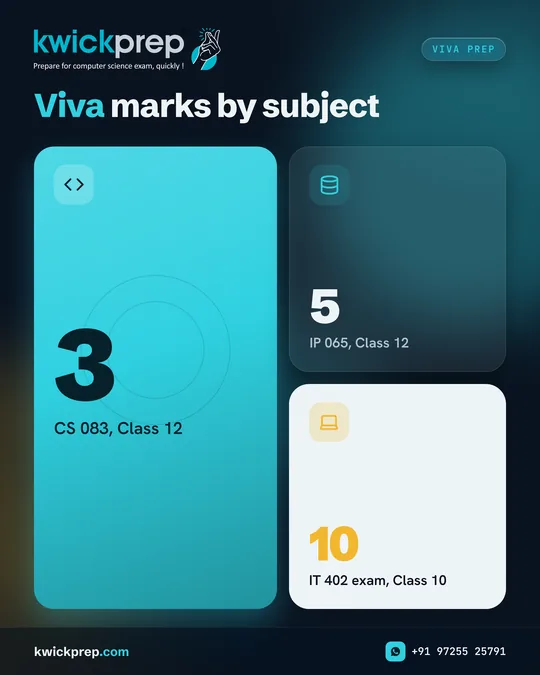
Viva Prep
Viva marks by subject
- CS 083, Class 12
- IP 065, Class 12
- IT 402 exam, Class 10
Viva feels scary only when it is unrehearsed, and it carries real marks: 3 in CBSE CS Class 12, 5 in IP Class 12 and 10 inside the IT 402 practical exam.
The questions usually come from your own work: your file, your project, the concepts you used. Speaking your answers aloud before the day turns nervousness into confidence.
Start with one program today. Explain it as if teaching a younger student.
Kwickprep students rehearse viva questions in class with Kajal Ma'am, speaking answers aloud until explaining their own work feels natural and calm.
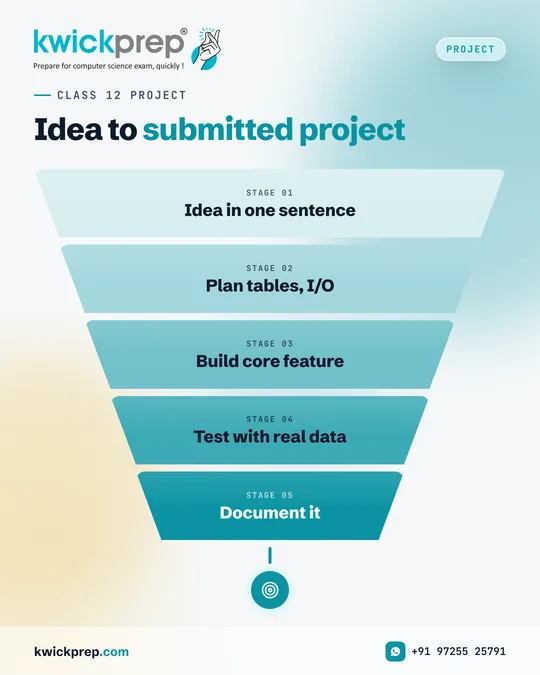
CLASS 12 PROJECT
Idea to submitted project
- Idea in one sentence
- Plan tables, I/O
- Build core feature
- Test with real data
- Document it
A project becomes stressful when it has no plan.
Breaking it into these five stages keeps it moving steadily and gives you a clear story to tell in the viva. Remember, a working simple project beats an unfinished complex one.
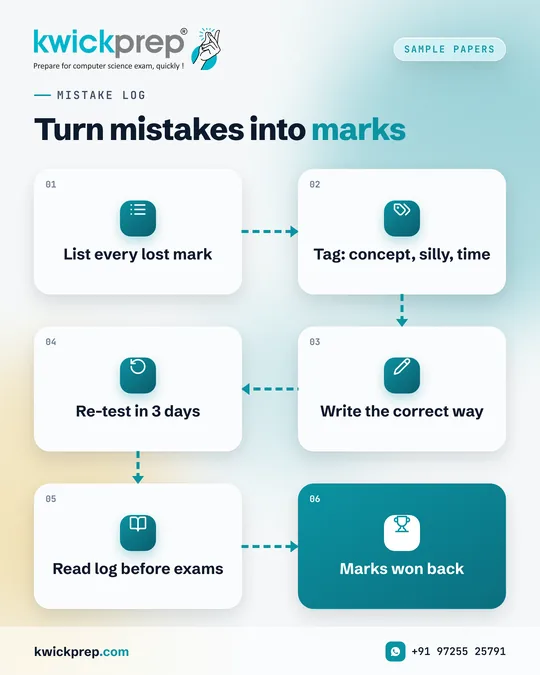
MISTAKE LOG
Turn mistakes into marks
- List every lost mark
- Tag: concept, silly, time
- Write the correct way
- Re-test in 3 days
- Read log before exams
- Marks won back
Your mistakes are the most personal study material you own.
A textbook doesn't know where you go wrong. Your mistake log does. Labelling each error shows you whether you need to relearn a concept, slow down, or manage time better.
Start a small notebook for it today. It will be your best revision tool by February.
Kwickprep students practise with KwickAssignment and board-style papers, with honest feedback from Kajal Ma'am on where marks are being lost and why.
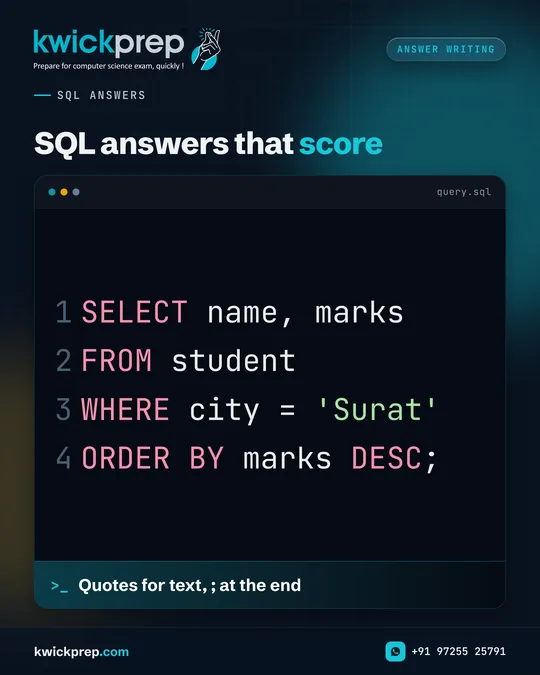
SQL ANSWERS
SQL answers that score
Quotes for text, ; at the end
SELECT name, marks
FROM student
WHERE city = 'Surat'
ORDER BY marks DESC;
SQL questions are some of the most scoring in CS and IP, if written carefully.
Most lost marks come from small slips: a wrong column name, a missing quote, clauses in the wrong order. A fixed routine for every query removes those slips.
Practise five queries today using this exact routine.
Kajal Ma'am reviews answer presentation in Kwickprep's small batches, so good habits are corrected early and carried confidently into the board exam hall.
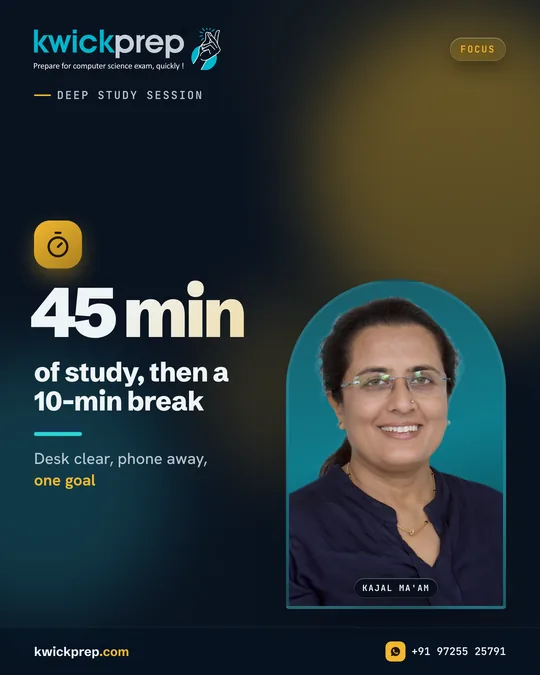
DEEP STUDY SESSION
45 min of study, then a 10-min break
Desk clear, phone away, one goal
Focus is not a talent. It is a setup.
When your space and goal are clear before you start, your mind stops wandering. Ending with a written 'what I finished' gives a small sense of progress that keeps motivation alive.
Try two such sessions this evening and compare with a normal day.
Small, live online batches at Kwickprep keep you engaged and accountable, and recorded versions of classes let you revise without endless searching or scrolling.
Written by Kajal Mehta (Kajal Ma'am), MCA, teaching computer subjects since 2004. All KwickCards