

ICSE Class 10 Computer Applications Classes
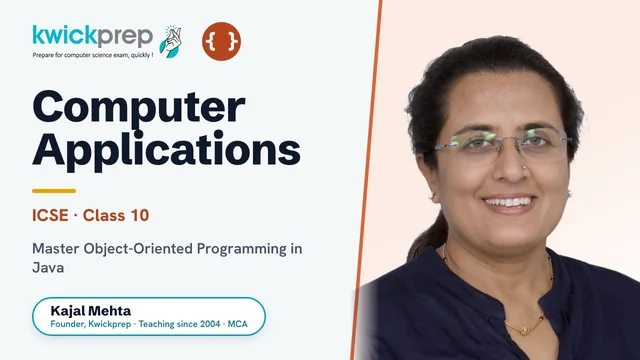
Master Object-Oriented Programming in Java with BlueJ for the ICSE board exam.
A complete preparation course for ICSE Class 10 Computer Applications, following the official CISCE syllabus. Students learn core Java and object-oriented programming concepts using the BlueJ environment, covering classes, methods, constructors, arrays, and string handling. The course balances the 100-mark theory paper with the 100-mark internal assessment of lab assignments and project work.
What you'll learn
- ✓Write and debug Java programs in the BlueJ environment following ICSE conventions
- ✓Apply core object-oriented concepts: classes, objects, encapsulation and data hiding
- ✓Design user-defined methods using overloading, call by value/reference, and static vs instance methods
- ✓Build classes with default, parameterised and overloaded constructors
- ✓Use wrapper classes, autoboxing/unboxing and character/numeric library methods
- ✓Implement sorting and searching on single and double-dimensional arrays
- ✓Solve string-handling problems using String class methods
- ✓Prepare lab assignments and project work for the 100-mark internal assessment
Full syllabus
Mapped to the official ICSE curriculum.
01Revision of Class IX Syllabus+
- Introduction to Object-Oriented Programming concepts
- Elementary concept of objects and classes
- Values and data types (primitive and non-primitive)
- Operators in Java and expressions
- Statements, scope and lifetime of variables
- Input in Java (Scanner class)
- Mathematical library methods (Math class)
- Conditional constructs (if, if-else, switch-case)
- Iterative constructs (for, while, do-while) and nested loops
02Class as the Basis of All Computation+
- Objects as instances of a class encapsulating state and behaviour
- Member variables (attributes) and member methods
- Class as a composite type and an object factory
- Primitive vs composite data types
- Differences between objects and classes
03User-Defined Methods+
- Need for and syntax of methods
- Method definition, declaration and method calling
- Method prototype, parameters and arguments
- Call by value and call by reference (actual vs formal parameters)
- Method overloading and polymorphism
- Static and non-static (instance) methods
- Pure and impure methods
04Constructors+
- Definition and characteristics of a constructor
- Default constructor
- Parameterised constructor
- Constructor overloading
- Difference between constructors and methods
05Library Classes+
- Wrapper classes for primitive data types
- Autoboxing and unboxing
- Methods to convert numeric and character data (parseInt, parseDouble, etc.)
- Character checking methods (isDigit, isLetter, isWhitespace, etc.)
- Case conversion methods (toUpperCase, toLowerCase)
06Encapsulation+
- Concept of encapsulation and data hiding
- Access specifiers: private, protected, public
- Scope of variables: class, instance, local and argument
- Visibility rules
07Arrays+
- Single-dimensional arrays: declaration, initialisation, accessing elements
- Double-dimensional arrays and matrix operations (row, column, diagonal sums)
- Sorting techniques: selection sort and bubble sort
- Searching techniques: linear search and binary search
08String Handling+
- String class and its methods (length, charAt, indexOf, substring, etc.)
- String comparison (equals, equalsIgnoreCase, compareTo)
- Case conversion and trimming (toLowerCase, toUpperCase, trim, replace)
- Character extraction and manipulation
- Concatenation and string-based programs (palindrome, reverse, etc.)
Tools you'll use
Exam pattern
Two components of 100 marks each. Theory: one written paper of 2 hours carrying 100 marks. Internal Assessment (practical): 100 marks, evaluated jointly by the subject teacher (50 marks) and a visiting external examiner (50 marks).
Practical / project
Internal Assessment requires a minimum of 20 laboratory assignments completed during the year, covering class design, coding, documentation, execution and testing in BlueJ/Java. Evaluation criteria include class design (10), variable description (10), coding and documentation (10) and execution/output (20), with the subject teacher and external examiner each awarding 50 marks.
Who it's for
ICSE Class 10 students taking Computer Applications who want to strengthen Java programming fundamentals and score well in both the theory paper and the practical internal assessment.
What's included
- ✓Live, interactive online classes taught personally by Kajal Ma'am with shared-screen Java + BlueJ coding
- ✓Chapter-wise study notes covering OOP, methods, constructors, library classes, encapsulation, arrays and string handling
- ✓Worked textbook solutions and ICSE-style programming questions for every unit
- ✓Regular coding assignments mapped to the 20+ lab assignments required for internal assessment
- ✓Dedicated doubt-solving sessions where students get individual attention on errors and logic
- ✓Previous-year and sample board paper practice for the 100-mark theory exam
- ✓Step-by-step guidance for the practical internal assessment: class design, documentation and execution in BlueJ
- ✓Viva and project-work preparation to help students face the external examiner confidently
Why study Computer Applications?
ICSE Class 10 Computer Applications is a high-scoring subject when concepts are clear, with a 100-mark theory paper and a 100-mark internal assessment, so it can meaningfully lift a student's overall percentage. More importantly, it is the foundation of programming logic in Java and object-oriented thinking that ISC Computer Science (Class 11 and 12) builds directly upon. Strong command over classes, methods, constructors, arrays and string handling now makes the senior-school transition far smoother. Because the syllabus rewards understanding over rote learning, structured live coaching turns a feared subject into a reliable scorer.
The Java and object-oriented programming skills built in this course are the same fundamentals used in engineering, BCA, B.Sc Computer Science and software development. Students who genuinely understand classes, methods and data structures here find first-year college programming, data structures and even competitive coding far easier. It is an early, practical step toward careers in software engineering, IT, data and AI.

Learn directly from Kajal Ma'am
An MCA who has taught computer subjects since 2004, Kajal Mehta personally mentors every batch, turning dense theory into clear, exam-ready understanding.
The Kwickprep Method
Computer subjects are not learnt by memorising code. Since 2006, Kajal Ma'am has taught ICSE Class 10 Computer Applications with one simple loop that turns logic into marks:
Concept in plain words
Every topic starts from why it exists and what problem it solves, before any code.
Worked through live with you
Kajal Ma'am writes and runs it on a shared screen, so you see it work, not just read it.
Board-pattern practice
You solve the exact question types that repeat in your board's paper, section by section.
Doubts till it clicks
Ask anything, any time in the live class. Nothing moves on until the concept is clear.
Exam & practical drill
Full papers, the practical file, the project and viva, rehearsed until you walk in confident.
Where this takes you
This is not just a subject to clear, it is a skill that carries forward:
- →Java & object-oriented programming the base of Android and enterprise software.
- →Logic building with BlueJ clean problem-solving, not memorising.
- →App-development foundations how real software is structured.
It opens B.Tech, BCA and software development, and is the perfect base for ISC Computer Science with Java. We teach for the board first, and for the thinking that lasts after it.
What students say
“Learning with kwickprep has been a wonderful experience. It has a very user friendly interface and is aesthetically pleasing. It provides all the important points and the proper explanation of the topics without prevaricating from the original topic.”
“My experience with Kwickprep was good. They guided me well for the Boards. That's why I would recommend Computer Science Aspirants to join Kwickprep, as their teaching and study material is the best among all others. Kwickprep is the best choice for classes 11 and 12.”
“I have joined kwick revision course before board examination. It found very useful for preparation of board examination. Educator cover all the topics. Investment of time was worth. Study material and sample paper practice were well organised.”
Read all 36 verified student & parent reviews (4.9/5) or see the board results.
Course FAQs
Are the ICSE Class 10 Computer Applications classes live or recorded?+
Do you offer both group batch and one-to-one coaching, and how do the fees differ?+
Who can join this course?+
Is the course aligned with the official CISCE / ICSE syllabus?+
Will you help with the practical exam and internal assessment?+
Can we attend a demo or trial class before joining?+
Related courses
Computer Applications
Build a strong Java and OOP foundation with BlueJ for the ICSE Class 9 Computer Applicatio
Computer Applications
Master computer fundamentals, cyber safety, and office tools for CBSE Class 9 Computer App
Computer Applications
Master web design with HTML, CSS, networking and cyber ethics for the CBSE Class 10 Comput
What students & parents say
4.9/5 from 36 verified student & parent reviews. Below are three, unedited.
Being a part of Kwickprep was such a wonderful experience. The course quality, teaching style, and study materials were all excellent, I couldn't have asked for more. Everything was explained clearly, and the teaching methods made learning smooth and enjoyable. What made the biggest difference for me was the educator, their way of teaching, guidance, and constant support truly stood out for me. I always felt supported and encouraged, and I'm really grateful for that. Honestly, everything about Kwickprep was just the best. It was completely worth it, and I'm happy I chose to learn here!
Learning with Kwickprep has truly been a wonderful experience. The course was well-structured, and the teaching methods were clear, effective, and easy to follow. The study materials, especially the notes and tricks shared, played a huge role in helping me prepare efficiently and score well, even in a short amount of time. What I appreciated the most was the constant guidance and support from the teacher. The way everything was taught made concepts easy to grasp and apply in exams. I'm genuinely grateful for the time, effort, and dedication put into each session. It was completely worth it. Thank you so much for everything, your teaching really made a difference in my learning journey! 😊
Very knowledgeable teacher, with thorough understanding of current paper pattern, FAQs, as well as syllabus.
Book a free demo for Computer Applications
See a real class before you decide. No pressure, no payment.
Book Free Demo on WhatsApp