

CBSE Class 10 Artificial Intelligence (AI) Classes
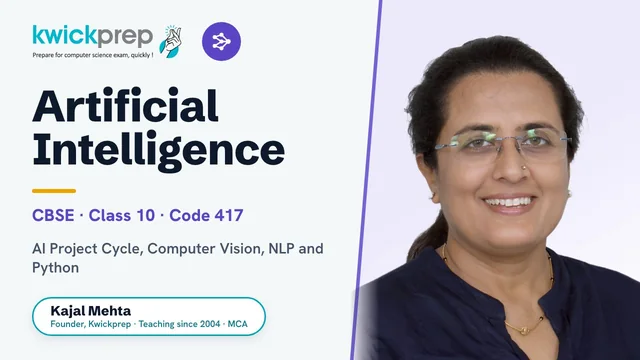
Master CBSE Class 10 AI (Code 417), from the AI Project Cycle to Computer Vision, NLP and Python.
A complete CBSE Class 10 Artificial Intelligence (Subject Code 417) course aligned to the official 2026-27 curriculum. Covering the AI Project Cycle, modelling, model evaluation, data sciences, Computer Vision, Natural Language Processing and Advanced Python, this 100-mark subject is split equally between theory (50) and practical (50). Students build real skills through hands-on Python projects and the prescribed practical file, preparing for both the written exam and practical assessment.
What you'll learn
- ✓Apply the AI Project Cycle (Problem Scoping, Data Acquisition, Exploration, Modelling, Evaluation) to real problems
- ✓Distinguish supervised, unsupervised and reinforcement learning and build basic models including decision trees and neural networks
- ✓Evaluate models using confusion matrix, accuracy, precision, recall and F1 score
- ✓Perform data science tasks: basic statistics, data visualisation and the KNN algorithm
- ✓Process images using OpenCV and understand pixels, features and Convolutional Neural Networks
- ✓Build NLP applications using tokenisation, Bag of Words and TF-IDF
- ✓Write Python programs using NumPy, Pandas and Matplotlib in Jupyter Notebooks
- ✓Understand AI ethics, bias, data privacy and ethical frameworks for responsible AI
Full syllabus
Mapped to the official CBSE curriculum.
01Part A: Communication Skills-II+
- Methods and importance of communication
- Verbal, non-verbal and visual communication
- Communication cycle and feedback
- Barriers to effective communication
- Writing skills and basic English grammar
02Part A: Self-Management Skills-II+
- Stress management techniques
- Self-awareness and self-motivation
- Building self-confidence
- Goal setting and time management
- Working independently
03Part A: ICT Skills-II+
- Operating systems basics
- Basic file and folder management
- Computer care and maintenance
- Antivirus and data security
- Productivity tools overview
04Part A: Entrepreneurial Skills-II+
- Entrepreneurship and society
- Qualities and functions of an entrepreneur
- Types of business activities
- Myths about entrepreneurship
- Entrepreneurship as a career option
05Part A: Green Skills-II+
- Importance of green jobs
- Sustainable development
- Conservation of resources
- Reducing environmental impact
- Role of green economy
06Part B Unit 1: Revisiting AI Project Cycle & Ethical Frameworks for AI+
- Recap of AI domains and the AI Project Cycle
- Problem Scoping, Data Acquisition, Data Exploration, Modelling, Evaluation
- AI ethics: bias, data privacy and access
- Ethical frameworks and principles for AI
- AI and its societal challenges (e.g. self-driving cars)
07Part B Unit 2: Advanced Concepts of Modelling in AI+
- Rule-based vs learning-based AI approaches
- Supervised, unsupervised and reinforcement learning
- Classification and regression
- Decision trees
- Introduction to neural networks and deep learning
08Part B Unit 3: Evaluating Models+
- Need for model evaluation
- Confusion matrix
- Accuracy, Precision, Recall
- F1 Score
- Interpreting evaluation results
09Part B Unit 4: Statistical Data / Data Sciences+
- Introduction to Data Sciences
- Basic statistics: mean, median, mode
- Data collection, features and labels
- Data visualisation
- K-Nearest Neighbours (KNN) algorithm
10Part B Unit 5: Computer Vision+
- Concept of computer vision and applications
- Pixels, resolution and image features
- Image processing with OpenCV
- Convolution and feature extraction
- Convolutional Neural Networks (CNN)
11Part B Unit 6: Natural Language Processing+
- Introduction to NLP and applications
- Chatbots
- Text normalisation and tokenisation
- Bag of Words model
- TF-IDF and its applications
12Part B Unit 7: Advance Python+
- Python environment setup and Jupyter Notebooks
- Recap of Python basics and data types
- Lists, tuples and dictionaries
- NumPy arrays
- Working with Pandas and Matplotlib for data
13Part C: Practical Work+
- Practical file with a minimum of 15 Python programs
- Practical examination
- Viva voce
- Project work / field visit / portfolio
- Project-related viva voce
Tools you'll use
Exam pattern
Total 100 marks: Theory 50 + Practical 50. Theory written paper of 2 hours = Part A Employability Skills (10 marks) + Part B Subject-Specific Skills (40 marks). Practical (50 marks) = Practical file/programs (15) + Practical examination (15) + Viva voce (5) + Project work/portfolio (10) + Project viva voce (5).
Practical / project
Hands-on practical component worth 50 marks. Students maintain a practical file with a minimum of 15 Python programs, sit a practical examination and viva voce, and complete a project (project work, field visit or portfolio) with a related viva. Practical work spans Python programming, data science, Computer Vision (OpenCV) and NLP tasks.
Who it's for
CBSE Class 10 students taking Artificial Intelligence (417) as a skill subject who want to strengthen both theory and practical/project work, including those continuing from the Class 9 AI foundation.
What's included
- ✓Live interactive online classes covering the full CBSE Artificial Intelligence (Code 417) Class 10 syllabus, every unit explained step by step
- ✓Chapter-wise study notes and concise summaries for Introduction to AI, AI Project Cycle, Advance Python, Data Sciences, Computer Vision, NLP and Evaluation
- ✓Solved textbook questions, NCERT/CBSE workbook solutions and previous-year board paper walkthroughs
- ✓Topic-wise assignments and worksheets with personalised checking and feedback
- ✓Regular doubt-solving sessions where no question is too small
- ✓Board-pattern theory paper practice (50-mark theory portion) with marking-scheme guidance
- ✓Hands-on practical and project guidance for the 50-mark practical, including the Python and AI domain projects
- ✓Viva voce and practical file preparation so students walk into the exam confident
Why study Artificial Intelligence?
CBSE Class 10 Artificial Intelligence (Skill Subject Code 417) is one of the most scoring subjects on the board mark sheet, with a 100-mark structure split as 50 marks theory and 50 marks practical, the practical and project component makes high marks very achievable when a student is properly guided. It builds an early, real foundation in how data, machine learning and AI domains like Computer Vision and Natural Language Processing actually work, which most students never encounter until college. Beyond marks, the subject develops computational thinking, beginner Python coding and an ethical, data-literate mindset that pays off across every future stream. Choosing AI 417 in Class 10 gives students a confident head start for Class 11-12 AI, Computer Science and Informatics Practices.
A strong grounding in the AI Project Cycle, Python and data handling maps directly onto in-demand fields like data science, machine learning, software engineering and IT. Students who understand Computer Vision and NLP early are better prepared for B.Tech/BCA/B.Sc Computer Science and AI specialisations, and for the analytical thinking valued across the technology industry. It is an honest first step toward AI/data careers, not a guarantee, but it opens the door early.

Learn directly from Kajal Ma'am
An MCA who has taught computer subjects since 2004, Kajal Mehta personally mentors every batch, turning dense theory into clear, exam-ready understanding.
The Kwickprep Method
Computer subjects are not learnt by memorising code. Since 2006, Kajal Ma'am has taught CBSE Class 10 Artificial Intelligence (AI) with one simple loop that turns logic into marks:
Concept in plain words
Every topic starts from why it exists and what problem it solves, before any code.
Worked through live with you
Kajal Ma'am writes and runs it on a shared screen, so you see it work, not just read it.
Board-pattern practice
You solve the exact question types that repeat in your board's paper, section by section.
Doubts till it clicks
Ask anything, any time in the live class. Nothing moves on until the concept is clear.
Exam & practical drill
Full papers, the practical file, the project and viva, rehearsed until you walk in confident.
Where this takes you
This is not just a subject to clear, it is a skill that carries forward:
- →The AI project cycle how real AI products are actually built, end to end.
- →Data literacy & Python the language of AI and data science.
- →Machine-learning basics a head start in the fastest-growing field in tech.
It opens AI, machine-learning and data-science paths, the careers of the next decade, and gives a head start most students never get. We teach for the board first, and for the thinking that lasts after it.
What students say
“Enrolling in the Kwick Revision Course was a decision that proved its value many times over. What I appreciate most are the meticulously prepared notes, the question papers, and the comprehensive practice materials provided.”
“I was able to get my doubts cleared and I had access to a lot of material. Always got response within the committed time.”
“Joining the Kwick Revision Course has been entirely worthwhile, as I have consistently received timely responses within the committed timeframe.”
Read all 36 verified student & parent reviews (4.9/5) or see the board results.
Course FAQs
Is this CBSE Class 10 AI course conducted fully online?+
Who can join this AI 417 course?+
What are the fees, and is there a difference between Group and One-to-One?+
Is the course aligned to the official CBSE 417 syllabus?+
Do you help with the practical exam, project and viva?+
Can we attend a free demo class before enrolling?+
Related courses
Computer Applications
Master computer fundamentals, cyber safety, and office tools for CBSE Class 9 Computer App
Computer Applications
Master web design with HTML, CSS, networking and cyber ethics for the CBSE Class 10 Comput
Computer Science
Master Python programming and computational thinking with the official CBSE Class 11 Compu
What students & parents say
4.9/5 from 36 verified student & parent reviews. Below are three, unedited.
I had a very good experience with Kwickprep. The course was excellent in every way, the teaching, the study materials, and the support from the educators were all top-notch. What helped me the most was the consistent practice in Computer Science, which made it easier to revise and stay confident during the final days before the exam. The staff was kind and always ready to help, and the way they explained both the concepts and exam-writing techniques really made a difference. Overall, it was completely worth it, and I'm really thankful for the support and guidance I received throughout the course.
I have enrolled in the CS40 session. It was very useful for me in a short period of time. Kajal Ma'am answered the call immediately and also solved doubts. I got enough practice before the board examination. The study materials and sample papers provided before the examination were up to the mark.
My experience with Kwickprep was really great! The course quality and teaching style were excellent, everything was explained in a simple and clear way. The study materials were also good and supported my learning well. What I appreciated the most was how the course helped me build critical thinking and problem-solving skills. It wasn't just about learning theory, but actually understanding how to apply it. The content was very well-organized, and the teaching methods made it easy to grasp even the tougher topics. I always got timely responses whenever I had questions, which made things even smoother. Overall, I'd say the entire course was completely worth it and helped me grow both academically and mentally. Thank you, Kwickprep!
Book a free demo for Artificial Intelligence
See a real class before you decide. No pressure, no payment.
Book Free Demo on WhatsApp