

KwickAcademy Java · 7 min · free
Stacks, Queues and Deques Using Classes
Building a stack, a queue, a circular queue and a deque from a Java class and an array, with overflow and underflow checks.
Follows the syllabus of: ISC Class 11 Computer Science (868), ISC Class 12 Computer Science (868)
On screen in this lesson
What is a stack?
| Items are added and removed at one end: the top |
| LIFO: Last In, First Out |
| push: add an item on top |
| pop: remove the top item |
| peek: look at the top item without removing it |
Trace a stack
| Operation | Stack, bottom first | top |
|---|---|---|
| push(10) | 10 | 0 |
| push(20) | 10, 20 | 1 |
| push(30) | 10, 20, 30 | 2 |
| pop() gives 30 | 10, 20 | 1 |
| peek() gives 20 | 10, 20 | 1 |
What is a queue?
| Items join at the rear and leave from the front |
| FIFO: First In, First Out |
| insert (enqueue): add at the rear |
| delete (dequeue): remove from the front |
Problem with a simple queue
| Deleting moves front forward, leaving empty cells |
| Rear reaches the last index: "queue full" |
| But cells at the start are empty and wasted |
| Fix: let the rear wrap around to index 0 |
Pause and predict
| Size | Rear now | Next rear |
|---|---|---|
| 5 | 2 | ? |
| 5 | 4 | ? |
| 4 | 3 | ? |
What is a deque?
| Type | Insert at | Delete from |
|---|---|---|
| Deque | both ends | both ends |
| Input restricted | one end only | both ends |
| Output restricted | both ends | one end only |
Quick answers
What is the circular queue formula?
rear = (rear + 1) % size, so the rear wraps to index 0.
What is the difference between pop and peek?
pop removes the top item; peek only looks at it.
KwickClips from this lesson
Short clips, one idea each. Good for revision the night before.
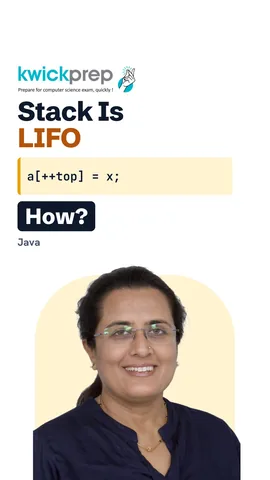 Which plate comes off a pile first?44 sec
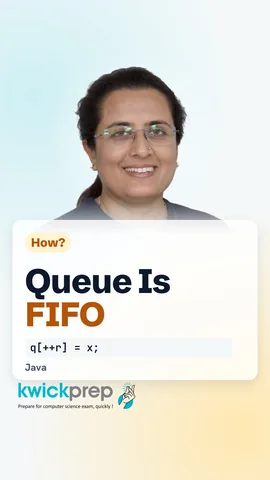 Who is served first in a ticket line?43 sec
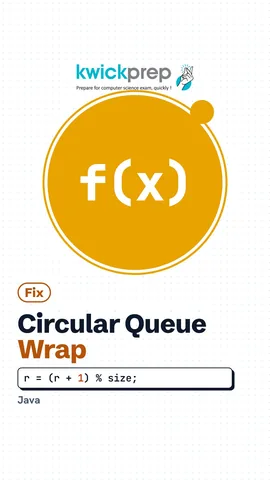 Why does my queue say full when cells are empty?40 sec
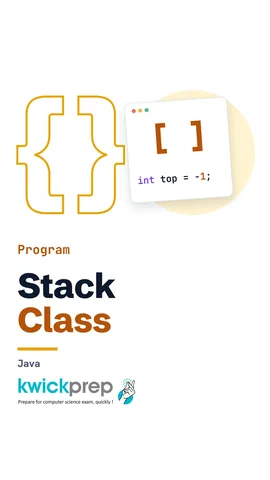 What does top = -1 mean?42 sec
The full lesson, in text
Hello students, welcome to Kwickprep. At a wedding, you take the top plate from a pile. At a ticket counter, the first person in line is served first. These two everyday rules are two famous data structures. Today we build a stack, a queue, a circular queue and a deque, using a Java class and an array.
A data structure is a way of storing data so that we can use it well. A stack is a data structure where items enter and leave from one end only, called the top. So it follows LIFO, which means last in, first out, just like a pile of plates. Push means adding an item on top. Pop means removing the top item. Peek means looking at the top item, without removing it.
Let us trace a stack stored in an array, with a variable top that holds the index of the top item. Push ten, and top becomes zero. Push twenty, and top becomes one. Push thirty, and top becomes two. Pop removes the last item added, which is thirty, and top goes back to one. Peek shows twenty, but the stack does not change.
Now we build the stack as a Java class. The array a stores the items, and top starts at minus one, which means empty. Push first increases top, then stores x at that index. Pop first gives the item at top, then decreases top. In main, s is our stack object. We push four, then nine, and pop gives nine, the last item pushed.
A real stack must check two dangers. Overflow means pushing when the stack is already full, so top equals the array length minus one. In that case, we print Overflow instead of storing. Underflow means popping when the stack is empty, so top equals minus one. Here pop returns minus one, so the caller must check that the stack is not empty first. Exams give marks for these checks, so never skip them.
Now the ticket counter. A queue is a data structure where items join at one end, called the rear, and leave from the other end, called the front. So it follows FIFO, which means first in, first out. Insert, also called enqueue, adds an item at the rear. Delete, also called dequeue, removes the item at the front.
Here is a queue class. The variable f is the front index and r is the rear index. The method ins, short for insert, moves r forward and stores the item. The method del, short for delete, gives the item at f and moves f forward. We insert four, then nine. Delete gives four, because four came first. A full version checks overflow when r equals size minus one, and underflow when f is greater than r.
A simple queue has a hidden problem. Every delete moves the front forward, so the cells behind it become empty. Soon the rear reaches the last index, and the queue says it is full. But the cells at the start are empty, and they are wasted. The fix is to let the rear wrap around to index zero, which gives us a circular queue.
In a circular queue, the last cell is joined back to the first cell, like seats on a merry go round. The variable count keeps how many items are stored. If count equals size, the queue is truly full. Otherwise, r becomes r plus one, modulus size. With size five, when r is four, four plus one modulus five is zero, so the rear wraps to the start. Delete moves the front in the same way.
Pause the video and predict the next rear index, using r plus one, modulus size. With size five and rear two, the next rear is three. With size five and rear four, the next rear is zero, because it wraps around. With size four and rear three, the next rear is also zero. The wrap happens exactly at the last index.
A deque, pronounced deck, is a double ended queue. In a full deque, we can insert and delete at both the front and the rear. An input restricted deque allows insertion at only one end, but deletion at both ends. An output restricted deque allows insertion at both ends, but deletion at only one end. A deque can behave like a stack or like a queue, as we choose.
Let us compare stacks and queues, a common exam question. A stack follows LIFO, while a queue follows FIFO. A stack uses one end, the top, while a queue uses two ends, front and rear. We add with push in a stack, and with insert in a queue. We remove with pop in a stack, and with delete in a queue. Undo in an editor and method calls use a stack, while printer jobs wait in a queue.
Let us revise. A stack is LIFO, with push, pop and peek at the top. A queue is FIFO, inserting at the rear and deleting from the front. A circular queue wraps around using rear plus one, modulus size. A deque allows insert and delete at both ends. In Java, we build them with a class holding an array and index variables, and we always check overflow and underflow.
Courses that teach this
| Course | Unit |
|---|---|
| ISC Class 11 Computer Science (868) | Elementary Data Structures and Implementation |
| ISC Class 12 Computer Science (868) | Data Structures |
| Programming All levels Java | Data Structures and Collections |
Voice-over in this lesson is AI-generated. The script is written and checked by Kajal Ma'am. Boards can revise a syllabus mid-year, so confirm anything you plan around against the official board circular. Keep your passwords, OTPs and ID numbers to yourself — we never ask for them. To reach Kajal Ma'am, use the WhatsApp button; sharing your number there is how we call you back.
Free to watch, no sign-up. Live classes with Kajal Ma'am are the paid course; these lessons stay free either way.