

KwickAcademy Course Topics · 6 min · free
Creating and saving documents
Create a document with Ctrl+N and save with Ctrl+S; saving moves your work from RAM to storage so it stays after shutdown.
Follows the syllabus of: GSEB Std 9 Computer Studies
On screen in this lesson
Key terms first
| Document: a file you create, like a letter |
| File name: the name you give the file |
| Extension: letters after the dot, showing the type |
| Folder: a place that holds files together |
Creating a new document
| Way | How | Result |
|---|---|---|
| Menu | File, New | Text Document |
| Shortcut | Ctrl+N | blank page |
| Toolbar | New button | blank page |
Why save?
| Typed work is only in RAM, temporary memory |
| RAM is cleared when power goes off |
| Saving writes the file to storage, like a hard disk |
| Stored files stay even after shutdown |
Saving for the first time
| Click File, then Save, or press Ctrl+S |
| The Save dialog box opens |
| Choose a folder, such as Documents |
| Type a file name and click Save |
File formats
| Format | Extension | Opens in |
|---|---|---|
| OpenDocument Text | .odt | Writer default |
| Word document | .docx | MS Word too |
| any PDF reader |
Good file names
| Short and meaningful: Science_Project_Plants | |
| Avoid symbols like / \ : * ? " < > and | |
| Linux names are case sensitive | |
| Let Writer add the extension for you |
Quick answers
Letter.odt is saved. You edit and press Ctrl+S. Does the Save dialog open again?
No. Save updates the same file.
What is Writer's default format?
.odt
KwickClips from this lesson
Short clips, one idea each. Good for revision the night before.
The full lesson, in text
Hello students, welcome to Kwickprep. You typed a two page project, and the power went off. Is everything gone? It depends on one habit: saving. Today we will learn how to create, save, open and close documents in LibreOffice Writer.
Let us start with four terms. A document is a file you create, like a letter or a project. The file name is the name you give it, like Leave Letter. The extension is the short set of letters after the dot, which tells the file type. A folder is a place that keeps related files together, like a file cover in your school bag.
There are three ways to create a new document in Writer. From the menu, click File, then New, then Text Document. Or press the shortcut Ctrl+N. Or click the New button on the standard toolbar. Each way opens a fresh blank page named Untitled.
Why do we need to save at all? While you type, your work is kept only in RAM, the computer's temporary working memory. RAM is cleared the moment the power goes off. Saving writes the document to storage, like a hard disk, SSD or pen drive. Files in storage stay safe even after the computer shuts down.
Here are the steps to save a new document. Click File, then Save, or simply press Ctrl+S. Because the file has no name yet, the Save dialog box opens. Choose the folder where the file should go, such as Documents. Type a meaningful file name and click the Save button.
Writer can save in different formats. The default format is OpenDocument Text, with the extension dot o d t, and it is an open standard. You can also choose the Word format, dot d o c x, if a friend uses Microsoft Word. When you choose it, Writer may ask, Keep current format, or Use Word format. A PDF, with dot p d f, is made with File, Export as PDF, and anyone can open it but not easily edit it.
A good file name helps you find the file later. Keep it short and meaningful, like Science Project Plants, not abc. Avoid special symbols like slash, colon, star and question mark, because some systems do not allow them. In Ubuntu, names are case sensitive, so Project and project are different files. And let Writer add the extension automatically.
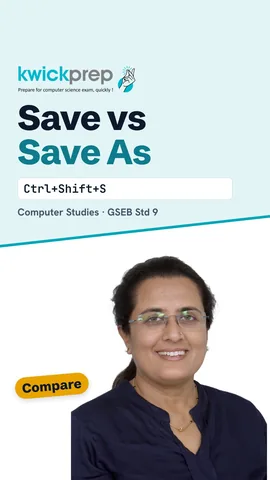
Once a file has a name, Save and Save As do different jobs. Save, with Ctrl+S, updates the same file with your latest changes, and no dialog box appears. Save As, with Ctrl+Shift+S, lets you save a copy with a new name, a new folder or a new format. The original file stays as it was.
Pause and predict. A file named Letter dot odt is already saved in Documents. You add a line and press Ctrl+S. Does the Save dialog box open again? No, because the file already has a name and a place. Writer quietly updates the same file.
Make saving a habit. Press Ctrl+S every few minutes while you work. Writer also has AutoRecovery, which keeps backup information to restore work after a crash. You can set how often it runs in Tools, Options, Load Save, General. But AutoRecovery is only a safety net, so always save properly yourself.
To work on a saved file again, you open it. Click File, then Open, find the folder and choose the file. Or press Ctrl+O to open the same dialog box. Or use File, Recent Documents, which lists files you opened lately.
When you finish, close the document properly. File, then Close, closes only the current document. File, then Exit LibreOffice, closes all open LibreOffice documents, and Ctrl+Q does the same. If you have unsaved changes, Writer warns you before closing. You can choose Save, Don't Save, or Cancel to go back to your work.
Let us put the whole workflow together. First, create a new document with Ctrl+N. Next, type and edit your content. Then save it with Ctrl+S. Ask yourself, is there more work to do? If yes, keep typing and save again. If no, close the document with File, Close.
Let us revise what we learned today. Create a new document with File, New, or Ctrl+N. Saving moves your work from temporary RAM to permanent storage. Writer saves in the dot o d t format by default. Save updates the same file, while Save As makes a copy with a new name, place or format. Open a file with Ctrl+O, and close it with File, Close. Save early and save often.
Courses that teach this
| Course | Unit |
|---|---|
| GSEB Std 9 Computer Studies | Introduction to Word Processing |
Voice-over in this lesson is AI-generated. The script is written and checked by Kajal Ma'am. Boards can revise a syllabus mid-year, so confirm anything you plan around against the official board circular. Keep your passwords, OTPs and ID numbers to yourself — we never ask for them. To reach Kajal Ma'am, use the WhatsApp button; sharing your number there is how we call you back.
Free to watch, no sign-up. Live classes with Kajal Ma'am are the paid course; these lessons stay free either way.