

IGCSE Grade 9 Computer Science (CS) Classes
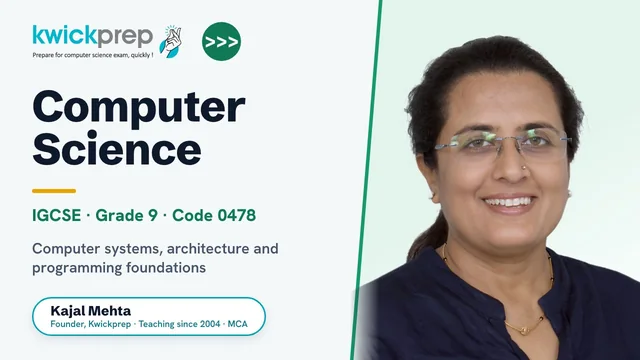
Build a strong foundation in Cambridge IGCSE Computer Science (0478), computer systems theory plus real programming.
A Grade 9 (Year 1) course covering the Cambridge IGCSE Computer Science 0478 syllabus for 2026-2028 examinations. Students learn computer systems theory, data representation, hardware, software, networks and cyber security, alongside algorithm design, pseudocode and hands-on programming in Python, Visual Basic or Java. The course follows the official Cambridge International two-paper structure and builds computational thinking and problem-solving skills for the full IGCSE qualification.
What you'll learn
- ✓Convert and calculate across binary, denary, hexadecimal and two's complement number systems
- ✓Explain how computer hardware, the CPU, memory and storage work, including the fetch-decode-execute cycle
- ✓Describe networks, data transmission, encryption and core cyber security threats and protections
- ✓Apply computational thinking to design algorithms using pseudocode, flowcharts and trace tables
- ✓Write, test and debug working programs in Python, Visual Basic or Java using selection, iteration and arrays
- ✓Construct logic circuits and complete truth tables using Boolean logic gates
- ✓Create and query single-table databases using SQL
- ✓Evaluate automated and emerging technologies such as robotics, AI, expert systems and machine learning
Full syllabus
Mapped to the official IGCSE curriculum.
011. Data Representation+
- Number systems: binary, denary and hexadecimal
- Converting between binary, denary and hexadecimal
- Two's complement and binary arithmetic (binary shifts)
- Text, sound and image representation
- Measuring data storage (bit, byte, KiB, MiB, GiB, etc.)
- Data compression: lossless and lossy
022. Data Transmission+
- Packets and packet switching
- Serial vs parallel, simplex/half-duplex/full-duplex transmission
- Universal Serial Bus (USB)
- Error detection: parity check, checksum, check digit, ARQ, echo check
- Symmetric and asymmetric encryption
033. Hardware+
- Computer architecture and the CPU; von Neumann model
- Core, cache and clock speed; fetch-decode-execute cycle
- Embedded systems
- Input and output devices
- Primary, secondary and off-line storage (magnetic, optical, solid state)
- Sensors, microprocessors and control/monitoring systems
- Logic gates (NOT, AND, OR, NAND, NOR, XOR)
044. Software+
- System software vs application software
- Operating systems and their functions
- Interrupts and the role of the OS
- High- and low-level languages; compilers, interpreters and assemblers
- The relationship between hardware, firmware and software
055. The Internet and Its Uses+
- The internet vs the world wide web; URLs
- HTTP and HTTPS; web browsers and how web pages are retrieved
- Cookies: session and persistent
- Digital currency and blockchain
- Cyber security threats (brute-force, data interception, DDoS, phishing, malware, etc.)
- Keeping data safe: solutions and protection methods
066. Automated and Emerging Technologies+
- Automated systems: sensors, microprocessors and actuators
- Robotics and the characteristics of robots
- Artificial intelligence: expert systems and machine learning
- Advantages, disadvantages and applications of emerging technologies
077. Algorithm Design and Problem-Solving+
- Program development life cycle (analysis, design, coding, testing)
- Computational thinking: decomposition, abstraction, pattern recognition
- Pseudocode and flowcharts
- Standard methods of solution: linear/bubble sort, linear/binary search, totalling, counting
- Trace tables and identifying/correcting errors
- Validation, verification and suitable test data
088. Programming+
- Declaring and using variables and constants; basic data types
- Input, output, sequence, selection and iteration
- Nested statements; counts and totals
- One-dimensional and two-dimensional arrays
- Procedures, functions and parameters; library routines
- File handling; writing maintainable programs
099. Databases+
- Single-table databases
- Fields, records and data types; primary keys
- Database structure (validation and basic SQL retrieval)
- Querying and selecting data with structured query language (SQL)
1010. Boolean Logic+
- Logic gates and their symbols
- Constructing logic circuits from problem statements
- Producing and completing truth tables
- Writing logic expressions from circuits and vice versa
Tools you'll use
Exam pattern
Externally assessed across two written papers, each worth 75 marks and 50% of the total. Paper 1 (Computer Systems) covers Topics 1-6; Paper 2 (Algorithms, Programming and Logic) covers Topics 7-10 and includes a programming scenario/scenario-based section. Both papers are 1 hour 45 minutes, all questions compulsory, no calculators permitted. There is no separate coursework component.
Practical / project
Programming is integral to the course: students design, write, test and debug programs and algorithms using pseudocode or a high-level language (Python, Visual Basic or Java). Practical work covers arrays, file handling, validation, trace tables and single-table SQL databases. The programming and algorithm skills are assessed within Paper 2 rather than as standalone coursework.
Who it's for
Grade 9 / Year 1 students enrolled in (or preparing for) Cambridge IGCSE Computer Science 0478 who want to master both the theory papers and practical programming from the start.
What's included
- ✓Live interactive online classes with Kajal Ma'am covering both Paper 1 (Computer Systems) and Paper 2 (Algorithms, Programming and Logic) of the 0478 syllabus
- ✓Chapter-wise study notes and concise summaries for data representation, hardware, networks, cyber security and emerging technologies
- ✓Worked solutions to past-paper questions and topic-wise question banks aligned to the 2026-2028 Cambridge syllabus
- ✓Regular assignments and graded practice sets after each unit to reinforce theory and pseudocode
- ✓Dedicated doubt-solving sessions where every student's questions are addressed personally
- ✓Hands-on programming practice in Python (or Visual Basic / Java) including arrays, file handling, validation and trace tables
- ✓Single-table database and SQL query practice plus Boolean logic and truth-table drills
- ✓Paper 1 and Paper 2 exam practice with marking-scheme-based feedback and a free trial demo class
Why study Computer Science?
Grade 9 is Year 1 of the two-year Cambridge IGCSE Computer Science 0478 journey, and getting the foundations right here directly shapes the final A*-G grade. The qualification is assessed entirely through two written papers worth 50% each (75 marks apiece), so theory in Paper 1 and programming/algorithms in Paper 2 carry equal weight and must both be strong from the start. Building solid habits in data representation, hardware, pseudocode and programming in Grade 9 makes the Grade 10 exam year far less stressful and protects scoring potential. Because IGCSE Computer Science rewards genuine understanding and applied problem-solving (AO2 and AO3 together carry 60% of the marks), real conceptual clarity now translates into higher marks later.
Cambridge IGCSE Computer Science 0478 is the recognised foundation for AS & A Level Computer Science and the IB, and is accepted by leading universities worldwide as evidence of academic achievement. The computational thinking, programming and problem-solving skills built here feed directly into degrees in computer science, software engineering, data science and artificial intelligence. Even for students who pursue other fields, the logic, coding and data-handling skills are increasingly valued across engineering, IT and the wider digital economy.

Learn directly from Kajal Ma'am
An MCA who has taught computer subjects since 2004, Kajal Mehta personally mentors every batch, turning dense theory into clear, exam-ready understanding.
The Kwickprep Method
Computer subjects are not learnt by memorising code. Since 2006, Kajal Ma'am has taught IGCSE Grade 9 Computer Science (CS) with one simple loop that turns logic into marks:
Concept in plain words
Every topic starts from why it exists and what problem it solves, before any code.
Worked through live with you
Kajal Ma'am writes and runs it on a shared screen, so you see it work, not just read it.
Board-pattern practice
You solve the exact question types that repeat in your board's paper, section by section.
Doubts till it clicks
Ask anything, any time in the live class. Nothing moves on until the concept is clear.
Exam & practical drill
Full papers, the practical file, the project and viva, rehearsed until you walk in confident.
Where this takes you
This is not just a subject to clear, it is a skill that carries forward:
- →Programming to the Cambridge standard computational thinking done properly.
- →Algorithms & problem-solving the heart of computer science.
- →A globally recognised foundation respected by universities worldwide.
It is strong preparation for A-Levels, the IB and university computer science anywhere in the world. We teach for the board first, and for the thinking that lasts after it.
What students say
“I have joined kwick revision course before board examination. It found very useful for preparation of board examination. Educator cover all the topics. Investment of time was worth. Study material and sample paper practice were well organised.”
“I joined the CS40+ course in January 2023, and it was completed within the mentioned time. I found the course very effective and well-organized. The teaching method and study material are up to the mark. I learned new things, and rather than mugging up the code, I learned to develop logic.”
“I have enrolled in the Kwick Revision course, which is designed for 10 days. They have covered all the topics in meticulous time. The teaching method was good. Study materials and course content were up to the mark. Educators resolved doubts within the committed time only.”
Read all 36 verified student & parent reviews (4.9/5) or see the board results.
Course FAQs
Is this IGCSE Grade 9 Computer Science course conducted fully online?+
Do you offer both group batches and one-to-one classes, and how do the fees differ?+
Which syllabus does the course follow?+
Which programming language is taught?+
How does the course help with exam and practical programming preparation?+
Can I attend a demo class before enrolling?+
Related courses
Computer Science
Master the full Cambridge IGCSE Computer Science 0478 syllabus and build exam-ready progra
Computer Science
Master Python programming and computational thinking with the official CBSE Class 11 Compu
Computer Science
Master Python, file handling, data structures and SQL for the CBSE Class 12 CS (083) board
What students & parents say
4.9/5 from 36 verified student & parent reviews. Below are three, unedited.
Thank you so much ma'am for believing in me and teaching me so well that i developed interest in computer science. i'll always be grateful for the help you've done. i'll surely miss our classes. Take care of your health ma'am. Once again Thanks a lot ma'am.
I had a very good experience with Kwickprep. The course was excellent in every way, the teaching, the study materials, and the support from the educators were all top-notch. What helped me the most was the consistent practice in Computer Science, which made it easier to revise and stay confident during the final days before the exam. The staff was kind and always ready to help, and the way they explained both the concepts and exam-writing techniques really made a difference. Overall, it was completely worth it, and I'm really thankful for the support and guidance I received throughout the course.
I have enrolled in the CS40 session. It was very useful for me in a short period of time. Kajal Ma'am answered the call immediately and also solved doubts. I got enough practice before the board examination. The study materials and sample papers provided before the examination were up to the mark.
Book a free demo for Computer Science
See a real class before you decide. No pressure, no payment.
Book Free Demo on WhatsApp