

ISC Class 12 Computer Science (with Java) (CS) Classes
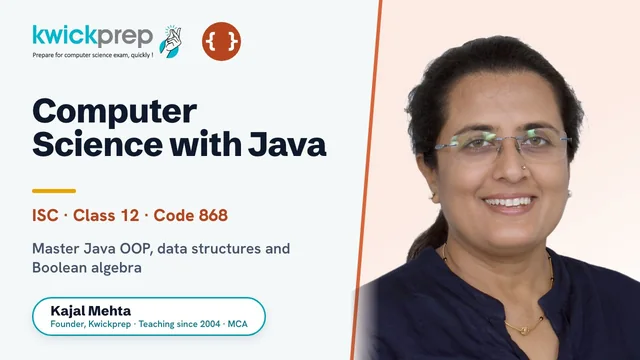
Master Java OOP, data structures and Boolean algebra for the ISC Class 12 Computer Science exam.
A complete preparation course for the CISCE ISC Class 12 Computer Science (868) syllabus, taught in Java. Covers Boolean algebra and logic circuits, object-oriented programming, recursion, inheritance and polymorphism, data structures (stacks, queues, linked lists, binary trees) and Big O complexity. Aligned to the official two-paper format: 70-mark theory and 30-mark BlueJ practical, with guided project and lab work.
What you'll learn
- ✓Simplify Boolean expressions using laws, De Morgan's theorems and Karnaugh maps (up to 4 variables)
- ✓Design logic circuits including adders, encoders, decoders and multiplexers from Boolean algebra
- ✓Write object-oriented Java programs using classes, constructors, inheritance, interfaces and polymorphism
- ✓Implement searching, sorting and recursion algorithms in Java
- ✓Build and operate core data structures: stacks, queues, linked lists and binary trees
- ✓Convert and evaluate infix, prefix and postfix expressions
- ✓Analyse algorithm efficiency using Big O notation and best/average/worst case reasoning
- ✓Solve the ISC practical programming problems and complete the BlueJ lab work confidently
Full syllabus
Mapped to the official ISC curriculum.
01Boolean Algebra+
- Propositional logic, well-formed formulae, truth tables and interpretation
- Satisfiable, unsatisfiable and valid formulae
- Binary-valued quantities; AND, OR, NOT operations and equivalence laws
- Basic theorems: duality, idempotence, commutativity, associativity, distributivity
- De Morgan's laws and applications
- Canonical SOP and POS forms; minimization
- Karnaugh maps for minimization of Boolean expressions (up to 4 variables)
02Computer Hardware+
- Elementary logic gates: NOT, AND, OR, NAND, NOR, XOR, XNOR
- Universal gates (NAND, NOR) and circuit applications
- Half adder and full adder
- Encoders, decoders and multiplexers using Boolean algebra
03Implementation (Algorithms to Programs)+
- From algorithms to working Java programs
- Programming environment (BlueJ, JDK)
- Review of Class XI Java concepts
04Objects and Classes+
- Objects as attributes (state) and behaviour (methods)
- Object as an instance of a class
- Constructors: default, parameterized and copy constructors
- Static members and static methods
- Encapsulation and access specifiers
05Primitive Values, Wrapper Classes, Types and Casting+
- Primitive types: int, short, long, float, double, boolean, char
- Wrapper classes and autoboxing/unboxing
- User-defined types via classes
- Type conversion, coercion and casting
06Variables and Expressions+
- Variables as named values
- Arithmetic, relational and logical expressions
- Operators, associativity and precedence
- Assignment operations
07Statements and Scope+
- Conditional statements: if, if-else, switch, ternary operator
- Loops: for, while, do-while; break and continue
- Blocks, scope and variable visibility
08Functions (Methods)+
- Methods as abstractions of operations; side effects
- Formal vs actual parameters; pass-by-value vs object references
- Static methods and the 'this' reference
- Algorithmic problem solving with methods
09Arrays and Strings+
- Single and multi-dimensional arrays; row-major/column-major addressing
- String class methods and manipulation
- Searching: linear and binary search
- Sorting: bubble, selection, insertion sort
- Exception handling (try, catch, throw)
- Basic file I/O and the Scanner class; tokenisation
10Recursion+
- Recursive definitions and base cases
- Factorial, GCD, Fibonacci, binary search
- Conversion of number representations
- Recursive sorting techniques
11Inheritance, Interfaces and Polymorphism+
- Single, multilevel, hierarchical and hybrid inheritance
- Base and derived classes; super and protected access
- Abstract classes and the Object class
- Interfaces and multiple inheritance of type
- Method overloading and overriding; dynamic (run-time) polymorphism
12Data Structures+
- Stack, queue and dequeue implementations
- Interfaces and multiple implementations
- Infix to prefix and postfix conversion and evaluation
- Single linked lists: insertion, deletion, traversal
- Binary trees: root, nodes, leaves, height, depth, level, size, degree, siblings, subtree, completeness, balancing
- Tree traversals: pre-order, in-order, post-order (conceptual)
13Computational Complexity and Big O Notation+
- Input size and estimating computational complexity
- Dominant term and order of growth
- Best, average and worst case analysis
- Big O notation and analysing algorithm complexity
Tools you'll use
Exam pattern
Total 100 marks. Paper 1 (Theory) 70 marks, 3 hours: Part I (20 marks) compulsory short-answer questions covering the whole syllabus; Part II (50 marks) with Section A and Section B (10 marks each) and Section C (5 marks), candidates answering set numbers of questions. Paper 2 (Practical) 30 marks, 3 hours: candidates write a working Java program for one of three given problems, evaluated by a visiting examiner.
Practical / project
Paper 2 is a 3-hour, 30-mark practical conducted in BlueJ/JDK where students design, code and test a Java program for one of three problems (assessed on planning, coding, output and viva). Programs are documented in a practical file/lab record maintained through the year, reflecting algorithm design, data structures and OOP work.
Who it's for
ISC (CISCE) Class 12 students taking Computer Science (868) who want structured, syllabus-aligned coaching in Java programming, theory and the BlueJ practical exam.
What's included
- ✓Live interactive online classes with Kajal Ma'am (teaching Computer Science since 2004), aligned to the full CISCE ISC Class 12 Computer Science (868) syllabus
- ✓Chapter-wise notes covering Boolean algebra, OOP, recursion, inheritance and polymorphism, data structures and complexity
- ✓Worked Java/BlueJ programs for every data-structure and algorithm topic, with line-by-line dry runs
- ✓Topic-wise assignments and coding practice sheets after each unit, checked and corrected with feedback
- ✓Regular live doubt-solving sessions so no concept or program is left unclear
- ✓Solved ISC previous-year and specimen paper practice for the 70-mark theory paper
- ✓Guided BlueJ practical preparation, program file and viva preparation for the 30-mark internal assessment
- ✓Choice of small-group live batch or fully personal one-to-one coaching with flexible timings
Why study Computer Science (with Java)?
ISC Class 12 Computer Science (paper 868) is a 100-mark subject split into a 70-mark Java theory paper and a 30-mark BlueJ practical, which makes it a high-scoring board subject when programming and Boolean algebra are understood properly rather than crammed. The Java-based syllabus builds genuine object-oriented thinking, recursion and data-structure skills that directly feed into university computer science and engineering. Because much of the paper rewards correct logic and clean code, a student with strong fundamentals can convert this subject into one of their best ISC scores. Studying it live with structured notes, solved papers and consistent practice closes the gap between understanding a concept and writing it under exam conditions.
The course builds core object-oriented programming, recursion and data-structure foundations in Java that map directly onto B.Tech/BE Computer Science, BCA and B.Sc CS coursework. These same fundamentals (classes, inheritance, stacks, queues, linked lists, trees and Big O analysis) are the basis of software development, data structures and algorithms interviews used across the IT industry. It also gives an early, credible starting point for fields like software engineering, data and AI/ML, where strong programming logic is essential.

Learn directly from Kajal Ma'am
An MCA who has taught computer subjects since 2004, Kajal Mehta personally mentors every batch, turning dense theory into clear, exam-ready understanding.
The Kwickprep Method
Computer subjects are not learnt by memorising code. Since 2006, Kajal Ma'am has taught ISC Class 12 Computer Science (with Java) (CS) with one simple loop that turns logic into marks:
Concept in plain words
Every topic starts from why it exists and what problem it solves, before any code.
Worked through live with you
Kajal Ma'am writes and runs it on a shared screen, so you see it work, not just read it.
Board-pattern practice
You solve the exact question types that repeat in your board's paper, section by section.
Doubts till it clicks
Ask anything, any time in the live class. Nothing moves on until the concept is clear.
Exam & practical drill
Full papers, the practical file, the project and viva, rehearsed until you walk in confident.
Where this takes you
This is not just a subject to clear, it is a skill that carries forward:
- →Java & data structures the language of software engineering and interviews.
- →Object-oriented design how large software is actually built.
- →Algorithmic thinking exactly what placements and contests test.
It opens B.Tech Computer Science, software engineering and competitive programming. We teach for the board first, and for the thinking that lasts after it.
What students say
“Enrolling in the Kwick Revision Course was a decision that proved its value many times over. What I appreciate most are the meticulously prepared notes, the question papers, and the comprehensive practice materials provided.”
“I was able to get my doubts cleared and I had access to a lot of material. Always got response within the committed time.”
“Joining the Kwick Revision Course has been entirely worthwhile, as I have consistently received timely responses within the committed timeframe.”
Read all 36 verified student & parent reviews (4.9/5) or see the board results.
Course FAQs
Are the ISC Class 12 Computer Science classes online or in person?+
Who can join this ISC Class 12 Computer Science course?+
What is the difference between the group batch and one-to-one fees?+
Is the course aligned to the official ISC syllabus and exam pattern?+
Do you help with the BlueJ practical and viva?+
Can I get a demo or trial class before enrolling?+
What students & parents say
4.9/5 from 36 verified student & parent reviews. Below are three, unedited.
My experience with Kwickprep was good. They guided me well for the Boards. That's why I would recommend Computer Science Aspirants to join Kwickprep, as their teaching and study material is the best among all others. Kwickprep is the best choice for classes 11 and 12.
My experience with Kwickprep has been incredibly rewarding. The course quality, teaching style, and study materials were all excellent. What I found most valuable were the in-depth notes and the extensive collection of question papers available on the website at all times. The notes were clear, concise, and easy to understand, while the question papers gave me the freedom to practice at my own pace and build confidence. The one-on-one classes were especially helpful, allowing me to learn at my own speed and clear all my doubts on the spot. Ma'am explained every concept with great clarity using easy-to-follow PowerPoints, and the additional resources in the app, including year-wise papers, helped me gain a solid understanding of every topic I studied. It was completely worth it, and I'm really grateful for the learning experience I've had with Kwickprep.
Shubhranshu enjoyed the classes with Kajal Mam as she taught really well. She kept him engaged even in online classes. He joined the classes just few months before exams and still managed to score well as Kajal Mam taught him strategically and continuously. Hats off to her hard work and perseverance.
Book a free demo for Computer Science (with Java)
See a real class before you decide. No pressure, no payment.
Book Free Demo on WhatsApp