

ISC Class 11 Computer Science (with Java) (CS) Classes
Build strong computing foundations and object-oriented programming with Java, the CISCE way.
A complete ISC (CISCE) Class 11 Computer Science course covering computer fundamentals, Boolean logic, computer architecture and object-oriented programming with Java. Aligned to the official CISCE syllabus, it pairs theory with hands-on Java lab work and a project to prepare students for the 70-mark theory and 30-mark practical papers.
What you'll learn
- ✓Convert between binary, octal, decimal and hexadecimal and represent integers, floats and characters
- ✓Design and simplify Boolean logic, draw truth tables and build basic logic circuits
- ✓Explain computer architecture, memory hierarchy and the role of system software
- ✓Write object-oriented Java programs using classes, objects, methods and proper data types
- ✓Use control structures, arrays and strings to implement algorithms
- ✓Apply sorting and searching techniques and reason about their working
- ✓Use elementary data structures (stacks, queues, deques) and recursion to solve problems
- ✓Complete Java lab assignments and a project while understanding ethical and legal issues in computing
Full syllabus
Mapped to the official ISC curriculum.
01Computer Systems and Number Representation+
- Number systems: binary, octal, decimal, hexadecimal and inter-conversions
- Integer encodings: sign-magnitude, one's and two's complement representation
- Floating-point representation; character encoding (ASCII, ISCII, UNICODE)
- High-level structure of a computer: block diagram, functional units and data flow
02Boolean Algebra and Computer Architecture+
- Propositional (Boolean) logic, logic gates: AND, OR, NOT, NAND, NOR, XOR, XNOR
- Truth tables, basic logic circuits and half/full adders
- Basic architecture of a simple processor and instruction set
- Memory units and types: RAM, ROM, cache and secondary storage
03Software and Algorithmic Problem Solving+
- System and application software; operating system basics, booting
- Process, memory and file management overview
- Introduction to algorithmic problem solving using Java
- Designing and expressing algorithms for problems
04Object-Oriented Programming with Java+
- Objects as data (attributes) and behaviour (methods/functions)
- Classes, objects and the object-oriented paradigm
- Primitive values, wrapper classes, data types and type casting
- Variables, expressions, operators and operator precedence
05Statements, Control Flow and Functions+
- Statements, scope and variable visibility
- Conditional statements: if, if-else, nested if, switch
- Iterative statements: while, do-while, for; jump statements
- Functions/methods: arguments, return values and static members
06Arrays and Strings+
- Single and multi-dimensional arrays; address calculation (row-major, column-major)
- Sorting techniques: bubble, selection and insertion sort
- Searching techniques: linear and binary search
- Java String class and basic string operations
07Elementary Data Structures and Implementation+
- Stacks, queues and deques as elementary data structures
- Recursion and recursive problem solving
- Basic file input/output in Java
- Implementation of algorithms in Java to solve problems
08Social Context of Computing+
- Intellectual property rights, software licensing and copyrights
- Privacy, data security and computer-related crimes
- Ethical issues and professional responsibility in IT
- New developments and emerging trends in information technology
Tools you'll use
Exam pattern
Total 100 marks. Theory paper: 70 marks (a compulsory short-answer section plus sections A, B and C with internal choice). Practical paper: 30 marks (planning session to hand-write a Java program, followed by an examination session to key-in and execute it on the computer).
Practical / project
30-mark practical exam based on Java programming. Students complete a minimum of about 20 lab assignments across the year plus ONE project based on the syllabus. In the exam, candidates plan and hand-write a Java program, then key-in and execute it on seen and unseen inputs, attaching the program listing and output to the answer script.
Who it's for
ISC (CISCE) Class 11 students taking Computer Science who want clear, syllabus-aligned coverage of computing fundamentals and Java programming, including those new to coding and those aiming for strong practical-exam scores.
What's included
- ✓Live interactive online classes with Kajal Ma'am (teaching since 2004), covering the full ISC Class 11 Computer Science (Java) Paper-1 theory syllabus
- ✓Chapter-wise structured notes mapped to the CISCE syllabus for revision before exams
- ✓Solved questions and worked examples for every unit, including boolean algebra, OOP and Java programming constructs
- ✓Regular Java programming assignments with code reviewed and corrected line by line
- ✓Dedicated doubt-solving sessions where students can ask questions live and get instant clarification
- ✓Practical (Paper-2) lab guidance, including writing, compiling, debugging and documenting Java programs
- ✓Board-style paper practice with marking-scheme-based feedback to improve answer presentation
- ✓Viva and practical-file preparation support for the internal/practical assessment
Why study Computer Science (with Java)?
ISC Class 11 Computer Science is the foundation year of the two-year CISCE programme, and the OOP and Java fundamentals built here directly carry into Class 12 and the final ISC board examination. The subject carries 100 marks (70 for the theory paper and 30 for the practical), so a strong, conceptual start in Class 11 makes Class 12 far easier to score in. Topics such as object-oriented programming, data types, control structures, arrays and recursion are highly logical and scoring when understood properly rather than memorised. A solid grasp of Java here also builds genuine programming ability that helps in college entrance preparation and beyond.
Java and object-oriented programming taught in ISC Class 11 are the same core skills expected at the start of most computer science and software engineering degrees, where algorithm design is commonly introduced through Java. The logical foundation built here supports paths into software development, data and AI roles, cybersecurity and IT, all of which are projected to grow faster than average. Even students who later choose other fields gain durable problem-solving and coding literacy.
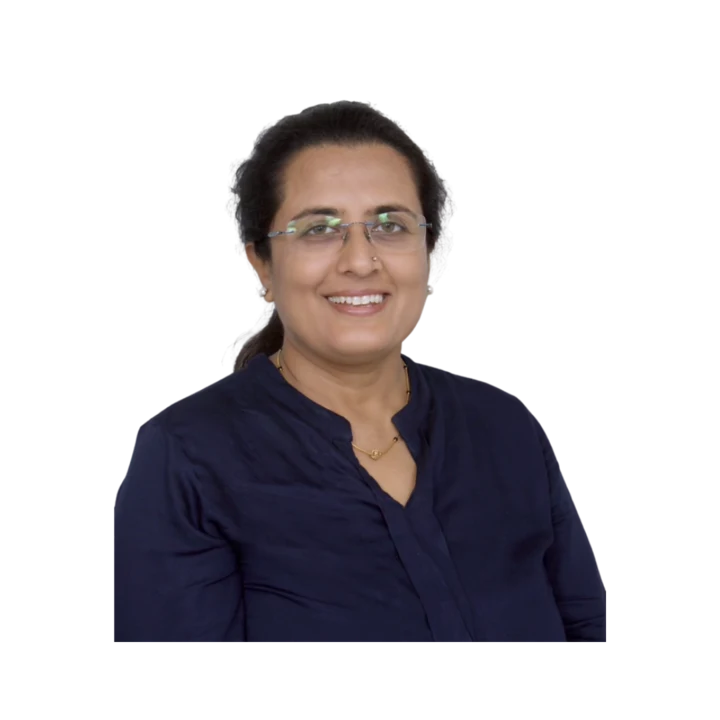
Learn directly from Kajal Ma'am
An MCA who has taught computer subjects since 2004, Kajal Mehta personally mentors every batch, turning dense theory into clear, exam-ready understanding.
The Kwickprep Method
Computer subjects are not learnt by memorising code. Since 2006, Kajal Ma'am has taught ISC Class 11 Computer Science (with Java) (CS) with one simple loop that turns logic into marks:
Concept in plain words
Every topic starts from why it exists and what problem it solves, before any code.
Worked through live with you
Kajal Ma'am writes and runs it on a shared screen, so you see it work, not just read it.
Board-pattern practice
You solve the exact question types that repeat in your board's paper, section by section.
Doubts till it clicks
Ask anything, any time in the live class. Nothing moves on until the concept is clear.
Exam & practical drill
Full papers, the practical file, the project and viva, rehearsed until you walk in confident.
Where this takes you
This is not just a subject to clear, it is a skill that carries forward:
- →Java & data structures the language of software engineering and interviews.
- →Object-oriented design how large software is actually built.
- →Algorithmic thinking exactly what placements and contests test.
It opens B.Tech Computer Science, software engineering and competitive programming. We teach for the board first, and for the thinking that lasts after it.
What students say
“The course's greatest benefit for me was the profound comprehension of the core principles it fostered, which has been pivotal in enhancing my academic foundation.”
“I was able to complete entire syllabus in short duration while preparing for conpetitive exams. Best way to cover entire syllabus. Highly satisfied with teaching method.”
“Very knowledgeable teacher, with thorough understanding of current paper pattern, FAQs, as well as syllabus.”
Read all 36 verified student & parent reviews (4.9/5) or see the board results.
Course FAQs
Is this ISC Class 11 Computer Science course fully online and live?+
Who can join this ISC Class 11 CS with Java course?+
Do you offer one-to-one classes as well as group batches?+
Is the course aligned with the latest CISCE / ISC syllabus?+
Will you help with the practical (Paper-2) and viva?+
Can I get a demo or trial before enrolling?+
What students & parents say
4.9/5 from 36 verified student & parent reviews. Below are three, unedited.
Enrolling in the Kwick Revision Course was a decision that proved its value many times over. What I appreciate most are the meticulously prepared notes, the question papers, and the comprehensive practice materials provided.
Before joining Kwickprep, I honestly struggled a lot with Computer Science. I couldn't understand most of the concepts, but thanks to Kajal Ma'am, that completely changed. Her teaching helped me improve so much, and I'm really grateful for that. She's one of the best teachers I've ever had. She explains everything with so much clarity and patience, and even if I didn't understand something the first time, she would happily explain it again, as many times as needed. Yes, sometimes she got strict, but I know it was always for our own good. What I appreciated most was the way she helped us solve a variety of question papers during the Kwick Revision sessions. That really boosted my confidence. The course overall was great, the materials, the teaching, and the support. I'm quite satisfied with everything. Thank you, Kajal Ma'am and Kwickprep, for helping me grow in a subject I once found impossible!
I'm deeply impressed by the supportive environment fostered by Kajal Ma'am during the Kwickrevision workshop. Her approach not only facilitates a thorough understanding of the subject matter but also encourages a collaborative and nurturing learning experience. This workshop stands out as one of the best I've ever attended, and I attribute much of that to Kajal Ma'am's exceptional guidance.
Book a free demo for Computer Science (with Java)
See a real class before you decide. No pressure, no payment.
Book Free Demo on WhatsApp