

KwickCards HTML and the web
HTML and the web: 6 revision cards
Every card below is written out in full underneath its picture, so you can read it, search it and copy from it. Free, no sign-up.
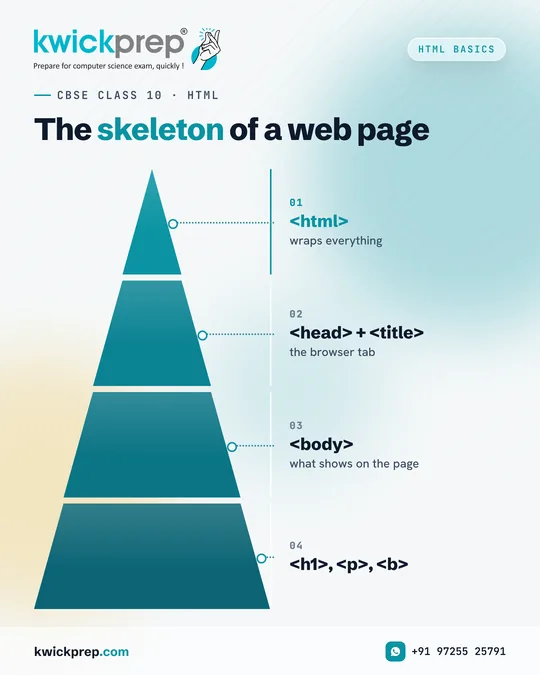
CBSE CLASS 10 · HTML
The skeleton of a web page
- <html>
- <head> + <title>
- <body>
- <h1>, <p>, <b>
Every HTML page follows the same skeleton. Learn it once, use it always.
<html> wraps everything. <head> holds information about the page, and the <title> inside it sets the text shown in the browser tab. Everything inside <body> is shown on the page itself, such as an <h1> heading, a <p> paragraph and <b> for bold text.
Most tags are written in pairs, an opening tag and a closing tag with /.
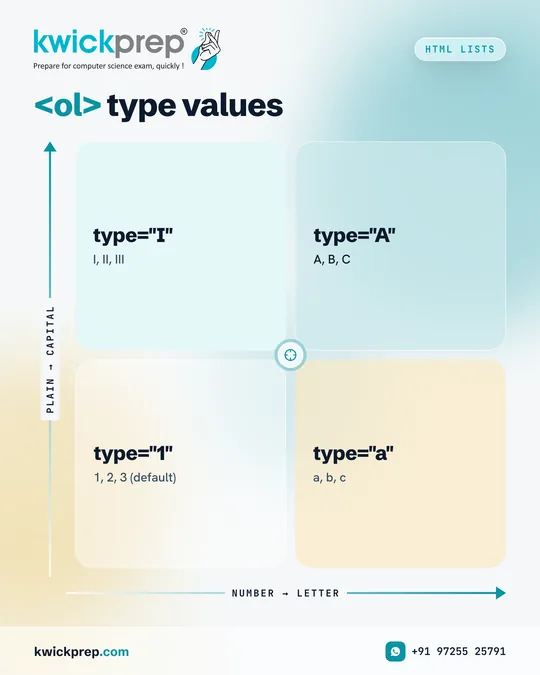
HTML Lists
<ol> type values
- type="I"
- type="A"
- type="1"
- type="a"
The type attribute of <ol> is a common exam question.
type="1" numbers items 1, 2, 3 and is the default. type="A" uses capital letters, type="a" small letters, and type="I" capital Roman numerals. There is also type="i" for small Roman numerals.
These attributes are easy to test on any browser. Add start to begin from a later value: <ol type="A" start="3"> labels the first item C.
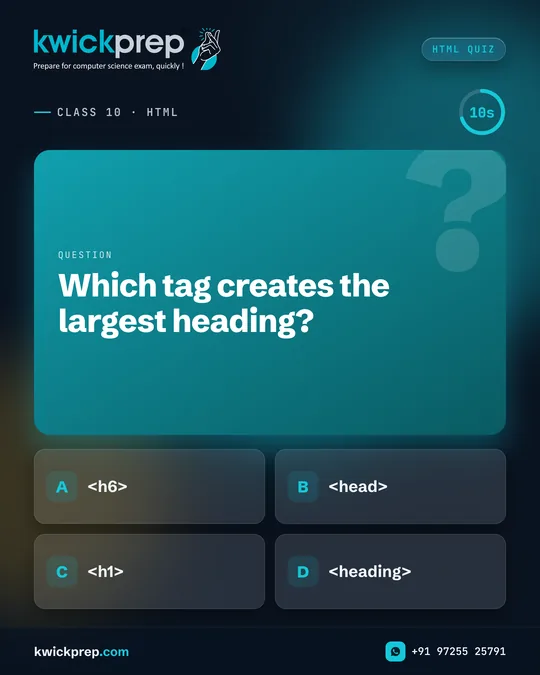
CLASS 10 · HTML
Which tag creates the largest heading?
- <h6>
- <head>
- <h1>
- <heading>
HTML headings, a quick one for Class 10 students.
Answer: C) <h1>.
HTML has six heading levels, <h1> to <h6>. <h1> is the largest and most important, and <h6> is the smallest.
Do not confuse <head>, which holds page information such as <title>, with heading tags. <heading> is not a valid HTML tag. Use headings in order to give your page a clear, logical structure.
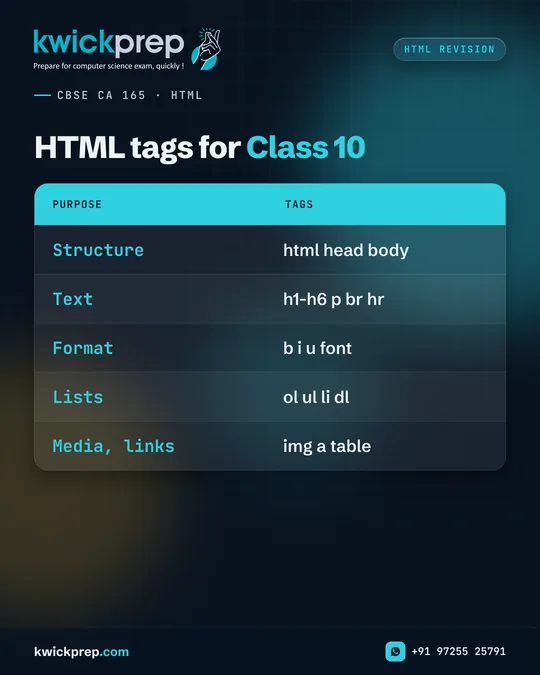
CBSE CA 165 · HTML
HTML tags for Class 10
| Purpose | Tags |
|---|---|
| Structure | html head body |
| Text | h1-h6 p br hr |
| Format | b i u font |
| Lists | ol ul li dl |
| Media, links | img a table |
A quick revision sheet for HTML in CBSE Class 10 Computer Applications.
Group tags by purpose and they are much easier to remember. Structure tags build the page, text tags lay out content, formatting tags style it, and list, image, link and table tags add richer content.
Also revise important attributes: src and alt for <img>, href for <a>, and border, rowspan and colspan for tables.
CLASS 10 · HTML
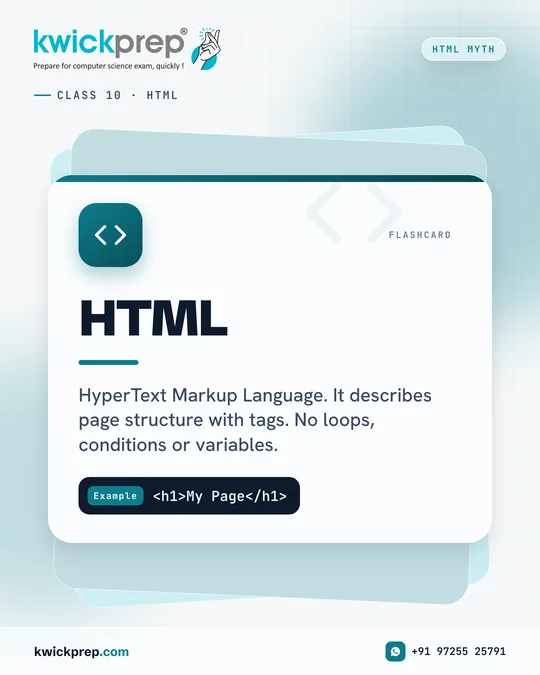
- HTML
- HyperText Markup Language. It describes page structure with tags. No loops, conditions or variables.
Example<h1>My Page</h1>
A basic question that students often answer incorrectly.
HTML stands for HyperText Markup Language. It tells the browser what each part of the page is, a heading, a paragraph, a list, an image or a link.
Logic and interactivity on web pages come from languages like JavaScript, while CSS handles styling.
HTML is still the first and most important step in learning how web pages are built.
CLASS 10 · GSEB · HTML
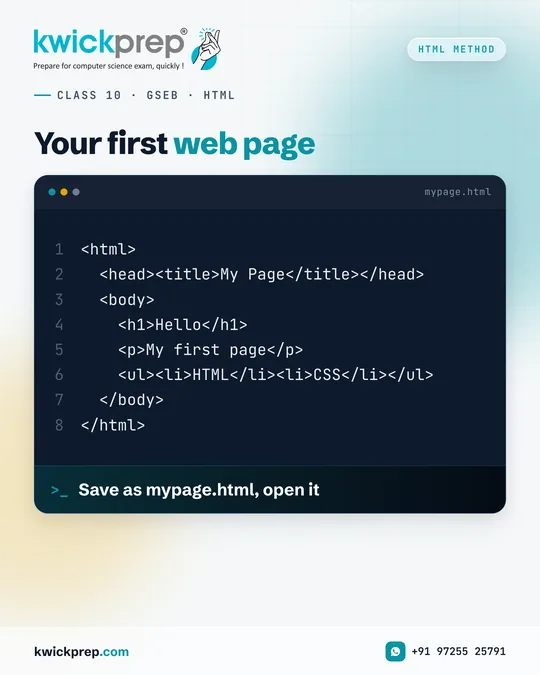
Your first web page
Save as mypage.html, open it
<html>
  <head><title>My Page</title></head>
  <body>
    <h1>Hello</h1>
    <p>My first page</p>
    <ul><li>HTML</li><li>CSS</li></ul>
  </body>
</html>
You can build a real web page in five minutes.
Start with the basic structure: <html> wraps everything, <head> holds the <title>, and <body> holds what appears on the page. Add an <h1> heading, a <p> paragraph and a <ul> list.
Save it as mypage.html and double-click to open it in your browser.
Edit, save and refresh, this simple loop is how every web developer learns.
Written by Kajal Mehta (Kajal Ma'am), MCA, teaching computer subjects since 2004. All KwickCards