KwickCards Artificial intelligence
Artificial intelligence: 30 revision cards
Every card below is written out in full underneath its picture, so you can read it, search it and copy from it. Free, no sign-up.
AI Basics
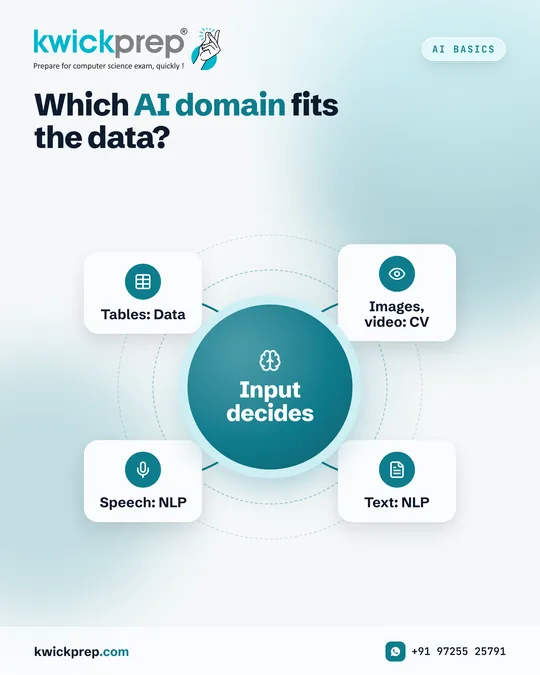
Which AI domain fits the data?
Input decides
- Tables: Data
- Images, video: CV
- Text: NLP
- Speech: NLP
Every AI system you study in CBSE AI sits in one of three domains, and the input usually tells you which.
Data Science works with numbers and tables to find patterns and make predictions. Computer Vision lets machines understand images and video. Natural Language Processing helps machines read, understand and generate human language.
When you meet a new AI example in your textbook, first ask: what kind of input does it take? That one question usually tells you the domain, and makes case-study answers much easier to write.
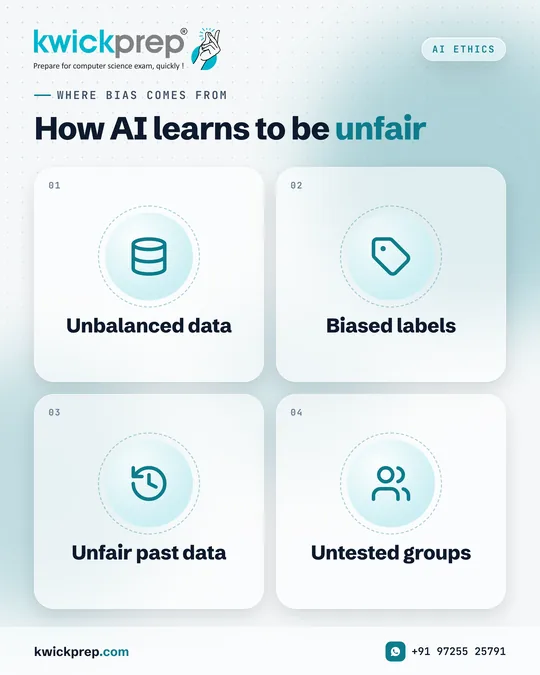
Where bias comes from
How AI learns to be unfair
- Unbalanced data
- Biased labels
- Unfair past data
- Untested groups
An AI model is only as fair as the data and decisions behind it.
If training data over-represents one group, the model learns that imbalance. If labels were made by people with blind spots, the model copies those blind spots. And if nobody tests results across different groups, unfair outcomes can go unnoticed.
CBSE AI asks you to think about ethics at every stage of the AI Project Cycle, not only at the end. Understanding where bias enters is the first step to reducing it.
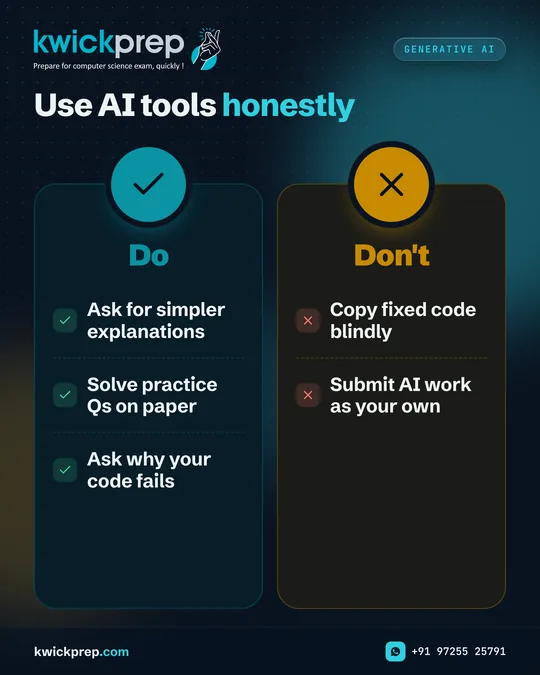
Generative AI
Use AI tools honestly
Do
- Ask for simpler explanations
- Solve practice Qs on paper
- Ask why your code fails
Don't
- Copy fixed code blindly
- Submit AI work as your own
AI chatbots can be brilliant study partners, if you use them the right way.
Ask them to explain a concept in simpler words, then close the tool and explain it back in your own words. Ask for practice questions, then attempt them on paper before checking. Use them to find the bug in your code, but make sure you understand why it was a bug.
What they should not do is write your practical file or project for you. Boards test your understanding, and so does the viva.
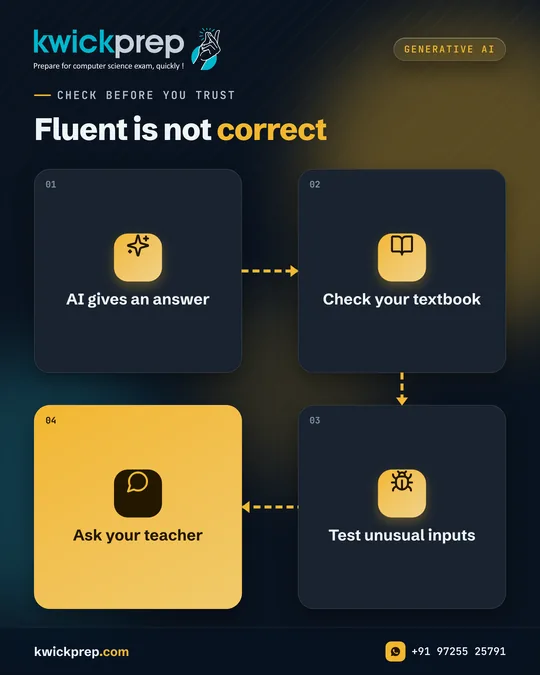
Check before you trust
Fluent is not correct
- AI gives an answer
- Check your textbook
- Test unusual inputs
- Ask your teacher
Generative AI tools produce fluent, confident text. Fluent is not the same as correct.
These tools can state wrong facts, invent references, or give code that looks right but fails on edge cases. They may also not know your exact board syllabus or the latest changes to it.
So treat every answer as a draft. Cross-check facts with your NCERT or board textbook, run the code yourself, and ask your teacher when something does not match. Verification is a skill, and it is one CBSE AI actively wants you to build.
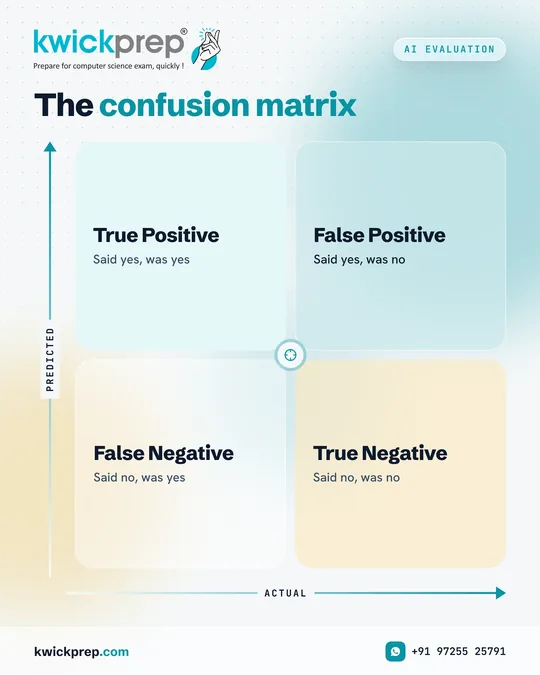
AI Evaluation
The confusion matrix
- True Positive
- False Positive
- False Negative
- True Negative
A confusion matrix compares what a model predicted with what was actually true.
True Positive: predicted yes, actually yes. True Negative: predicted no, actually no. False Positive: predicted yes, but actually no. False Negative: predicted no, but actually yes.
Every evaluation metric in your CBSE AI syllabus, including accuracy, precision, recall and F1 score, is calculated from these four numbers. Learn them well, and the formulas start to make natural sense instead of feeling like things to memorise.
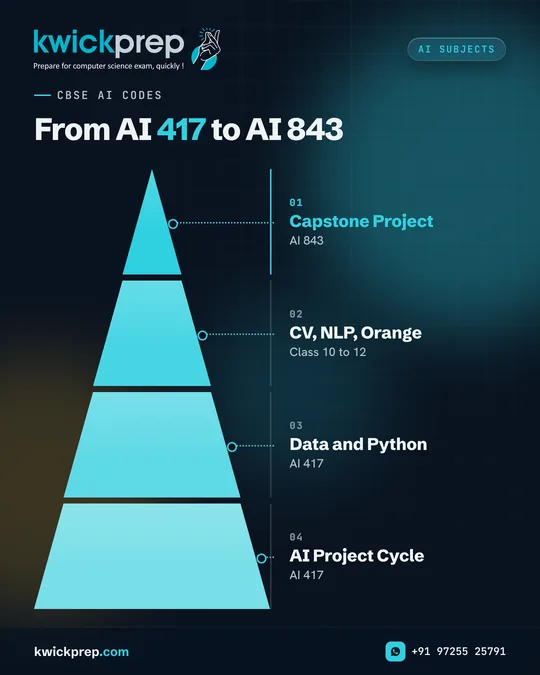
CBSE AI codes
From AI 417 to AI 843
- Capstone Project
- CV, NLP, Orange
- Data and Python
- AI Project Cycle
Both are CBSE Artificial Intelligence skill subjects. The difference is the stage.
AI 417 is for Classes 9 and 10. It introduces AI, the AI Project Cycle, data literacy, the domains of AI and beginner Python.
AI 843 is for Classes 11 and 12. It goes further into Python for data analysis, data science methodology, computer vision, NLP, Orange Data Mining, neural networks and generative AI, finishing with a Capstone Project.
In both, practical work carries half the marks, so steady hands-on practice pays off.
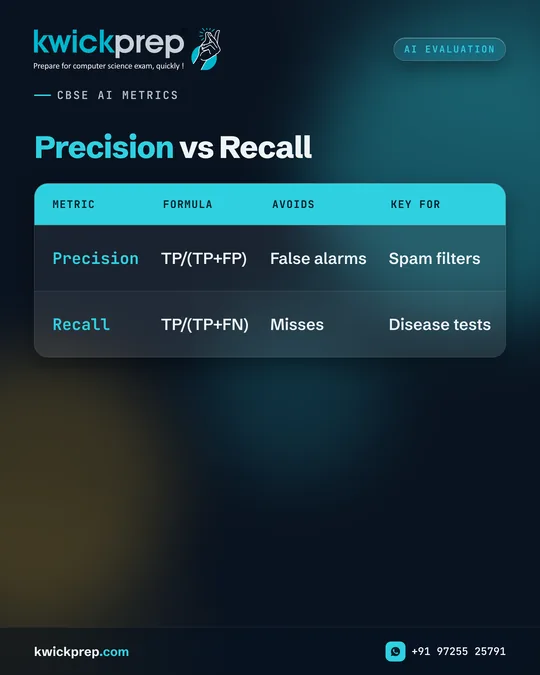
CBSE AI metrics
Precision vs Recall
| Metric | Formula | Avoids | Key for |
|---|---|---|---|
| Precision | TP/(TP+FP) | False alarms | Spam filters |
| Recall | TP/(TP+FN) | Misses | Disease tests |
Two metrics students often mix up. Here is the clean difference.
Precision = TP / (TP + FP). Of all the cases the model called positive, how many really were positive? High precision means few false alarms.
Recall = TP / (TP + FN). Of all the truly positive cases, how many did the model catch? High recall means few misses.
Which matters more depends on the problem. For a disease screening test, missing a sick patient is serious, so recall is often prioritised. For a spam filter, precision protects important emails.
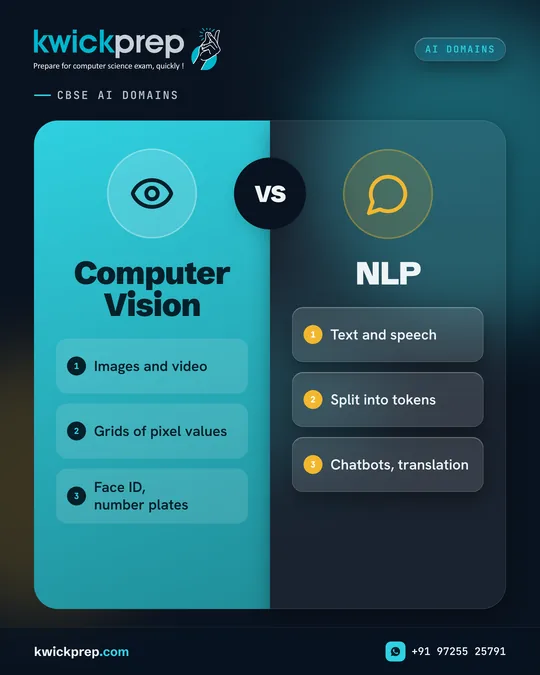
CBSE AI domains
Computer Vision
- Images and video
- Grids of pixel values
- Face ID, number plates
NLP
- Text and speech
- Split into tokens
- Chatbots, translation
Two of the three AI domains in your CBSE syllabus, side by side.
Computer Vision works with images and video. Face recognition on phones, reading number plates and detecting objects in a photo are examples. Images are handled as grids of pixel values.
Natural Language Processing works with text and speech. Chatbots, translation apps, voice assistants and sentiment analysis all use NLP. Text is broken into smaller units such as words or tokens.
Tip for exams: always connect the domain to the type of data the system uses.
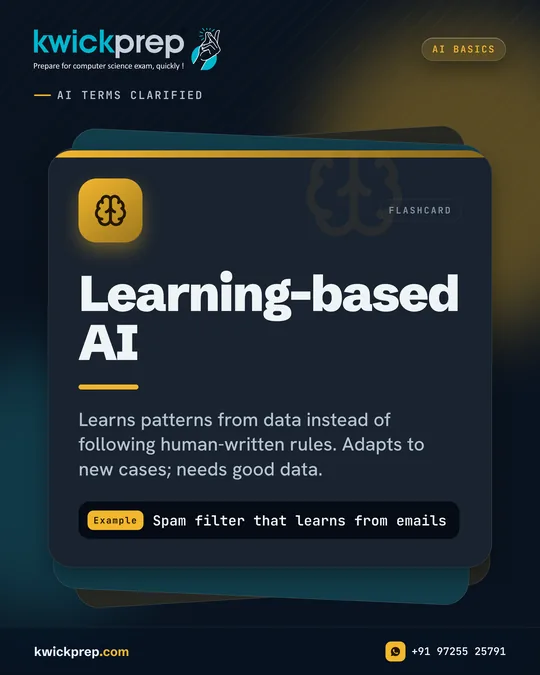
AI terms clarified
- Learning-based AI
- Learns patterns from data instead of following human-written rules. Adapts to new cases; needs good data.
ExampleSpam filter that learns from emails
Not every 'smart' system learns. CBSE AI helps you tell the difference.
A rule-based system follows rules written by humans: if this, then that. It is predictable and easy to explain, but it cannot handle situations its rules do not cover.
A learning-based system, as in machine learning, finds patterns from data during training. It can handle new, varied examples, but its quality depends on the data it learned from.
Both approaches are useful. The right choice depends on the problem.
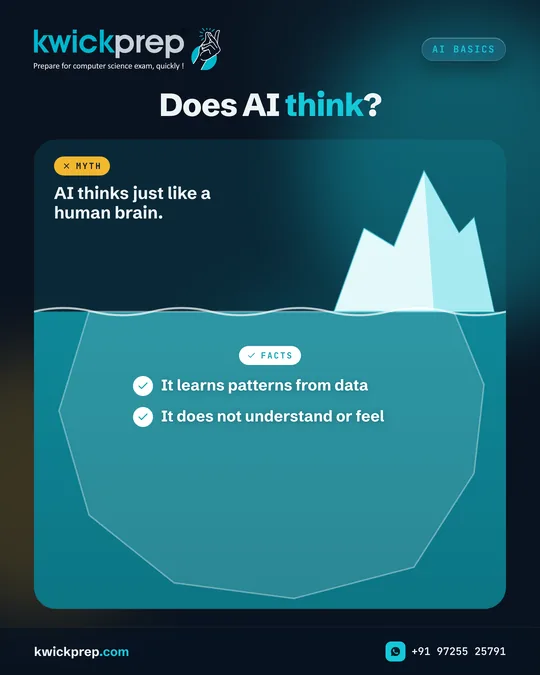
AI Basics
Does AI think?
- It learns patterns from data
- It does not understand or feel
Myth: AI thinks just like a human brain.
Films make AI look like a thinking, feeling mind. Reality is different.
Today's AI systems learn statistical patterns from data. A language model predicts likely next words; an image model spots pixel patterns. They can be remarkably useful, but they do not have human understanding, feelings or intentions.
This matters for how you use AI: it can be wrong in ways a thoughtful person would not be. CBSE AI teaches you what AI can and cannot do, so you use it wisely.
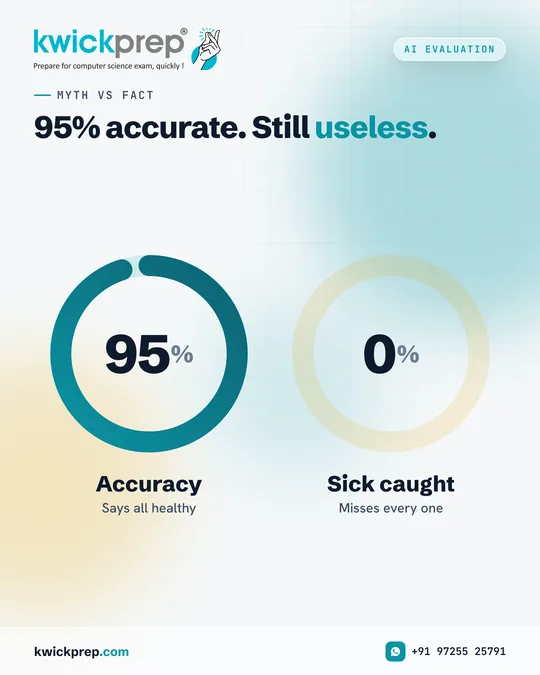
Myth vs fact
95% accurate. Still useless.
- Accuracy
- Sick caught
Imagine a data set where only 5 out of 100 patients have a disease. A lazy model that always says 'healthy' is right 95 times out of 100. Accuracy: 95%. Useful? Not at all, since it misses every sick patient.
This is why CBSE AI teaches precision, recall and F1 score alongside accuracy. When classes are imbalanced, accuracy alone can hide serious failures.
Always ask: what does the model get wrong, and how costly are those mistakes?
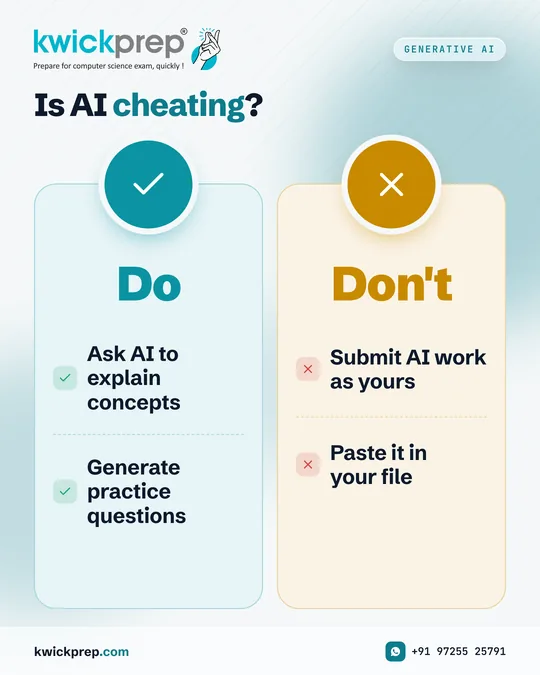
Generative AI
Is AI cheating?
Do
- Ask AI to explain concepts
- Generate practice questions
Don't
- Submit AI work as yours
- Paste it in your file
Using AI is not automatically cheating. Submitting AI's work as yours is.
Asking a chatbot to explain recursion in simpler words, or to generate practice questions, can genuinely support learning. Copying its answer into your practical file or project report is dishonest, and it also leaves you unprepared for the viva.
Always follow your school's rules on AI use. When in doubt, ask your teacher, and be transparent about how you used a tool.
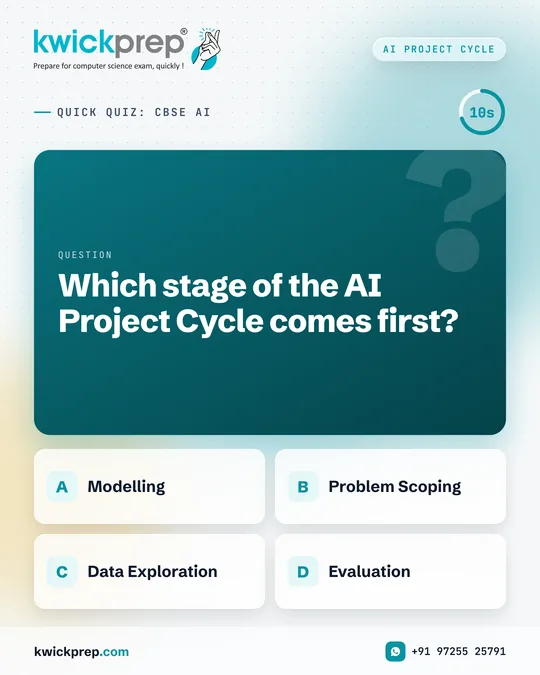
Quick quiz: CBSE AI
Which stage of the AI Project Cycle comes first?
- Modelling
- Problem Scoping
- Data Exploration
- Evaluation
Test yourself before scrolling down.
Answer: (B) Problem Scoping.
The AI Project Cycle begins by clearly understanding the problem: who is affected, what the issue is, where it happens and why solving it matters. The 4Ws problem canvas helps with this. Only then do we move to Data Acquisition, Data Exploration, Modelling, Evaluation and Deployment.
Skipping problem scoping is like writing an answer without reading the question. Comment your score below!
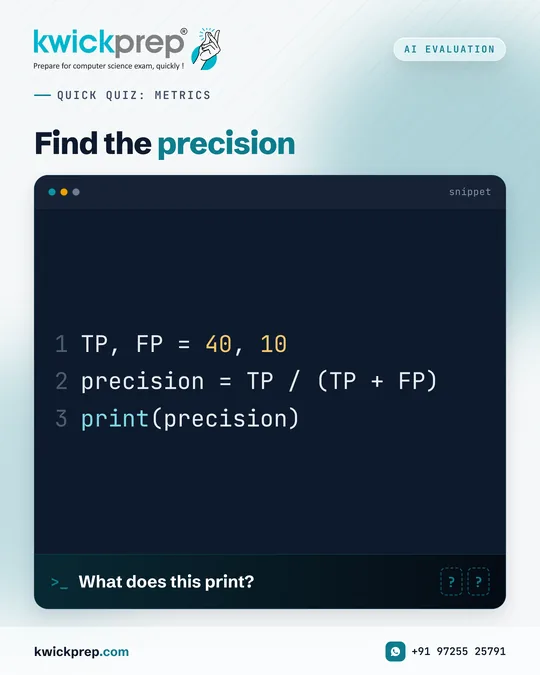
Quick quiz: metrics
Find the precision
What does this print?
TP, FP = 40, 10
precision = TP / (TP + FP)
print(precision)
A classic CBSE AI evaluation question.
Output: 0.8 (that is 0.80, or 80%).
Precision = TP / (TP + FP) = 40 / (40 + 10) = 40 / 50 = 0.80, or 80%. This tells us that of all the cases the model predicted as positive, 80% were actually positive.
Remember: precision looks at predicted positives, while recall looks at actual positives and uses false negatives instead. Write both formulas at the top of your rough sheet in the exam.
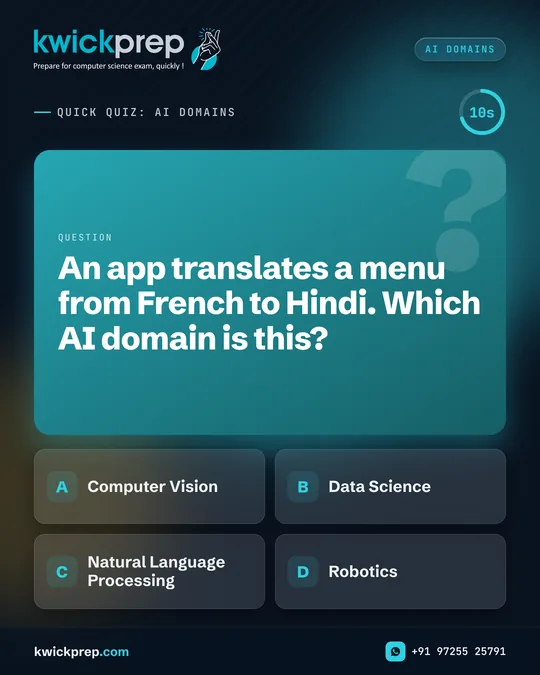
Quick quiz: AI domains
An app translates a menu from French to Hindi. Which AI domain is this?
- Computer Vision
- Data Science
- Natural Language Processing
- Robotics
Think about the type of data the app works with.
Answer: (C) Natural Language Processing.
Translation involves understanding and generating human language, which is the core of NLP. If the app reads the menu from a photo, it may first use computer vision to recognise the text in the image, but the translation itself is NLP.
Real apps often combine domains. In exams, identify the main task being described and justify your answer in one line.
Quick quiz: metrics
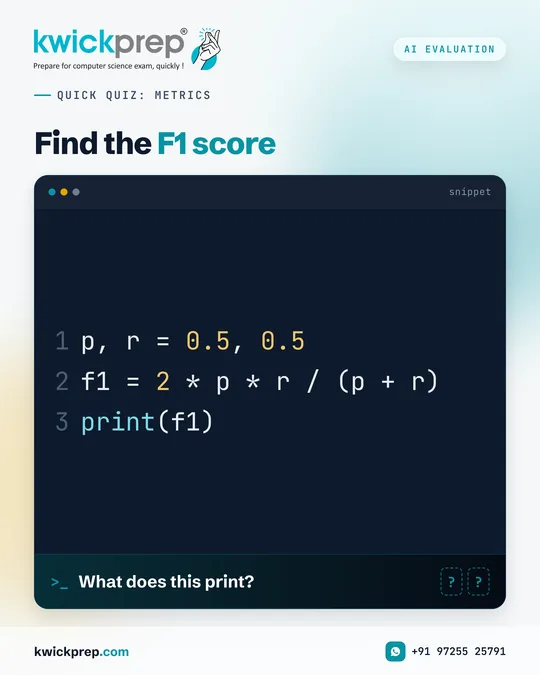
Find the F1 score
What does this print?
p, r = 0.5, 0.5
f1 = 2 * p * r / (p + r)
print(f1)
One more metric question from the CBSE AI syllabus.
Output: 0.5
F1 score = 2 × Precision × Recall / (Precision + Recall) = 2 × 0.5 × 0.5 / (0.5 + 0.5) = 0.5 / 1.0 = 0.5.
F1 is the harmonic mean of precision and recall. When both are equal, F1 equals that same value. When one is much lower than the other, F1 drops sharply, which is why it is useful for balancing false alarms and misses.
Quick quiz: metrics
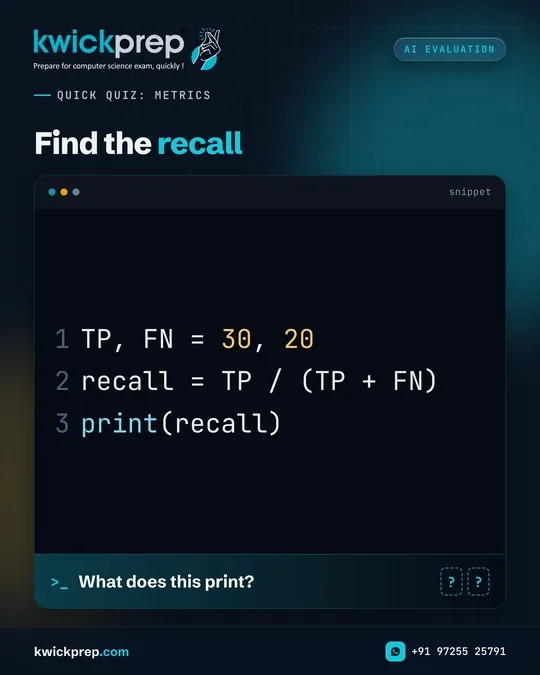
Find the recall
What does this print?
TP, FN = 30, 20
recall = TP / (TP + FN)
print(recall)
Sharpen your metric skills.
Output: 0.6
Recall = TP / (TP + FN) = 30 / (30 + 20) = 30 / 50 = 0.60, or 60%. This means the model caught 60% of all truly positive cases and missed the remaining 40%.
A common mistake is using FP in the recall formula. Recall is about misses, so it uses false negatives. Precision is about false alarms, so it uses false positives.
CBSE AI Class 9
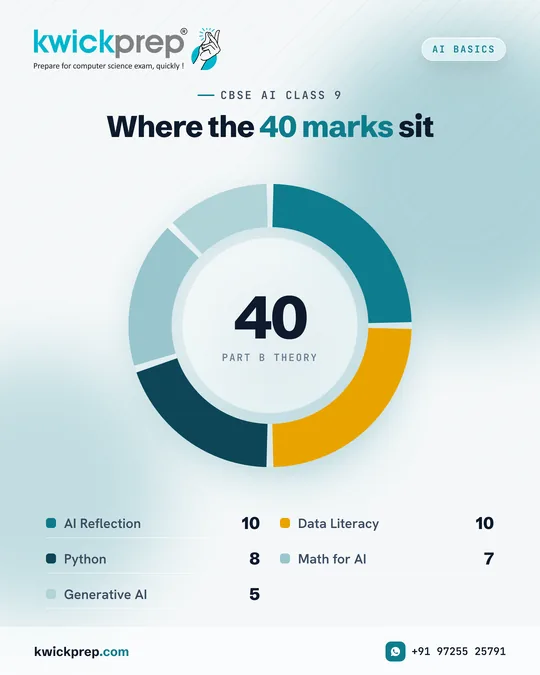
Where the 40 marks sit
40 Part B theory
- AI Reflection
- Data Literacy
- Python
- Math for AI
- Generative AI
CBSE Artificial Intelligence is one of the most practical subjects you can choose.
In AI 417 and AI 843 you explore the AI Project Cycle, data literacy, computer vision, natural language processing, generative AI and Python, with half the marks coming from practical work.
That means real understanding, not memorisation, is what scores. Kajal Ma'am, MCA, has been teaching computer subjects since 2006 and personally teaches every Kwickprep batch, live online, in small groups or one-to-one.
In CBSE AI Class 9, Part B theory carries 40 marks: AI Reflection, Project Cycle and Ethics 10, Data Literacy 10, Introduction to Python 8, Math for AI 7 and Generative AI 5.
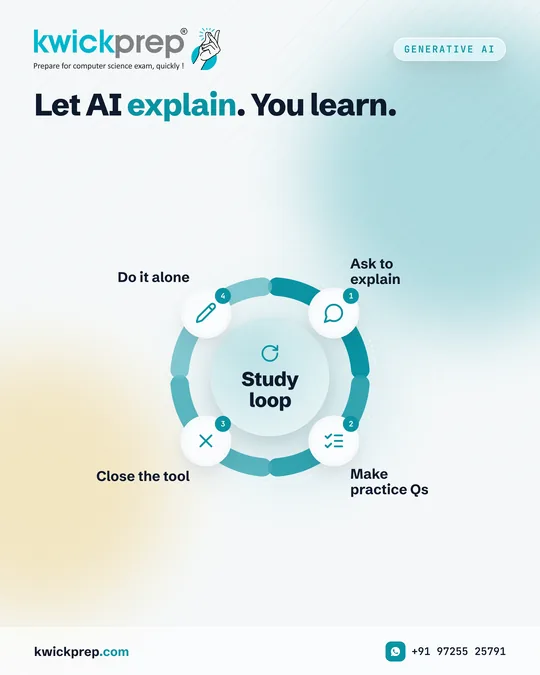
Generative AI
Let AI explain. You learn.
Study loop
- Ask to explain
- Make practice Qs
- Close the tool
- Do it alone
AI tools are here to stay, and knowing how to use them well is a genuine advantage.
Use a chatbot to get a second explanation, to create practice questions or to understand an error message. Then close it and prove to yourself that you can do it alone.
Board exams, practicals and vivas test what is in your head, not in a chat window. At Kwickprep, Kajal Ma'am helps students build that real understanding in live online classes.
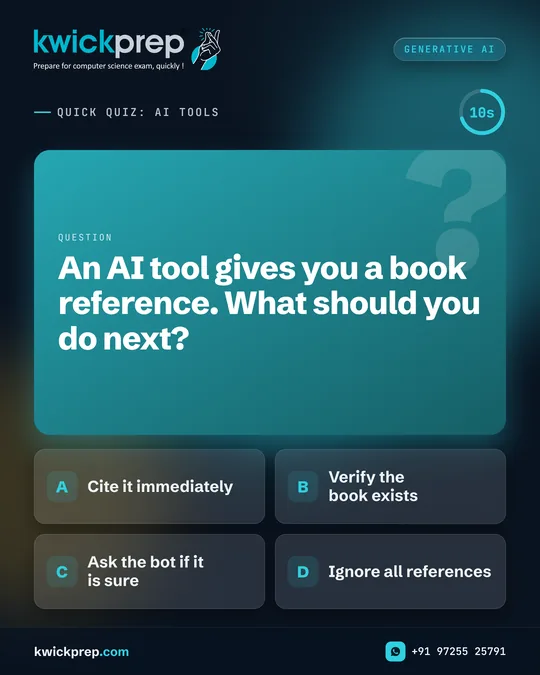
Quick quiz: AI tools
An AI tool gives you a book reference. What should you do next?
- Cite it immediately
- Verify the book exists
- Ask the bot if it is sure
- Ignore all references
Responsible AI use, tested.
Answer: (B) Verify the book exists.
Generative AI tools can sometimes produce references, quotes or facts that sound real but are not. Asking the same chatbot whether it is sure does not truly verify anything.
Search for the book in a library catalogue or a trusted source, and check the details match. This habit of verification is exactly what CBSE AI means by using generative AI responsibly.
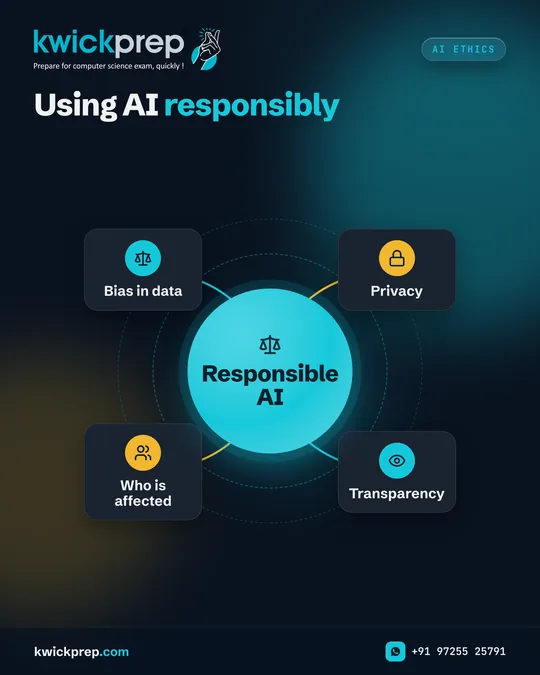
AI Ethics
Using AI responsibly
Responsible AI
- Bias in data
- Privacy
- Transparency
- Who is affected
The best AI students do not only ask 'can we build it?'. They ask 'should we, and is it fair?'.
CBSE AI weaves ethics through the AI Project Cycle: thinking about bias in data, privacy, transparency and who might be affected by a model's decisions.
These are not extra topics; they are part of doing AI well. Learn them with the care they deserve at Kwickprep, where every batch is taught personally by Kajal Ma'am, teaching computer subjects since 2006.
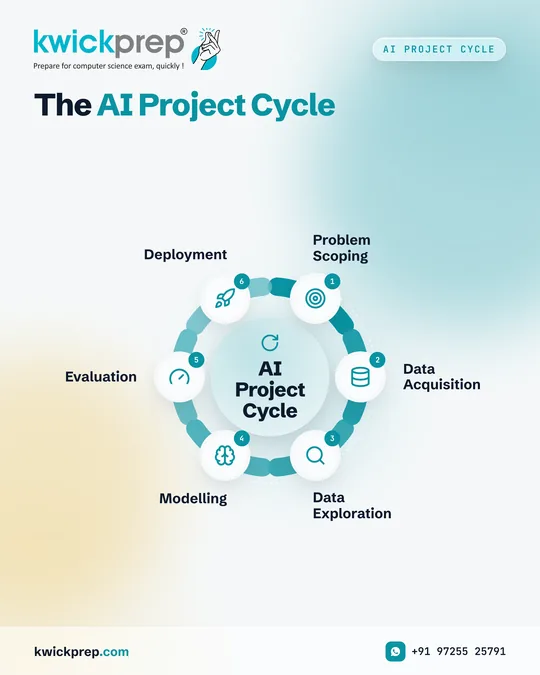
AI Project Cycle
The AI Project Cycle
AI Project Cycle
- Problem Scoping
- Data Acquisition
- Data Exploration
- Modelling
- Evaluation
- Deployment
The AI Project Cycle is the backbone of CBSE Artificial Intelligence.
It starts with Problem Scoping, using tools like the 4Ws canvas to understand who, what, where and why. Next comes Data Acquisition, then Data Exploration to find patterns. In Modelling, you choose a rule-based or learning-based approach. Evaluation checks how well the model performs, and Deployment puts it to real use.
Learn each stage with one example project, and case-study questions become far easier.
Study routine
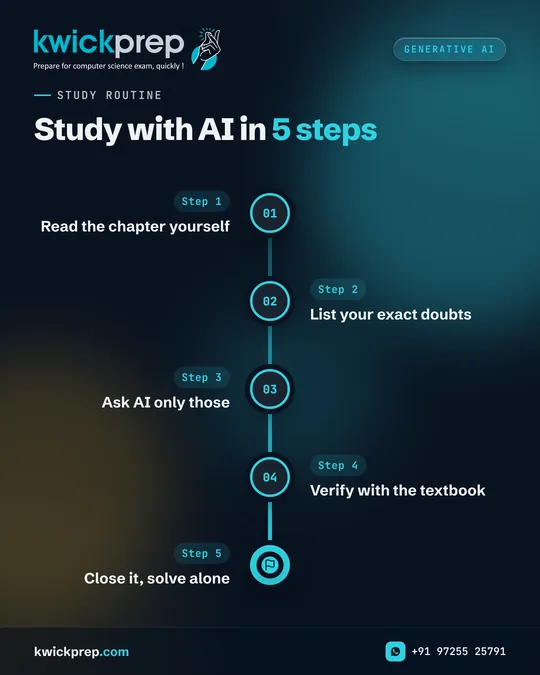
Study with AI in 5 steps
- Read the chapter yourself
- List your exact doubts
- Ask AI only those
- Verify with the textbook
- Close it, solve alone
Here is a simple routine that uses AI tools without letting them do your thinking.
First, read the chapter or your notes yourself. Second, write down what you did not understand. Third, ask an AI tool to explain only those doubts, at your class level. Fourth, verify the explanation against your textbook. Fifth, close the tool and attempt questions on your own.
This keeps you in charge of your learning while still making good use of the technology.
Python: CBSE AI metrics
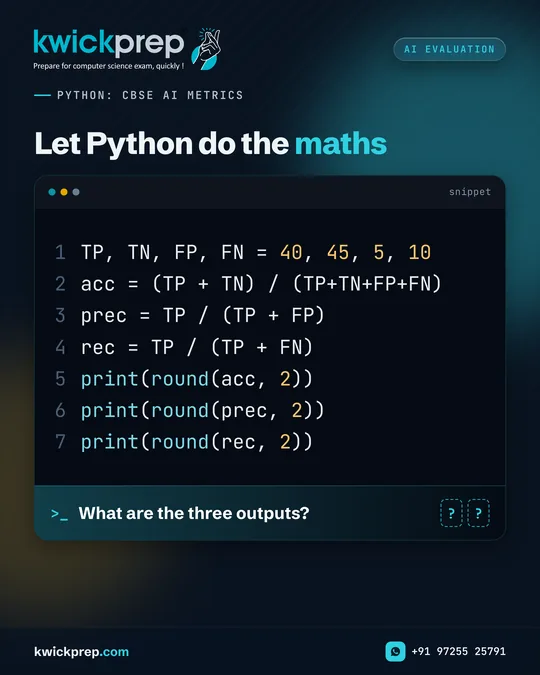
Let Python do the maths
What are the three outputs?
TP, TN, FP, FN = 40, 45, 5, 10
acc = (TP + TN) / (TP+TN+FP+FN)
prec = TP / (TP + FP)
rec = TP / (TP + FN)
print(round(acc, 2))
print(round(prec, 2))
print(round(rec, 2))
Let Python do the arithmetic while you focus on the meaning.
This program takes the four confusion-matrix values and calculates accuracy, precision and recall.
Output:
0.85
0.89
0.8
Accuracy = (40 + 45) / 100 = 0.85. Precision = 40 / 45, about 0.89. Recall = 40 / 50 = 0.8. Notice that round(0.8, 2) prints 0.8, not 0.80.
Try changing the values and see how each metric responds. This is great practice for your CBSE AI practical file.
Python: NLP basics
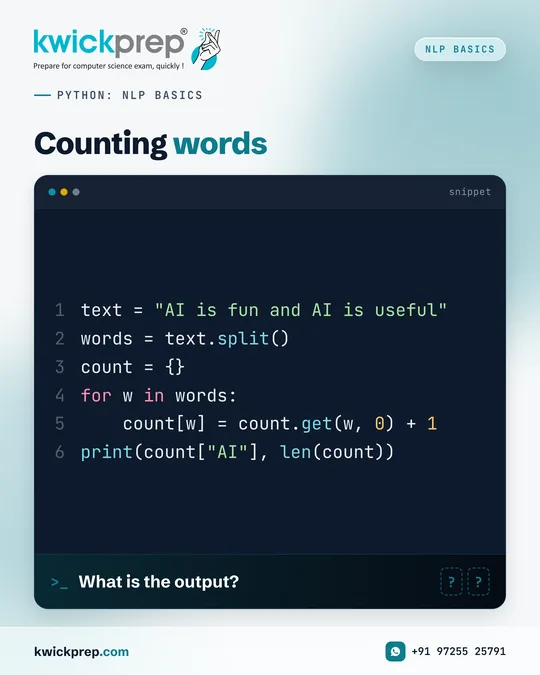
Counting words
What is the output?
text = "AI is fun and AI is useful"
words = text.split()
count = {}
for w in words:
    count[w] = count.get(w, 0) + 1
print(count["AI"], len(count))
Natural Language Processing often starts with something simple: breaking text into words and counting them.
This program splits a sentence into words and uses a dictionary to count each one.
Output:
2 5
'AI' appears 2 times. The unique words are AI, is, fun, and, useful, which makes 5.
This idea of counting word frequencies is similar to the bag-of-words approach you meet in CBSE AI. Try it with a sentence of your own!
AI and the future
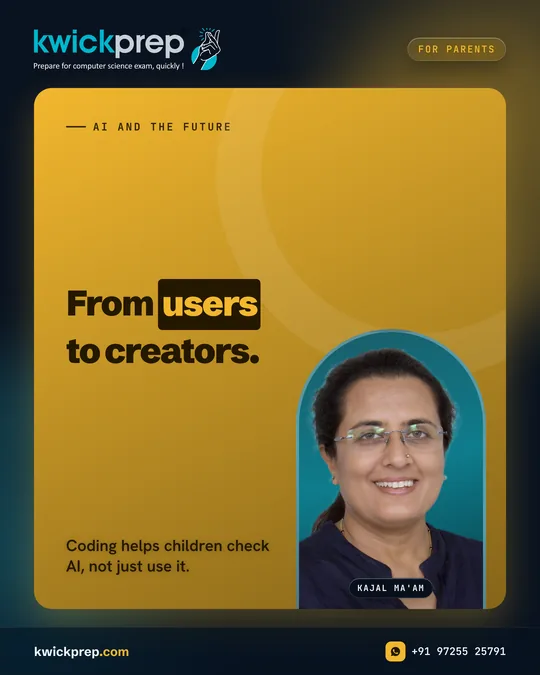
Coding helps children check AI, not just use it.
From users to creators.
With AI tools writing code, many parents wonder whether their child still needs to learn programming.
The calm answer: understanding how code works helps children use AI wisely instead of depending on it blindly. Logical thinking, problem-solving and the ability to check a result remain valuable.
Coding is less about memorising syntax and more about learning to think clearly.
Children who understand technology grow up as confident creators, not just users, and that confidence serves them in every field.
Save this for later, and share it with your family.
Coding & AI
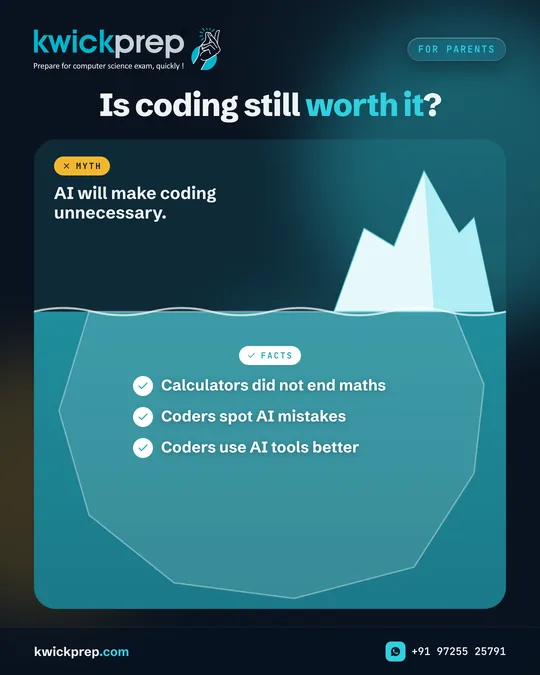
Is coding still worth it?
- Calculators did not end maths
- Coders spot AI mistakes
- Coders use AI tools better
Myth: AI will make coding unnecessary.
AI is in every headline, and parents naturally ask whether coding is still worth learning.
Think of it this way: calculators did not make mathematics unnecessary. They made understanding mathematics more valuable. Coding works the same way with AI.
A child who understands programming can use AI tools thoughtfully, spot mistakes and build their own ideas. CBSE has also introduced Artificial Intelligence as a subject for classes 9 to 12.
Starting with Python is often the gentlest first step.
First steps in coding
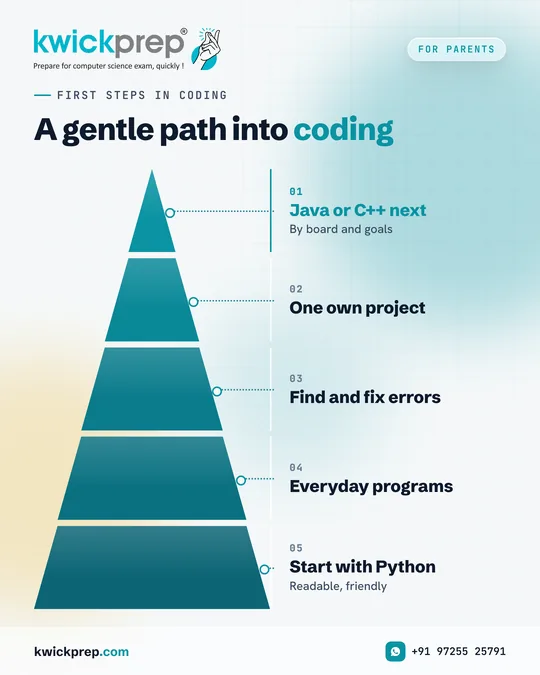
A gentle path into coding
- Java or C++ next
- One own project
- Find and fix errors
- Everyday programs
- Start with Python
Parents often ask where a school student should begin with programming.
For most children in India, Python is the gentlest first language, and it is also the language of CBSE Computer Science and Informatics Practices.
ICSE and ISC students will learn Java, and C++ often makes sense as a second language. Kwickprep teaches Python, Java, C and C++.
Children who understand technology grow up as confident creators, not just users, and that confidence serves them in every field.
Save this for later, and share it with your family.
AI AND CODING
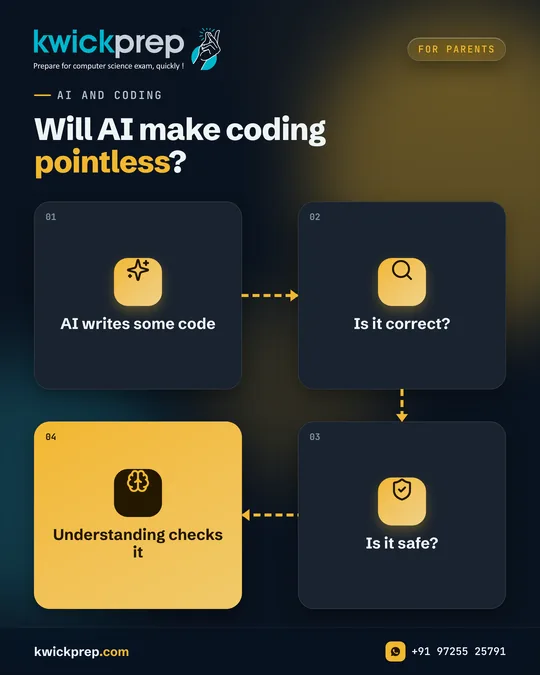
Will AI make coding pointless?
- AI writes some code
- Is it correct?
- Is it safe?
- Understanding checks it
It is a fair question in 2026, and the answer is reassuring.
AI tools can generate code, but someone still needs to know whether that code is correct, safe and suitable. That requires understanding, so understanding is what checks the code.
Learning to program also teaches structured thinking that helps across subjects. CBSE now offers Artificial Intelligence as a subject too.
Children who understand technology grow up as confident creators, not just users, and that confidence serves them in every field.
If this helped, share it with another parent in your circle.
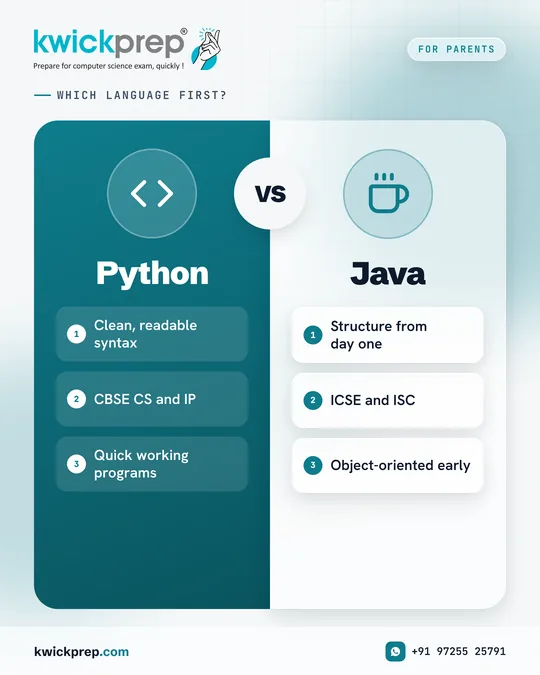
WHICH LANGUAGE FIRST?
Python
- Clean, readable syntax
- CBSE CS and IP
- Quick working programs
Java
- Structure from day one
- ICSE and ISC
- Object-oriented early
Parents often ask which programming language their child should learn first.
For most CBSE students, Python is the natural start. For ICSE and ISC students, Java is the board language.
The best first language is usually the one that matches your child's board. Kwickprep teaches Python, Java, C and C++.
Children who understand technology grow up as confident creators, not just users, and that confidence serves them in every field.
Share this with a parent who may find it helpful.
Written by Kajal Mehta (Kajal Ma'am), MCA, teaching computer subjects since 2004. All KwickCards