

KwickCards Java
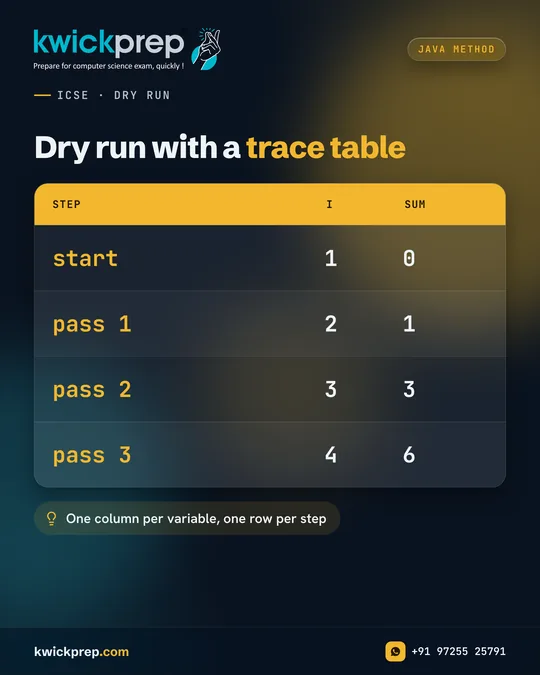
Dry run with a trace table
ICSE · DRY RUN
Dry run with a trace table
| Step | i | sum |
|---|---|---|
| start | 1 | 0 |
| pass 1 | 2 | 1 |
| pass 2 | 3 | 3 |
| pass 3 | 4 | 6 |
One column per variable, one row per step
Output questions become easy once you dry run them the right way.
Guessing the output from memory leads to mistakes. A dry-run table keeps every change visible, especially for loops, increments and nested conditions.
Notice whether the code uses print() or println(), because that decides whether output appears on the same line.
Practise this method on every output question for two weeks and you will see the difference.
The table traces: int sum = 0; for (int i = 1; i <= 3; i++) sum += i; The loop stops when i becomes 4, so sum is 6.
More on this: free Java lessons
More Java cards
 ICSE Java
 ISC CS
 Java Output
 Index the letters of BlueJ
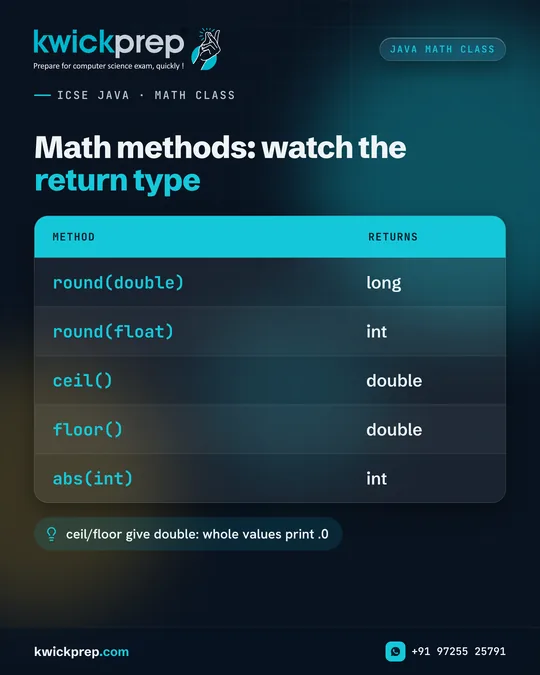 Math methods: watch the return type
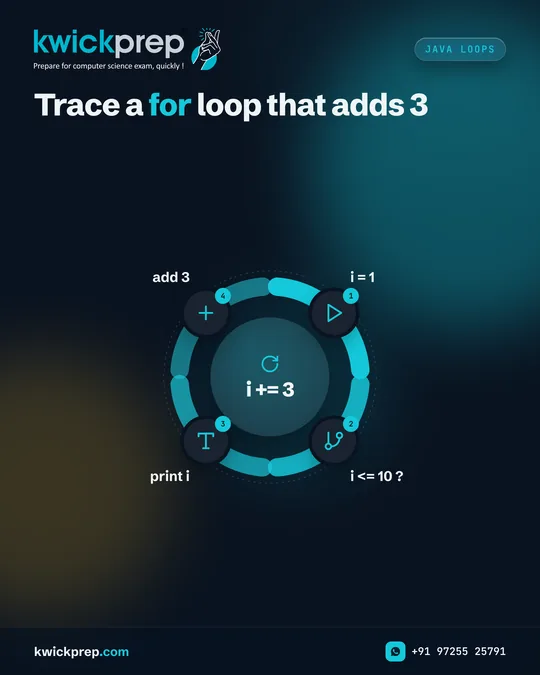 Trace a for loop that adds 3
Stuck on this in your own syllabus? Ask Kajal Ma'am in a free demo class.
Book a free demo classWritten by Kajal Mehta (Kajal Ma'am), MCA, teaching computer subjects since 2004. All KwickCards · KwickAcademy