
C Language Classes
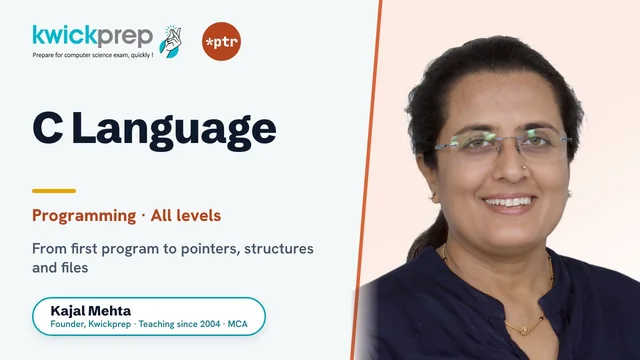
Learn C from first program to pointers, structures, and files, the foundation of all modern programming.
A complete, beginner-friendly C programming course that takes students from writing their first program through control flow, arrays, functions, pointers, structures, and file handling. Built on the widely adopted standard C curriculum used by school and college courses worldwide, it gives learners the strong procedural-programming foundation needed for C++, Java, Python, and computer science exams. Note: C is a general-purpose language without a single board-mandated syllabus, so this course follows the standard topic progression common to school and university C courses.
What you'll learn
- ✓Write, compile, and debug C programs from scratch using a standard compiler
- ✓Apply operators, decision-making, and loops to build problem-solving logic
- ✓Use one- and two-dimensional arrays and string functions to manage data
- ✓Create reusable, modular code with functions, recursion, and storage classes
- ✓Master pointers, pointer arithmetic, and dynamic memory allocation
- ✓Model real-world data with structures, unions, and enums
- ✓Read from and write to files for persistent data storage
- ✓Build a strong procedural foundation for C++, Java, Python, and CS exams
Full syllabus
Mapped to the official Programming curriculum.
01Unit 1: Introduction to C and Program Structure+
- History and features of the C language
- Structure and life cycle of a C program (editing, compiling, linking, running)
- Writing and running your first C program
- Header files, main() function, and the compilation process
- Comments, statements, and basic syntax
- Input and output: printf() and scanf()
02Unit 2: Data Types, Variables, and Operators+
- Identifiers, keywords, and variables
- Data types: int, float, double, char and their sizes
- Constants and the const qualifier
- Arithmetic, relational, logical, assignment, and increment/decrement operators
- Bitwise and ternary operators
- Type conversion and type casting
- Operator precedence and associativity
03Unit 3: Control Structures+
- Decision making: if, if-else, nested if-else, else-if ladder
- switch-case statements
- Loops: while, do-while, and for
- Nesting of loops
- Jump statements: break, continue, and goto
04Unit 4: Arrays and Strings+
- One-dimensional arrays: declaration, initialization, and traversal
- Array operations: searching, insertion, deletion, and sorting (bubble sort)
- Two-dimensional arrays: matrix addition, transpose, and multiplication
- Strings as character arrays
- String input/output and built-in string functions (strlen, strcpy, strcmp, strcat)
05Unit 5: Functions and Storage Classes+
- Defining and calling functions; function prototypes
- Function arguments and return values
- Call by value vs. call by reference
- Recursion
- Scope and lifetime of variables
- Storage classes: auto, register, static, extern
- Standard library and math functions
06Unit 6: Pointers and Dynamic Memory+
- Memory addresses and pointer fundamentals
- Pointer declaration, dereferencing, and arithmetic
- Pointers and arrays
- Passing pointers to functions (call by reference)
- Dynamic memory allocation: malloc, calloc, realloc, free
07Unit 7: Structures, Unions, and Enums+
- Structure declaration, initialization, and accessing members
- Array of structures and nested structures
- Passing structures to functions and structure pointers
- Unions and their use cases
- Enumerations (enum) and typedef
08Unit 8: File Handling and the Preprocessor+
- Introduction to files and streams in C
- Opening, closing, reading, writing, and appending to files
- Sequential and random access of files
- The C preprocessor: #include, #define, and macros
- Conditional compilation
Tools you'll use
Exam pattern
As a general programming course, C has no fixed board exam split. Assessment in school/college settings is typically theory plus a lab/practical component (commonly around 70 theory / 30 practical), with practical evaluation based on a programming lab record and viva.
Practical / project
Hands-on coding throughout: 175+ guided programming exercises spanning every topic, plus mini-projects such as a calculator, student record system using structures and files, and matrix/string utilities. Each unit includes lab assignments compiled and run on a real compiler, with debugging and code-tracing practice.
Who it's for
School and early-college students starting their programming journey, learners preparing for computer science courses or coding interviews, and anyone wanting a solid foundation in procedural programming before moving to C++, Java, or Python.
What's included
- ✓Live interactive online classes with Kajal Ma'am, teaching programming since 2004
- ✓Shared-screen live coding where every concept is typed, run and explained in real time
- ✓Chapter-wise C programming notes covering syntax, control flow, arrays, functions, pointers, structures and file handling
- ✓Worked example programs and dry-run walkthroughs for each topic
- ✓Topic-wise assignments and practice problem sets with feedback
- ✓Dedicated doubt-solving sessions to clear errors and logic gaps
- ✓Hands-on coding practice on real C programs and small projects
- ✓Choice of Group batch or One-to-One mode (fees differ by mode)
Why study C Language?
C is the foundational programming language of computer science and is widely regarded as the "mother of all languages," because mastering it builds the logical thinking, memory awareness and procedural-programming base that makes C++, Java and Python far easier to learn. For school and engineering students it is usually the first serious language in CS and IT curricula, so a strong start in C directly improves grades in programming papers and lab work. Because C teaches how computers actually handle memory, data types and control flow with minimal abstraction, students gain real understanding instead of surface-level coding, which has lasting scoring and career value.
C remains a core skill for systems-level work such as operating systems, embedded systems, device drivers and performance-critical software, and the cores of Linux, Windows and macOS are still built on C foundations. The high-performance backends of modern AI and data libraries like TensorFlow and PyTorch rely on optimised C and C++, so understanding C strengthens any future path in CS, engineering, data or the broader IT industry. For students heading into B.Tech, BCA, BSc CS or similar degrees, C is usually the first programming course and a dependable foundation for everything that follows.
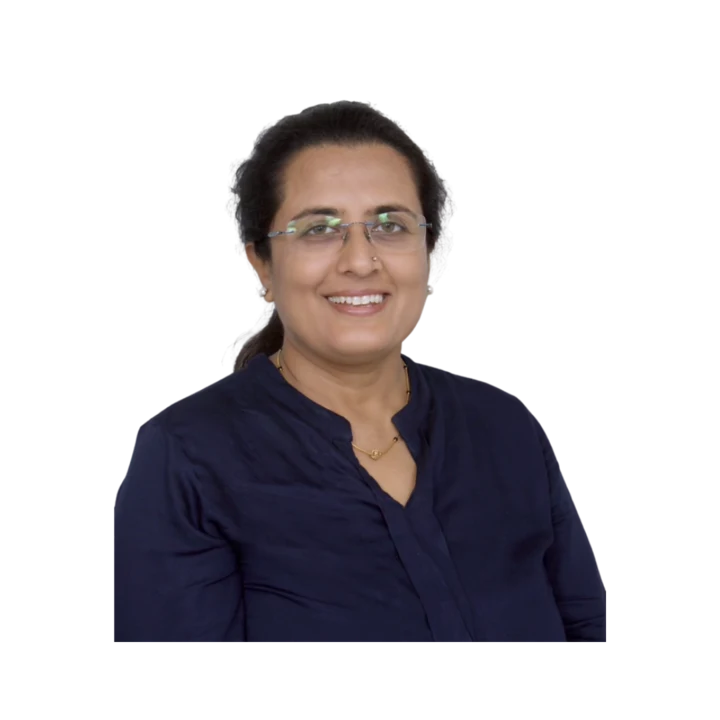
Learn directly from Kajal Ma'am
An MCA who has taught computer subjects since 2004, Kajal Mehta personally mentors every batch, turning dense theory into clear, exam-ready understanding.
The Kwickprep Method
Computer subjects are not learnt by memorising code. Since 2006, Kajal Ma'am has taught C Language with one simple loop that turns logic into marks:
Concept in plain words
Every topic starts from why it exists and what problem it solves, before any code.
Worked through live with you
Kajal Ma'am writes and runs it on a shared screen, so you see it work, not just read it.
Board-pattern practice
You solve the exact question types that repeat in your board's paper, section by section.
Doubts till it clicks
Ask anything, any time in the live class. Nothing moves on until the concept is clear.
Exam & practical drill
Full papers, the practical file, the project and viva, rehearsed until you walk in confident.
Where this takes you
This is not just a subject to clear, it is a skill that carries forward:
- →C the mother language under Python, Java and C++.
- →Systems & embedded programming how hardware is actually controlled.
- →Deep understanding of how computers really work underneath.
It is the strongest possible foundation before any other language, and core to every engineering branch. We teach for the board first, and for the thinking that lasts after it.
What students say
“Dear Kwickprep team, Thank you very much for your support to my son during this two years. Good Team, Great efforts. Thank you once again.”
“Excellent course material. Well experienced Dedicated teacher helped my son did well in CBSE exam today.”
“The Educator is very experienced and talented.”
Read all 36 verified student & parent reviews (4.9/5) or see the board results.
Course FAQs
Is this C programming course taught fully online and live?+
Who can join the C Language course?+
Do you offer Group batch and One-to-One classes, and how do the fees differ?+
Is there a fixed board syllabus for this course?+
Will this help with my school or college practical exams and viva?+
Can I get a demo or trial before enrolling?+
Related courses
What students & parents say
4.9/5 from 36 verified student & parent reviews. Below are three, unedited.
I had a really good learning experience with Kwickprep. The course was well-planned and taught in a very professional manner. The teaching style was engaging, and the study materials, especially for Python programming, were very helpful in understanding the subject better. All the concepts were explained clearly, and the teaching methods were easy to follow. I always received timely responses whenever I had a doubt, which made the learning process smooth and stress-free. I'm quite satisfied with the time I invested in this course. Overall, it was a valuable experience and helped strengthen my grasp on IP. Thank you, Kwickprep!
Enrolling in the Kwick Revision Course was a decision that proved its value many times over. What I appreciate most are the meticulously prepared notes, the question papers, and the comprehensive practice materials provided.
Before joining Kwickprep, I honestly struggled a lot with Computer Science. I couldn't understand most of the concepts, but thanks to Kajal Ma'am, that completely changed. Her teaching helped me improve so much, and I'm really grateful for that. She's one of the best teachers I've ever had. She explains everything with so much clarity and patience, and even if I didn't understand something the first time, she would happily explain it again, as many times as needed. Yes, sometimes she got strict, but I know it was always for our own good. What I appreciated most was the way she helped us solve a variety of question papers during the Kwick Revision sessions. That really boosted my confidence. The course overall was great, the materials, the teaching, and the support. I'm quite satisfied with everything. Thank you, Kajal Ma'am and Kwickprep, for helping me grow in a subject I once found impossible!
Book a free demo for C Language
See a real class before you decide. No pressure, no payment.
Book Free Demo on WhatsApp